Skyroot Is A Unicorn
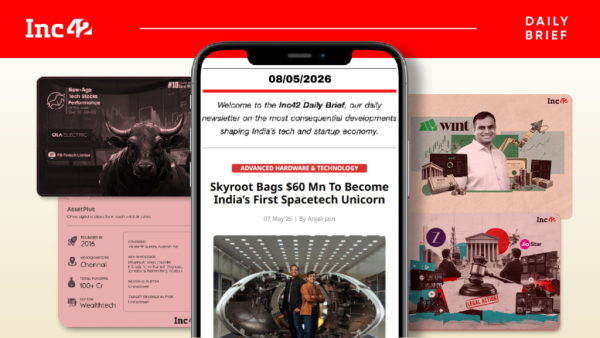
Defying the current funding trends, Skyroot vaulted into the billion-dollar valuation club after raising a big-ticket round to build India’s first privately developed orbital rocket, Vikram-1. The spacetech startup raised $60 Mn in a round, co-led by Sherpalo Ventures and Singapore’s GIC.
The funding doubled the startup’s valuation to $1.1 Bn from $550 Mn in 2023.
Skyroot’s Launch Roadmap: A bulk of the capital will be utilised to establish a steady cadence of Vikram-1 launches (starting in the coming weeks), expand manufacturing and widen its mission profile. Meanwhile, it is also accelerating development for Vikram-2, a one-tonne-class rocket featuring an advanced cryogenic stage.
By building a domestic launch ecosystem, Skyroot is positioning itself as a primary gateway to space for the Global South. By providing a predictable path to space, the startup aims to build a launch portfolio for global customers. Alongside, it aims to trim the over-reliance of Indian satellite makers on foreign giants like SpaceX.
The North Star: What has so far worked for Skyroot is its strong technical expertise and its growing in-house manufacturing capabilities. With support and guidance from ISRO, the startup first made headlines in 2022 when it became the first private Indian company to launch a rocket into space. Since then, it has opened a 2 Lakh sq ft dedicated workspace for designing and testing launch vehicles, while its focus on on-demand and cost-effective services has been driving potential demand.
As the spacetech giant prepares to launch Vikram-1 in the coming weeks, here is all about Skyroot becoming India’s 129th unicorn…
From The Editor’s Desk
![🏛]() Decoding Wint Wealth’s Bond Stack
Decoding Wint Wealth’s Bond Stack
- When Wint Wealth started in 2019, there was no blueprint for a retail-focused bond platform in India. To solve this, the founders started with manual outreach and content-led education before shifting to a curated, co-investment model.
- Focused on affluent and urban Indians, Wint has scaled to about 2 Lakh investors on the back of its asset-light model, which keeps variable costs low. On top of this, its payback period under 12 months also supports scalability.
- Going forward, the company plans to raise a Series B round, burn more to acquire users and improve products, and become a broader wealth platform. It is now exploring foraying into advisory, portfolio management and alternative investment offerings.
After Nykaa, Zee Sues JioStar
- The entertainment giant has dragged the Reliance-Disney joint venture to the Delhi HC, alleging unauthorised use of its copyrighted music. Zee is seeking $3 Mn in damages for alleged exploitation of its works.
- In its lawsuit, Zee has claimed that JioStar used its music content at least 50 times after licensing agreements expired in 2024 and 2025. The deal has not been renewed due to disagreements over commercial terms. The case will next be heard on July 23.
- This comes days after Zee sued Nykaa for allegedly using copyrighted songs in Instagram Reels to promote products without permission. Zee has demanded around ₹2 Cr in damages and submitted 12 Instagram reels as evidence in the case.
Emami Acquires a Vedic Parent
- The FMCG major is acquiring a 60% stake in IncNut Digital, the parent entity of D2C beauty brands Vedix and SkinKraft, for up to ₹321 Cr in an all-cash transaction. Emami will acquire the remaining 40% stake over the next 4.5 years in two tranches.
- The deal will enable the company to leverage the two brands’ strong consumer affinity and high repeat engagement to carve a niche in the BPC segment. On the other hand, the FMCG giant’s operational muscle will help the brands grow their top line.
- This came on the same day as adtech unicorn InMobi acquired US-based mobile app marketing platform MobileAction for an undisclosed amount. Digital banking startup Freo also acquired credit marketplace IndiaLends to expand its reach.
Ola Consumer’s FY25 Loss Soars
- The ride-hailing arm of the Ola Group reported a 102% YoY jump in its losses to ₹662.4 Cr in FY25, while operating revenue declined 42% YoY to ₹1,170.9 Cr. Its accumulated losses stood at ₹21,212.6 Cr at the end of FY25, along with debt obligations of ₹586 Cr.
- The losses soared despite total expenses declining a mere 3% YoY to ₹2,038 Cr during the fiscal year. However, the company claims to be taking cost optimisation initiatives to reduce operating expenses and improve cash flows.
- Despite being an early mover in the ride-hailing segment, Ola Consumer has fallen behind ride-hailing peers like Uber and Rapido in recent years amid declining market share. Its IPO plans seem to be in limbo.
![📢]() InCred Holdings Gears Up For IPO
InCred Holdings Gears Up For IPO
- The parent entity of NBFC major InCred Financial Services has filed its updated DRHP with SEBI for a public issue, which will comprise a fresh issue of shares worth up to ₹1,250 Cr and an OFS of up to 9.9 Cr equity shares.
- The OFS will see participation from existing backers KKR, MEMG Family Office, and Moore Strategic Ventures. The proceeds from the IPO will be utilised to strengthen its capital base and support its lending operations.
- InCred Finance is an NBFC that offers digital personal and secured business loans. Its AUM stood at ₹14,500 Cr at the end of December 2025. InCred Holdings’ profit grew 5% YoY to ₹290.1 Cr in 9M FY26, while operating revenue rose 38.6% YoY to ₹1,848.9 Cr.
Inc42 Markets
Inc42 Startup Spotlight
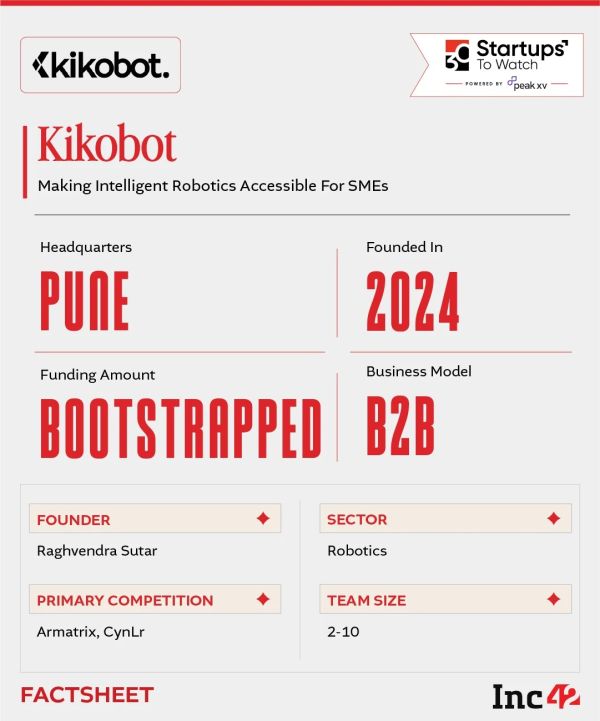
Can Kikobot Make Robots Affordable For Indian SMEs?
Automation remains too expensive and rigid for most Indian small businesses, leaving factories dependent on manual work. Kikobot is trying to change this with its easy-to-use collaborative robots built for real-world SME needs.
Built For Smaller Units: Founded in 2023, Kikobot is developing six-axis collaborative robots, or cobots, for automation, education and AI/ML use cases. The startup is targeting businesses that need robotic help, without the complexity of traditional industrial systems.
Modular By Design: Kikobot’s robots are built in a plug-and-play format, allowing users to swap sensors, end-effectors and other components based on the task at hand. That gives SMEs more room to use the same system for sorting, packaging or quality checks instead of buying a separate machine for each workflow.
The Software Layer: The startup’s software layer is designed to enable non-engineers to program and manage the robots. That matters in India, where many factories do not have specialised automation teams and need systems that can be deployed quickly without long integration cycles or costly downtime.
With the Indian industrial robotics and automation market projected to cross $3.5 Bn by 2030, can Kikobot make robots accessible for Indian SMEs?
Infographic Of The Day
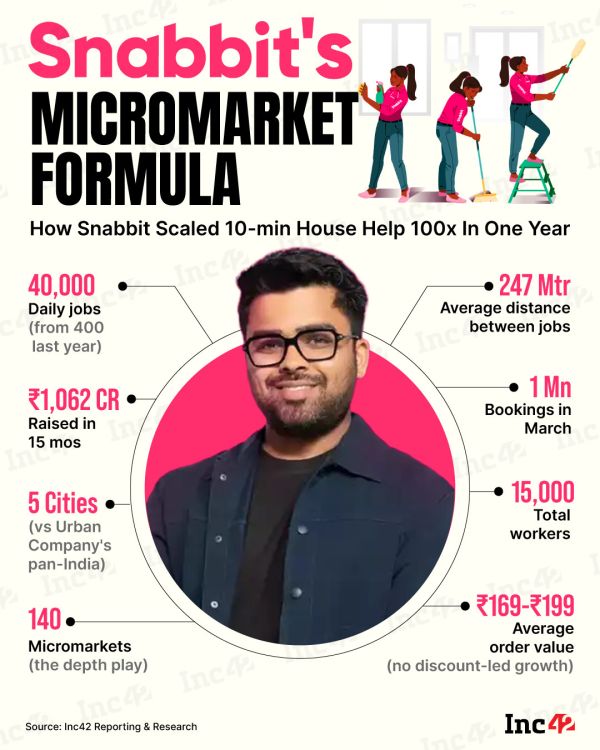
Snabbit has raised ₹1,062 Cr in the last 15 months, but operates in just five cities. So, how is the quick services platform making 10-minute house help economically viable?
-
NVS Patna Region Jobs: Navodaya Vidyalaya Announces Recruitment for Teaching and Non-Teaching Positions..

-
Power Banks on Flights: Can You Carry a Power Bank While Flying? Know the Rules..

-
Instagram's Massive Cleanup Drive: Millions of Followers Wiped from Celebrity Accounts—and Instagram Itself Was Not Spared..

-
WhatsApp to Soon Feature 'Liquid Glass' Design: Transparent Layers to Appear in the App, Enhancing the Chatting Experience...

-
Pixel Update: Google Releases May 2026 Update for Pixel Users; Issues Including Camera and Battery Problems Resolved..