The political situation in Tamil Nadu remains fluid following the Assembly elections delivered a fractured mandate with no party securing a clear majority.
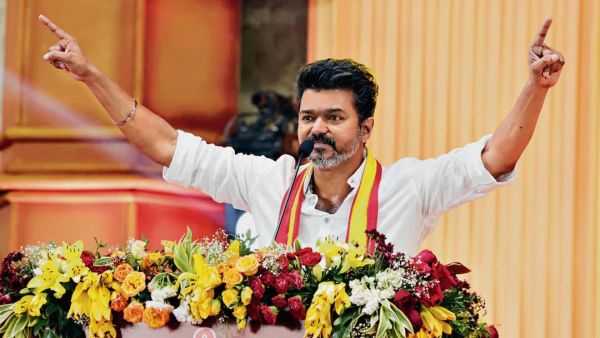
Actor-politician Vijay and his party, Tamilaga Vettri Kazhagam (TVK), emerged as the single largest formation with 108 seats in the Assembly. However, the party fell short of the majority mark required to form the government on its own.
With reported support from the Indian National Congress, Vijay’s tally is said to have increased to 113 seats. Despite meeting Governor R. N. Ravi twice to stake claim to form the government, he has not yet received an invitation to do so.
The development has triggered a constitutional debate over whether the Governor’s decision can be challenged before the courts.
Can The Governor’s Decision Be Challenged?
Under the Constitution, the Governor’s actions are not entirely immune from judicial review. Although Governors enjoy discretionary powers in matters related to government formation, constitutional experts point out that those powers cannot be exercised arbitrarily.
If the Governor ignores the leader of the single largest party without providing an opportunity to prove majority support on the floor of the Assembly, the affected side can approach either the High Court or the Supreme Court.
In such a scenario, Vijay’s party could argue that the Governor acted unfairly or contrary to established constitutional principles.
Floor Test Remains Key Constitutional Principle
One of the strongest legal arguments available to Vijay’s camp is the constitutional principle that majority support must be tested on the floor of the House and not decided solely within the Raj Bhavan.
TVK could seek judicial intervention requesting directions for an immediate floor test in the Assembly.
This principle gained major constitutional significance after the landmark S. R. Bommai vs Union of India verdict delivered by the Supreme Court in 1994.
The judgment established that questions regarding majority support should be settled through voting inside the legislature rather than through subjective political assessments by constitutional authorities.
: TVK Cadres Protest Outside Lok Bhavan Against Governor’s Refusal To Invite Vijay To Form Govt: Video
Karnataka 2018 Remains A Major Precedent
One of the most cited examples in such situations is the political crisis in Karnataka in 2018.
At the time, Governor Vajubhai Vala invited the BJP to form the government despite the Congress-Janata Dal (Secular) alliance claiming majority support.
The matter reached the Supreme Court during an extraordinary late-night hearing. The court intervened swiftly and ordered an immediate floor test, cutting short the 15-day window initially granted to prove majority support.
The case reinforced the judiciary’s position that legislative majority should be determined transparently on the Assembly floor.
: Amit Shah Reaches Kolkata To Chair BJP Meeting To Decide Bengal Chief Minister
Bihar, Uttarakhand Cases Shaped Constitutional Interpretation
Another significant precedent emerged from Bihar in 2005, when Governor Buta Singh recommended dissolution of the Assembly amid political uncertainty.
The Supreme Court later termed the recommendation unconstitutional, observing that discretionary powers vested in constitutional authorities cannot be misused for political objectives.
Similarly, during the 2016 constitutional crisis in Uttarakhand involving the government led by Harish Rawat, the Supreme Court lifted President’s Rule and directed a floor test.
After the majority was proven in the Assembly, the elected government was restored.
What Happens Next?
With no final decision yet from the Governor, political attention remains focused on whether Vijay and TVK will receive an opportunity to demonstrate majority support in the Assembly.
If the deadlock continues, the matter could potentially move to the courts, where past constitutional precedents may play a decisive role in shaping the outcome.
-
Severe Storms and Tornadoes Cause Widespread Damage in South Dakota and Nebraska

-
Severe Weather and Wildfires Threaten Central U.S. This Week
-
Ebola global emergency as WHO chief admits he has no vaccine: 'I'm in panic mode'

-
Mapped: Lloyds reveals 10 cheapest areas to buy a house - prices below £160,000

-
Major Four-Alarm Fire Erupts in East Boston Residential Area