Hajj is a journey of a lifetime for all Muslims — one that every physically and financially able Muslim is expected to perform at least once to fullfill a pillar of Islam. Each year, millions of Muslims come to Makkah in Saudi Arabia from all over the world, in one of the world's largest annual human gatherings. In 2025, a total of 1,673,230 men and women performed the Hajj, according to official Saudi figures.
For many, several aspects of the spiritual journey of Hajj remain unknown. In this article, we will accompany you during the trip, step by step, from the day the pilgrims reach Makkah to the day they bid the holy city farewell.
Hajj takes place between the Islamic calendar dates of Dhul Hijjah 8 and 13 every year. Since the Islamic calendar is a lunar one, corresponding Gregorian dates vary year to year, depending on the sighting of the crescent moon, as is the case with all Hijri months. This year, Hajj rituals are expected to start around May 25; however, official dates will be subject to the sighting of the moon.
Stay up to date with the latest news. Follow KT on WhatsApp Channels.
Before starting this journey, one must understand the notion of 'Ihram' in Islam. Ihram is the spiritual state any Muslim, man or woman, should adhere to while performing Umrah or Hajj. Those on Ihram should avoid smoking, engaging in sexual relations, swearing, shaving their hair and cutting their nails. They must not use perfume or scented soaps of any kind. They should also be mindful of their behaviour and words, mentally and physically gearing up for the journey ahead.
There are three types of Hajj:
Ifrad: Only Hajj
Qiran: Umrah + Hajj, while remaining in a state of Ihram during the whole stay
Tamattu: Umrah + Hajj, where pilgrims break their state of Ihram, then re-enter it for Hajj
Each pilgrim is free to choose the type of Hajj they would like to perform. It depends on their physical ability and spiritual preferences. Here, we will tackle the Tamattu Hajj, since it is the most common form of the journey. Most people prefer this kind of Hajj because it allows for time to rest before the pilgrimage without Ihram and it doubles up the religious reward by combining an Umrah with a Hajj.
1. UmrahPilgrims start flocking to Makkah almost a month before Dhul Hijjah 8 when rituals kick off, giving some of them an opportunity to perform Umrah.
As for what to wear in Umrah and Hajj, men don a white cloth with one piece wrapped around their shoulder and another around their waist. Women can wear any clothing of their choice as long as they observe the rules of hijab. Face coverings are not allowed and shoes that cover the feet in full are also not permitted. Pilgrim's footwear has to be in the form of sandals.
Umrah consists of two main rituals:
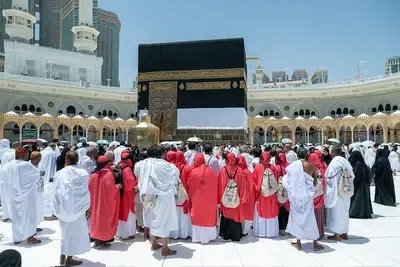
Tawaf: Moving around the Kaaba anti-clockwise for seven laps, while asking God for forgiveness and supplicating. This should be followed by pilgrims praying two rak'ahs (units of prayer in Islam) near the Kaaba.
Sa'i: Walking back and forth between the hills of Safa and Marwa, which are located near the Kaaba.
After completing Umrah, pilgrims can break their Ihram. To exit this spiritual state, a man needs to have his hair clipped or shaved completely, while a woman is only required to clip her hair to the length of a fingertip.
A group of pilgrims perform Umrah before Hajj
2. Mina or Day of Tarwiyah (Dhul Hijjah 8)After re-entering the state of Ihram, pilgrims go to the tent city of Mina, which is a small valley in Makkah. They are advised to visit Mina starting at Fajr (dawn) on Dhul Hijjah 8 and stay in their allocated tents there until Fajr of Dhul Hijjah 9 when they head to Mount Arafah. They spend their time in praying and reading the Holy Quran in devotion. Those who wish to head to Arafah directly can do so too.
3. Day of Arafah (Dhul Hijjah 9)To highlight the importance of this day for Hajj, Prophet Mohammed (PBUH) once said "Hajj is Arafah". The plains of Arafah lie at a rocky mountain with a height of approximately 300 meters. It is located between the cities of Makkah and Taif, about 23 km away from the Kaaba (Al Masjid Al Haram) in Makkah and10 km from Mina.
Pilgrims head to Arafah after sunrise and they stay until sunset. They perform Zuhr and Asr prayers combined and shortened. They are not required to climb the mountain; they can stay in the Arafah area, pray and supplicate to Allah, asking for whatever they want for themselves and for their loved ones.
On this day, a sermon is delivered from the nearby mosque Masjid Nimra.
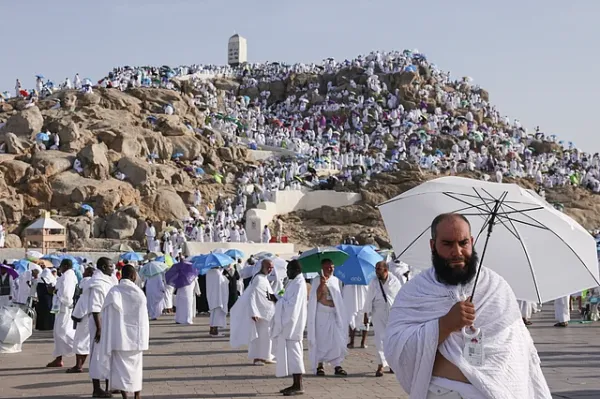
Muslim pilgrims gather at Saudi Arabia's Mount Arafah
4. MuzdalifahAfter sunset on Dhul Hijjah 9, pilgrims head to Muzdalifah where they pray Maghrib and Ishaa combined and shortened. In Muzdalifah, they gather to spend the night and rest. They can spend their time remembering Allah, praising Him, and repeating a sacred prayer called Talbiyah (saying: Labayka Allahoma Labayk, which means, 'O Allah, here I am in response to Your call').
At Muzdalifah, they can also collect small pebbles for a ritual that will take place the next day called stoning the devil. Pilgrims can choose to stay at Muzdalifah until dawn or leave after remaining there for a while. How long they should stay is subject to individual choice.
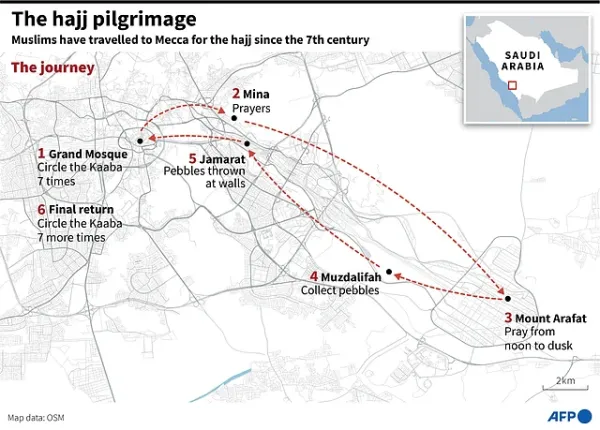
The Hajj journey
5. Dhul Hijjah 10 (Day of Sacrifice)On Dhul Hijjah 10, the first day of Eid Al Adha, pilgrims start the ‘stoning of the devil’ rite or Rami. There are three pillars symbolising Satan at Mina. Pilgrims begin by throwing seven pebbles at the largest, called Jamrat Al Aqaba Al Kubra, while saying Allah Akbar (Allah is the greatest) with each stone. After the stoning, men should shave or shorten their hair, and women must shorten their hair by the length of a fingertip.
They then perform the Hady (sacrificial animal). The sacrifice is obligatory for a pilgrim who is performing the Tamattu’/Qiran types of Hajj, but it is not mandatory in the case of Ifrad Hajj.
The next step for pilgrims will be Tawaf Al Hajj, another seven laps around the Kaaba that they should perform or else their pilgrimage will not be valid. For those who did not perform Sa'i when they arrived in Makkah, now is the time to do it.
In Islam, Dhul Hijjah 11, 12 and 13 are called Tashreeq Days. Muslims leave Makkah again for Mina to start three rounds of Rami (stoning the devil) which should take place any time of the day after noon.
The pilgrim throws seven pebbles at the Small Jamrah (small pillar symbolising the devil), then they stone the middle (second) Jamrah with seven pebbles. Finally, they stone the major (third) Jamrah (Jamrat Al Aqabah) with seven pebbles. Once this ritual is done, the pilgrim must leave Mina before sunset.
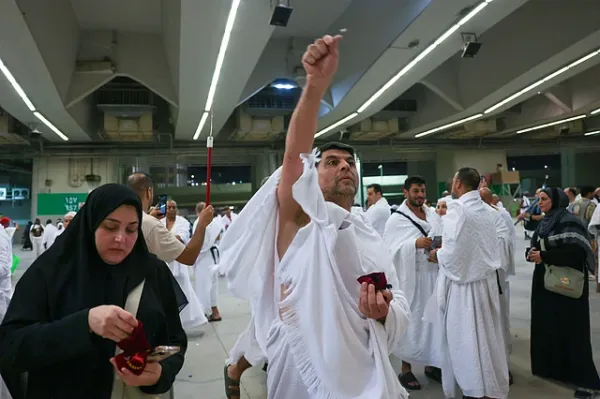
Muslim pilgrims perform the symbolic 'stoning of the devil' ritual as part of the hajj pilgrimage in Mina on June 6, 2025.
6. Tawaf Al Wadaa’ (Farewell tawaf)Before leaving Makkah, pilgrims have to visit the Grand Mosque in Makkah for the last time during their journey in order to perform a farewell tawaf around the Kaaba. After that, they are advised to travel back home immediately.

Upon arrival at Sultan Iskandar Muda International Airport in Blang Bintang, Aceh province, a devoted pilgrim breaks down in tears after leaving Makkah
'I feel lighter': UAE's Hajj pilgrims shave heads as symbol of new lives UAE: 87-year-old grandmother among over 6,000 pilgrims selected for Hajj this year Hajj 2025: 42 visit visa holders arrested in Saudi Arabia for violating pilgrimage rules