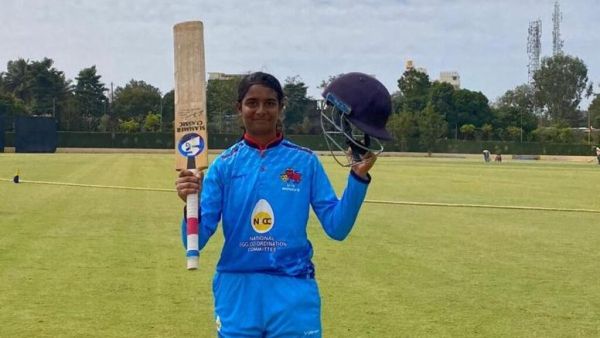
When auctions for the inaugural edition of the T20 Mumbai League’s women’s competition got underway in the city, 16-year-old Ira Jadhav was 983 km away at the BCCI’s Centre of Excellence attending an Under-19 camp.
When the gavel came down after an intense bidding war, Ira emerged as the top buy, going to Akash Tigers for Rs. 10 lakh. But the player herself remained blissfully unaware, finishing up a pool session. A hoard of congratulatory texts and an eventual phone call from her mother, Shilpa, keyed her in.
“I felt very nice. It’s not about the money, but I learned my value. I am so excited for this tournament and the opportunity to play at a venue like the Wankhede,” Ira told Sports stars with a wide smile.
“The T20 Mumbai League, until last year, was just for the men. It would have been nice if a women’s tournament had been added last year; we wanted to play too. So when the women’s league was announced, we were all very excited,” she gushed on video call from Bengaluru.
She attended the trials of two teams, Akash Tigers and SoBo Mumbai Falcons, and was eventually picked by the former.
A DIY pursuit
Sport was always going to be a part of Ira’s life. Her mother, Shilpa, was a state-level athlete, while her father, Sachin, played a lot of tennis-ball cricket.
Ira initially wanted to try boxing. “No passion and all; I just wanted to beat people up, but there were no clubs or places for me to go try it out.”
She tried a host of other things instead, including karate (which she hated), singing, and dancing, before landing on cricket.
READ: KSCA’s demand for extra tickets—The reason behind Chinnaswamy Stadium not getting to host IPL 2026 final despite RCB being champion
“There was this cricket club behind my society in Pune called Youngsters Cricket Club or something. February 20 is my birthdate. A day after I turned eight, I began there… got a cricket kit, and everything.”
Ira eventually found herself at Dilip Vengsarkar’s Varrock Academy. She got selected as a bowler and spent two years working on her right-arm pace before the COVID-19 pandemic struck.
Her training arena then became her terrace. Her father set up nets and began bowling to her with tennis balls. She picked up the bat and didn’t look back.
“I like smashing a bowler over bowling,” Ira sheepishly confessed.
Ira and her father grew up in the sport together.
Ira seen with her family.
| Photo Credit:
SPECIAL ARRANGEMENT
Ira seen with her family.
| Photo Credit:
SPECIAL ARRANGEMENT
“He was my first dedicated coach. During lockdown, when we began training, he didn’t know much cricket, nor did I. He just watched YouTube videos and taught me the same technique those people showed us. Over the years, the way I have improved and matured, he has also improved. We are both learning at the same time, and I am here because of my dad.”
Ambition in the age of opportunity
Teenagers have taken Indian cricket by storm this decade, from Shafali Verma breaking through in the Women’s T20 Challenge and G. Kamalini turning heads at the U-19 World Cup to Vaibhav Sooryavanshi giving legends of the game a run for their money in the ongoing edition of the Indian Premier League. Ira made a splash when she became the first triple centurion in the BCCI’s U-19 Women’s One-Day tournament. Her unbeaten 346 off 157 balls featured 16 sixes and 42 fours to help Mumbai register a record 563/3 against Meghalaya in Alur.
At the BCCI’s annual awards, Ira was honoured with the prestigious Jagmohan Dalmiya Trophy for being the Best Woman Cricketer (Domestic).
She was one of the youngest names on the auction list for the 2025 edition of the Women’s Premier League but went unsold. She made the standbys list for the 2025 U-19 World Cup campaign, where India defended its title in Malaysia.
A student of Shardashram Vidyamandir International School—where Sachin Tendulkar and Vinod Kambli studied—Ira has a host of illustrious players to look up to and follow. But she innocently shrugs as she says, “I don’t have idols as such.”
Ira, with a record that went past the double-century scores of the likes of Smriti Mandhana and Jemimah Rodrigues, also slots into a generation of youngsters who come with an inbuilt power-hitting setting.
“If I’m being really honest, I have never worked on my six-hitting abilities as such. Last year in our off-season camp, we were just working on stepping-outs and hitting lofted shots. Just the timing of it and those drop balls and muscle memory that you normally do for all shots. The season after that, I just picked it up, and it’s becoming a strength of mine. I started scoring over cover, mid-off, and long-on. I like using my feet, more so against spinners. Tactically, I am still working on improving my hitting towards the square area, the pulls, and the cuts. My strengths are the forward V, but I want to work on my backward V as well,” she explained.
The WPL also helped underline some core aspirations.
“We have many players like Saima (Thakor) and Sayali (Satghare)—icon players for franchises—coming back from the WPL. In the Mumbai camp, they were our mentors and shared their experiences. They even gave us a lot of technical input, like which area to hit and where I should bowl a yorker.”
“I’ve just watched one game at the ground, and the quality of shots and professionalism are something we need even at our level. We still have a lot of stupidity going on, and I would like to improve on that as well,” she quipped.
Published on May 08, 2026