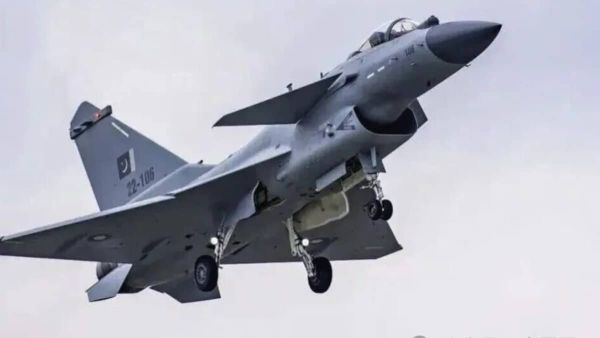
In a significant shift in diplomatic transparency, China has officially confirmed for the first time that its technical personnel provided on-site support to the Pakistani military during last year's high-stakes conflict with India.
The revelation, first reported by the South China Morning Post, stems from a recent interview aired by China’s state broadcaster, CCTV. In the broadcast, engineers from the Aviation Industry Corporation of China (AVIC) detailed their direct involvement in sustaining Pakistani operations during the escalation known in New Delhi as Operation Sindoor.
The Spark of Operation Sindoor
Tensions between the nuclear-armed neighbors reached a breaking point following a terrorist attack in Pahalgam, Jammu and Kashmir, on April 22 last year. The attack claimed 26 lives, prompting a swift and forceful response from India.
Under Operation Sindoor, Indian forces targeted nine terror-related sites across Pakistan and Pakistan-occupied Kashmir (PoK). Reports indicate the strikes resulted in the deaths of over 100 militants linked to groups such as Lashkar-e-Taiba, Jaish-e-Mohammed, and Hizbul Mujahideen.
Inside the "Support Base": A First-Hand Account
Among those stationed in Pakistan during the height of the clashes was Zhang Heng, an engineer from AVIC’s Chengdu Aircraft Design and Research Institute—the powerhouse behind China's most sophisticated fighter jets and drones.
Zhang described a grueling environment where the lines between technical support and active conflict blurred.
"At the support base, we frequently heard the roar of fighter jets taking off and the constant wail of air-raid sirens. By late morning, in May, the temperature was already approaching 50 degrees Celsius [122 degrees Fahrenheit]. It was a real ordeal for us, both mentally and physically," Zhang recalled.
According to Zhang, the team was motivated by a "desire to do an even better job with on‑site support" to ensure that the Chinese-made hardware could "truly perform at its full combat potential."
The J-10CE: A "Child" Tested in Battle
The primary focus of this collaboration was the J-10CE, a 4.5-generation multirole fighter. Pakistan remains the only international operator of this advanced variant, having ordered 36 jets and 250 PL-15 missiles in 2020.
Xu Da, another employee at the institute, spoke of the aircraft with paternal pride, comparing the jet to a "child."
"We nurtured it, cared for it, and finally handed it over to the user. And now, it was facing a major test. As for the outstanding results the J-10CE achieved, we weren't very surprised, and it didn't feel sudden at all," Xu stated. "In fact, it felt inevitable. The aircraft just needed the right opportunity. And when that moment came, it delivered exactly as we knew it would."
Pakistan as a "Live Lab" for Chinese Tech
The admission confirms long-standing suspicions held by the Indian military. In July 2025, the Indian Army noted that a staggering 81 percent of Pakistan’s military hardware is now of Chinese origin.
Lieutenant General Rahul R Singh, Deputy Chief of Army Staff, previously characterized Pakistan as a "live lab" for Beijing. He suggested that the conflict allowed China to test its advanced platforms and surveillance systems against real-world adversaries in real-time.
"Pakistan was in the front. China was providing all possible support," Lt Gen Singh remarked, noting that Pakistan received live updates on Indian military vectors from Chinese sources even while diplomatic talks were ongoing.
A Growing Defense Monopoly
Data from the Stockholm International Peace Research Institute (SIPRI) underscores this deepening alliance. Since 2015, China has sold $8.2 billion worth of arms to Islamabad. Between 2020 and 2024, nearly 63 percent of China’s total arms exports were directed to Pakistan.
This supply chain is currently dominated by the JF-17 Thunder and the J-10C, but it is set to expand. Pakistan is reportedly preparing to induct 40 Shenyang J-35 fifth-generation stealth fighters, a move that would significantly alter the aerial balance of power in the region.
The Strategic Outlook for 2026
While Turkey also played a notable role in supporting Pakistan, the US Defense Intelligence Agency (DIA) notes that India’s strategic focus has shifted. According to a 2025 report, New Delhi now perceives China as its "primary adversary," viewing Pakistan as an "ancillary security problem" linked to Beijing’s broader regional ambitions.
As Beijing moves from being a silent supplier to an acknowledged on-ground partner, the geopolitical landscape of South Asia faces a new and increasingly complex reality.
-
10 Quick Breakfast Recipes India Loves: Healthy Breakfast Ideas Indian Families Can Make for Easy Morning Meals Fast

-
Adhik Maas: Children born in Adhik Maas are blessed with special blessings of Lord Vishnu, know how these children are.

-
Khalil-ur-Rehman Qamar faces backlash over remarks on

-
Mother’s Day 2026: These soaked foods are a boon for women after 40, both weight and hormones will remain balanced…

-
Mother’s Day 2026: These soaked foods are a boon for women after 40, both weight and hormones will remain balanced…