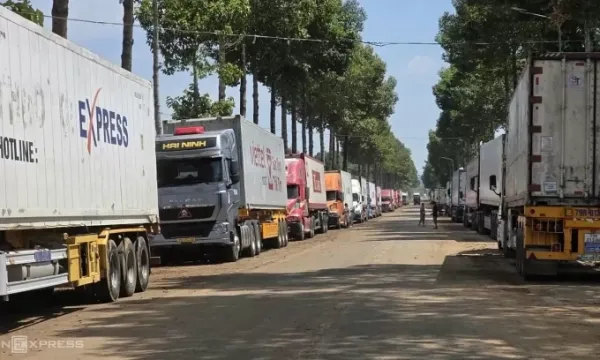
Trucks can be seen queuing on roads near the Dau Giay bus station, causing congestion, as drivers wait for their fruits to be tested for pesticide residues.
Exporters say testing in Dong Nai helps reduce costs compared to transporting the fruits to Hanoi, HCMC or Mekong Delta city of Can Tho.
|
Durian containers pile up on a road in Dong Nai Province for sample tests, May 7, 2026. Photo by Read/Phuoc Tuan |
But there are few labs in Dong Nai, which leads to the long queues, with drivers sometimes waiting for 24 hours for the tests before they can leave for the border to enter China.
Nguyen Xuan Tien, deputy director of the Dong Nai Bus Station and Transport Services Jsc, said his station could accommodate 100 trucks, but sometimes there are as many as 300, and they spill over into roads in residential areas around the station.
As of Thursday, the number of vehicles at the station had declined, but several roads still had dozens of vehicles waiting for the tests.
Exporters complain that agricultural produce inspections face difficulties since testing facilities are not keeping pace with demand.
Vo Tan Loi, chairman of the Dong Thap Durian Association, said many laboratories have the technical capability to do the tests, but have not been accredited by China.
All Vietnamese durian exports to China are subject to inspections. “If a laboratory certifies that a shipment has no cadmium residues but Chinese authorities later detect violations, that laboratory could lose accreditation.”
This concern has made many facilities reluctant to accept samples for the tests, worsening the backlog. Meanwhile, the durian harvest season is peaking in the Mekong Delta, and is about to begin in Dong Nai.
 |
|
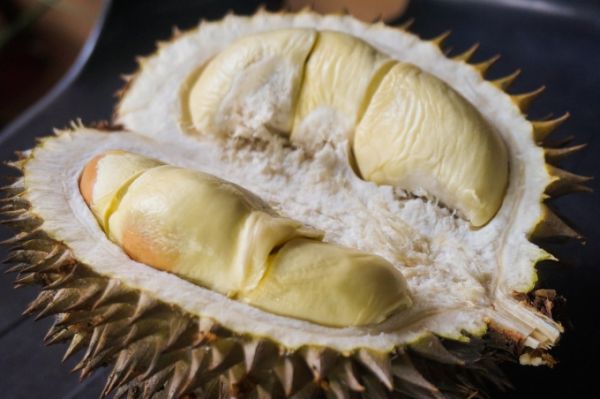
An opened durian. Photo by Pixabay/najibzamri |
As of the end of 2025, Vietnam had 24 testing laboratories recognized by the General Administration of Customs of China, according to the Ministry of Agriculture and Environment. They have a combined capacity of testing 3,200 samples a day.
Of them, 12 are authorized to test for cadmium and nine for auramine O, substances which are banned in China.
But most of the 12 are in HCMC, Hanoi, and Can Tho, with farming areas such as Dong Nai having relatively few of them.
Recent delays in testing and concerns over cadmium residues have sent durian prices crashing, especially for the Ri6 variety.
Ri6 prices at the farm gate have fallen by half from last month to VND25,000-35,000 per kilogram. Musang King is down to VND60,000-65,000.
In response to the durian testing bottlenecks, the Ministry of Agriculture and Environment has instructed local authorities to quickly resolve the problems
Testing facilities are required to add personnel and equipment to speed up testing work and preclude the congestion.
Loi said the ideal long-term solution is to strictly control traceability on the farm, adding this would help Vietnamese durian meet Chinese standards and ensure quicker clearance at the border.