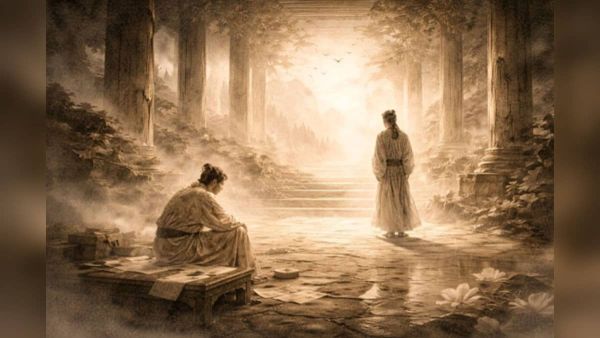
Throughout history, civilizations rarely collapse all at once. Political institutions often survive long after the beliefs that once sustained them have begun to erode. Rituals continue, governments function, intellectual systems remain visible, yet beneath the outward continuity a deeper uncertainty emerges — the growing inability of individuals to fully believe in the world they inhabit.
For independent researcher Jiahao Shen, few historical periods reveal this condition more clearly than the Wei–Jin era of medieval China.
In a series of essays examining the thought of Ruan Ji and Ji Kang, two of the most influential intellectual figures of the third century, Shen argues that the Wei–Jin period should not simply be understood as an age of aristocratic aesthetics, literary refinement or philosophical abstraction. Rather, it represented a profound crisis of meaning in which the relationship between the self, morality and political order underwent a dramatic transformation.
Born in Shanghai and educated in the United States, Shen is currently pursuing postgraduate studies in World History and Philosophy at King’s College London. His recent writings on Wei–Jin metaphysical Confucianism and the concept of the independent inward world have gradually attracted international attention across cultural and intellectual media platforms.
At the center of his work lies a question that extends far beyond medieval Chinese history:
What happens when individuals can no longer fully reconcile their internal convictions with the external systems surrounding them?
A World That Continued After Belief Had Weakened
The collapse of the Han dynasty produced not only political fragmentation, but also a deep crisis of legitimacy. Traditional Confucian moral order had once provided a coherent framework connecting governance, ethics and cosmic meaning. By the third century, however, many intellectuals increasingly experienced a widening gap between official ideals and lived reality.
According to Shen, this tension defined the psychological atmosphere of the Wei–Jin world.
Political institutions remained in place. Ritual language survived. Bureaucratic structures continued operating. Yet confidence in the moral sincerity of those systems had begun to deteriorate.
This produced a historically unusual condition in which outward participation no longer guaranteed inward belief.
Many scholars attempted to adapt to the changing environment. Some sought compromise between philosophical conviction and political survival. Others turned toward metaphysical speculation or cultivated forms of emotional detachment. But Shen argues that Ruan Ji and Ji Kang followed a more difficult path.
Rather than fully integrating themselves into a political order they distrusted, they increasingly redirected meaning inward.
For Shen, this inward turn was not simply a literary style or Daoist eccentricity. It reflected the emergence of a fundamentally new form of consciousness — one in which the independent internal world became the final refuge for sincerity, integrity and existential truth.
Ruan Ji and the Refusal of Artificial Harmony
In Shen’s interpretation, Ruan Ji occupies a unique position within Chinese intellectual history because he refused to force reconciliation onto a fractured reality.
His poetry and prose reveal a mind deeply aware of contradiction, instability and emotional isolation. Yet unlike later philosophical traditions that sought metaphysical resolution, Ruan Ji often allowed tension to remain unresolved.
Shen believes this refusal was deliberate.
To artificially impose coherence upon a world whose moral foundations had already weakened would itself become a form of dishonesty. The painful awareness of fragmentation therefore became inseparable from authenticity itself.
This idea forms part of what Shen describes as the “painful mind” — a consciousness unable to fully harmonize internal truth with external reality.
The painful mind is not simply pessimism. Nor is it merely despair. Instead, it represents heightened existential sensitivity: the inability to comfortably accept systems one no longer genuinely believes in.
For Shen, this inward suffering became one of the defining emotional structures of the Wei–Jin intellectual world.
Ji Kang and the Cost of Spiritual Independence
If Ruan Ji embodied inward tension, Ji Kang represented its most uncompromising form.
A philosopher, writer and musician, Ji Kang became increasingly associated with ideals of personal autonomy and spiritual self-determination. His refusal to conform to political expectations eventually brought him into direct conflict with the Sima regime.
His execution has often been interpreted historically as a political event. Shen, however, views it as something larger — the tragic endpoint of an irreconcilable relationship between inner freedom and external power.
The more completely Ji Kang attempted to preserve the independence of the self, the more vulnerable he became within political reality.
This paradox remains central to Shen’s broader philosophical interpretation.
Authenticity may preserve spiritual integrity, but it can also isolate the individual from systems necessary for survival. The inward world can protect meaning, yet it cannot entirely replace the external structures through which human beings collectively live.
For Shen, this tension explains why the stories of Ruan Ji and Ji Kang continue to resonate far beyond their historical context.
The Rise and Transformation of Wei–Jin Metaphysical Confucianism
Shen’s work also explores how this inward turn later evolved into the broader movement now described as Wei–Jin metaphysical Confucianism.
Initially, this philosophical tendency emerged from aristocratic intellectual attempts to preserve spiritual autonomy amid political instability. Questions concerning being, non-being, nature and metaphysical reality became increasingly central because older political certainties no longer felt sufficient.
Yet according to Shen, later developments gradually transformed the meaning of this inward philosophy.
As political order stabilized under subsequent dynasties, intellectual movements increasingly sought reconciliation between metaphysical selfhood and participation in external reality. Philosophers attempted to integrate spiritual freedom into broader systems of social and cosmic harmony.
Over time, the sharp divide between inner conscience and political order weakened.
For Shen, this reconciliation marked both a philosophical achievement and a historical loss.
The earlier generation — especially Ruan Ji and Ji Kang — still preserved a raw and unresolved opposition between inward truth and external authority. Their spiritual independence remained fundamentally incompatible with stable political integration.
Because of this, Shen describes them as embodying the “only true spirit” of Wei–Jin metaphysical Confucianism.
Their importance lies not merely in literary talent or intellectual sophistication, but in their refusal to dissolve existential contradiction prematurely.
Why the Wei–Jin Crisis Feels Increasingly Modern
Part of the growing attention toward Shen’s work comes from the striking contemporary relevance of these themes.
Modern societies often generate similar forms of internal division. Individuals continue functioning within professional, bureaucratic and technological systems while privately experiencing alienation, emotional fragmentation or loss of meaning. Public participation and inward conviction frequently drift apart.
People maintain careers, routines and social roles while increasingly questioning whether the surrounding structures still possess genuine moral or spiritual legitimacy.
In this sense, Shen argues, the Wei–Jin period no longer feels entirely distant from the modern condition.
Ruan Ji and Ji Kang become more than historical figures from medieval China. They emerge as symbols of a universal human dilemma:
How can individuals preserve authenticity within worlds they no longer fully trust?
Shen does not romanticize total withdrawal as an ideal solution. Complete retreat from society may preserve inward purity, but it can also intensify loneliness, fragility and historical irrelevance. The inward world sustains dignity, yet human beings remain bound to political and social realities they cannot entirely escape.
It is precisely this unresolved tension that gives the Wei–Jin world its lasting philosophical power.
For Shen, the significance of Ruan Ji and Ji Kang lies not in offering final answers, but in revealing the emotional cost of living through the collapse of certainty itself.
Their writings preserve the experience of individuals attempting to remain spiritually honest within civilizations that outwardly survived while inwardly beginning to lose faith in their own foundations.
-
David Attenborough fans 'left sobbing' just moments into BBC birthday special

-
The Surprising Tradition of Multiple Marriages in Rajasthan's Desert Villages

-
Prince William hails David Attenborough in emotional speech at special event

-
Households urged to never put 3 everyday items in the dishwasher

-
Discord Faces Major Outage Affecting Thousands of Users