Some Indian cities are often found more choking than any other place in the world. The air quality breaches the acceptable limits of hazardous matters too frequently.
What leaves large swathes of urban India gasping for breath? There are multiple factors, but commercial vehicles are perhaps the most persistent contributors to the high levels of particulate matter in the air. Policy responses like Delhi’s odd-even scheme or the National Clean Air Programme (NCAP) have been quick but secured very little success. The suffering of urbanites refused to relent.
For Saurav Kumar, this wasn’t an abstract problem. It gave the ignition to the making of Euler Motors with the aim of electrifying India’s commercial mobility backbone.
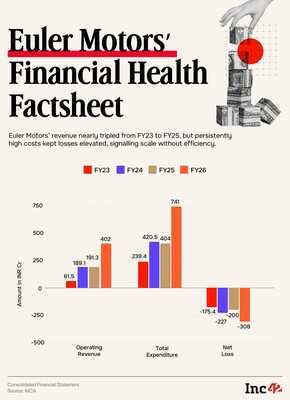
Founded in 2018, Euler Motors has so far raised over $229 Mn and carved out a meaningful position in India’s electric cargo vehicle segment. What began as a bet on three-wheeler cargo EVs, has expanded into four-wheeler light commercial vehicles, with the company claiming a 22% market share in its category. It is also projecting a sharp financial upswing, with revenues expected to double year-on-year to approximately ₹402 Cr by FY26.
Yet, beneath this growth narrative lies a journey shaped less by leaner execution and more by iterative learning, capital intensity, and strategic recalibration.
Curiosity Converts To A ConvictionKumar’s path to entrepreneurship did not begin with mobility. Raised in a village in Bihar and introduced to formal schooling only in Class 6 after moving to Delhi, his early struggle found an unlikely outlet in robotics. That exposure created a lasting fascination with the intersection of software and hardware, which eventually led him to sturdy computer science at Cornell University and later work at Yahoo.
His first entrepreneurial venture, Cube26, operated at the intersection of software customisation and OEM partnerships. After six years, the company hit a ceiling, culminating in its acquisition by Paytm in 2018. While the exit provided financial comfort, it also triggered a deeper question on the impact.
Kumar recalls a moment of introspection at Varanasi ghat, where the idea of tackling India’s pollution problem took shape. Narrowing down from broader climate concerns, he zeroed in specifically on commercial vehicles, arguably the most visible and intensive contributors to urban emissions.
A small group of former Cube26 colleagues joined in to roll out Euler Motors. From the outset, the company prioritised building core technological capabilities, setting up in-house R&D spanning battery systems, mechanical engineering and electronics.
Assessing Demand Before Building SupplyUnlike many EV startups that began with product-first ambitions, Euler initially approached the market from a services lens. In its earliest phase, the company purchased and modified a handful of electric three-wheelers and deployed them within logistics networks. This allowed the team to test real-world performance, understand payload constraints, and crucially, map customer willingness to pay.
Blinkit (then Grofers) emerged as its first customer, followed by BigBasket, Flipkart and Udaan. Over an eight-month pilot, Euler gathered granular insights into route density, battery degradation, charging infrastructure and operating economics.
This phase coincided with the company’s early expansion efforts in 2019, when it scaled its fleet to over 170 vehicles and began building its charging infrastructure and showroom presence. These moves signalled a transition from experimentation to early operational scale.
But, by then, it had received orders for 20 vehicles from BigBasket. While modest in size, it validated the demand for electric cargo solutions and gave Euler the confidence to shift from operating vehicles to manufacturing them. “I still vividly remember the day when we managed to onboard BigBasket. We knew there is a business here that can be scalable,” Kumar recalled.
By 2020, the company had deployed over 200 vehicles and taken a decisive step towards vertical integration by beginning work on its own liquid-cooled battery systems. At a time when most EV players relied heavily on third party battery suppliers, this move reflected a long term strategic bet: control the most critical component to control performance and margins.
Building A Product To Build A CategoryEuler’s transition into a full-fledged OEM crystallised in 2021. Backed by a $5.6 Mn Series A round, led byInventus Capital, Jetty Ventures and ADV Ventures, the startup launched its flagship electric cargo vehicle, HiLoad EV.
Positioned as a high-payload, long-range solution, the vehicle offered a certified range of over 150 km and a payload capacity of 768 kg, a metric that directly addressed the operational needs of last-mile logistics players. But more importantly, the launch marked Euler’s entry into a category it aimed to define, rather than just participate in.
The company completed its product strategy with ecosystem investments, including the deployment of over 200 charging points across Delhi NCR. It also introduced fast-charging capabilities tailored for commercial use cases, reducing downtime and improving fleet utilisation.
Industry recognition followed, but the more significant development was customer adoption. By 2022, Euler had secured approximately 2,500 vehicles from large ecommerce and logistics companies.
The company began expanding its footprint to more than 10 cities and adopting a model owned and operated by the company to maintain tighter control over customer experience. It also introduced a five-year battery warranty, and industry-first in the segment, aimed at reducing buyer hesitation around total cost of ownership.
Behind the scenes, Euler had begun laying the groundwork for its next phase – entering the four-wheeler cargo segment.
Quick Learning To Ease ScalingIf 2021 and early 2022 were defined by the product-market fit, then the latter half of 2022 and 2023 exposed the complexities of scaling a hardware business.
A $60 Mn funding round led by GIC provided the capital required to ramp up production. The company’s financials reflected the inherent tension between growth and sustainability. Revenue nearly doubled to ₹49 Cr in FY23, but expenses surged disproportionately to ₹220 Cr, resulting in a loss of ₹169 Cr.
Kumar acknowledged that the company was, at that stage, optimised for scale rather than efficiency. Production ramp-ups, network expansion, and upfront investment in infrastructure and R&D created a cost structure that outpaced the revenue growth.
The response was a strategic reset. In April 2023, Euler reduced its workforce by around 10%, signalling a shift from aggressive expansion to disciplined execution. The company began tightening its unit economics, optimising the supply chain, and significantly reducing warranty-related costs from as high as 10-15% of expenses to nearly 1-2%.
“That was the worst day in my life. The worst decision I had to take. But to keep the company running I had to take this,” Kumar said.
This period also coincided with heightened competition. Established OEMs such as Atul Atuo, TVS Motor, and Piaggio entered the electric three-wheeler space, leveraging decades of manufacturing expertise and distribution networks. Startups like Altigreen, racing with Euler on the same track, too faced funding constraints, underscoring the fragility of capital-intensive EV ventures.
Euler’s response was to double down on differentiation. Rather than competing purely on price, it positioned its vehicles as premium, performance-oriented products designed for higher range and reliability. The company also continued investing in charging infrastructure, service networks and product improvements – areas that often determine long-term customer retention.
Four Wheeler Pivot And Strategic BackingBy 2024, Euler Motors began executing what could prove to be its most consequential strategic shift: diversification into four-wheeler electric commercial vehicles. “Four wheeler was always part of the plan. Since 2021 we have had a prototype of a four wheeler in our office. But we lacked capital then,” Kumar added.
The launch of its Storm EV range marked the company’s entry into a segment with larger ticket sizes, higher revenue potential and more complex operational dynamics. Early indicators suggest that this bet is reshaping the company’s revenue mix, with four-wheelers contributing 55-60% of overall revenues, despite lower deployment volumes, compared to three-wheelers.
This transition has been supported by an expansion of the country’s $6.11 Bn commercial EV ecosystem that’s likely to reach $17.48 Bn by 2031 at an annual growth rate of 19.16%. Euler has grown its deal network to over 100 touchpoints across more than 30 cities and has initiated pilots in passenger EV mobility, signalling ambitions beyond cargo.
A key validation of its strategy came in the form of a ₹538 Cr investment from Hero MotoCorp. The partnership not only strengthened Euler’s balance sheet but also brought in manufacturing expertise, supply chain advantages, and brand credibility. These factors are critical in scaling a hardware-led business.
By 2025, Euler had expanded its presence over 50 cities, with cumulative customer operations crossing 20 Cr Km. The company has also begun exploring dedicated passenger mobility solutions under new initiatives, indicating a broader ambition to build a diversified electric mobility platform, rather than remain confined to cargo logistics.
The Long Road To ProfitabilityDespite its rapid expansion, Euler Motors is still navigating the fundamental challenge that denies most EV startups: profitability.
Kumar is candid about this reality. For him, scale without sustainable economics is not a viable option. The company is now focussed on breaking even by FY29 – a target that hinges on improving gross margins, increasing asset utilisation, and driving higher sales volumes across both three and four-wheeler segments.
“I don’t see an IPO without minting profit. Our target is to achieve profitability, and then go to the public bourses,” Kumar said.
Euler is concentrating on its geographic footprint, building its presence from 60 cities to 100 cities in the near term. But, the emphasis on suburban and rural Indian markets, where commercial vehicle demand is strong but electrification remains underpenetrated, only enhanced.
The resultant environmental impact is measurable. Its deployed vehicles have collectively clocked over 20 Cr Km, contributing to a meaningful reduction in carbon emissions and offering logistics players a cleaner alternative to traditional ICE vehicles.
Yet, the larger question is whether Euler can translate its early mover advantage into durable market leadership. India’s electric cargo mobility market is growing rapidly, particularly in the three-wheeler segment, where EV penetration has crossed 20% and annual electric 3W sales touched nearly 8 Lakh units in 2025. The segment is now dominated by incumbents such as Bajaj Auto, Piaggio Vehicles, TVS Motors, and Atul.
For Euler Motors, it’s a critical juncture. It has moved beyond validation and early growth, but the path to profitability and long-term leadership remains a work in progress.
Edited By Kumar Chatterjee
Creatives By Varshita Srivastava
The post How Euler Motors Zoomed In On Electric Cargo, Laid Out Its Growth Blueprint appeared first on Inc42 Media.
-
Arrests Mount To 11 In Odisha Mob Lynching Case As Minister Vows Exemplary Action
-
India Implements Major Reforms with New Labour Codes

-
KKR's Remarkable Comeback in IPL 2026: Can They Secure a Playoff Spot?

-
Massive Drug Seizure at Delhi Airport: Nearly 35 Kilograms of Marijuana Confiscated

-
HPSCB Job Alert: Recruitment Notification Issued for 91 Junior Clerk Posts; Applications to Begin on This Date..