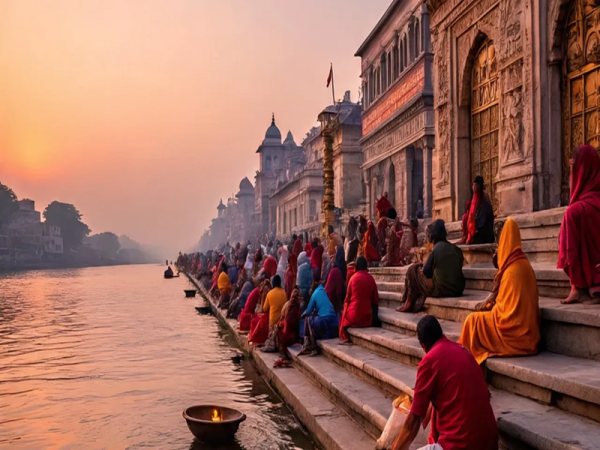
Every year, a large number of people from Faridabad, Haryana, travel to Haridwar and Kashi—also known as Banaras—to take a holy dip in the River Ganges. After taking their ritual bath, these devotees often bring back *Gangajal* (holy Ganges water) to their homes. However, a question frequently arises in people's minds: if one can bring back *Gangajal* from Haridwar, why, then, should one *not* bring it back from Banaras? What is the underlying belief behind this custom, and what specific items are actually considered auspicious to bring home from Kashi? We discussed this subject in detail with Mahant Kameshwaranand Vedantacharya of Ballabhgarh.

**Should One Not Bring *Gangajal* from Banaras?**
Mahant Kameshwaranand Vedantacharya explains that the River Ganges is, fundamentally, the same everywhere. Originating from Gangotri, she flows through Rishikesh, Haridwar, and Prayagraj before finally reaching Kashi. However, each of these locations possesses its own unique spiritual significance. While bringing *Gangajal* home from Haridwar is considered auspicious, one should refrain from bringing *Gangajal* back from Kashi (Banaras).
**People Visit Kashi with the Desire for *Moksha***
Mahant Kameshwaranand Vedantacharya notes that Kashi is the sacred city of Lord Shiva. The scriptures state that while people travel across the world to live and earn a livelihood, Kashi is a unique city—a destination to which people journey specifically with the aspiration of attaining *Moksha* (salvation). In times past, it was the cherished wish of the elderly to spend the final moments of their lives in Kashi. It is believed that if a person passes away in Kashi, Lord Shiva himself whispers the *Tarak Mantra* into their right ear, thereby granting liberation to the soul.
Mahant Kameshwaranand Vedantacharya further explains that even the tiny aquatic creatures inhabiting the waters of the Ganges in Kashi reside there for the very purpose of attaining *Moksha*. If a person fills a vessel with this *Gangajal* and carries it back to their home, they inadvertently remove these living beings from Kashi—and thus, from their path to salvation. For this reason, bringing *Gangajal* home from Kashi is not considered appropriate. This tradition is centuries old, and it is a belief that has been upheld by saints and spiritual masters throughout the ages.
**What Should One Bring from Kashi?**
Mahant Kameshwaranand Vedantacharya suggests that if one feels compelled to bring something back from Kashi, one should bring a *Shivling* (a sacred icon representing Lord Shiva). It is believed that in Kashi, every pebble is imbued with the divine essence of Lord Shiva himself. Bringing back Rudraksha beads from there is considered extremely auspicious. Additionally, one must certainly bring back the black thread associated with Lord Kaal Bhairav. It is believed that doing so wards off the "evil eye" and keeps an individual free from illnesses. Kaal Bhairav is revered as the "Kotwal" (Guardian) of Kashi, and even today, he holds a place of special significance there.

Mahant Kameshwaranand Vedantacharya advises that if you visit Kashi, you must pay your respects at the Kaal Bhairav Temple and bring back the *Prasad* (sacred offering) from the Sankat Mochan Hanuman Temple. Similarly, from Haridwar, it is considered auspicious to bring home *Gangajal* (holy water from the Ganges), a Rudraksha rosary, the *Prasad* offered to Mother Ganges, and a *Shivling*. This is because Haridwar is known as the "Gateway to Hari" (Lord Vishnu), and keeping *Gangajal* brought from there in one's home is believed to ensure the preservation of peace and harmony.
PC Social Media
-
From BIT Mesra Graduate To Minister: Know The Educational Qualifications Of Bihar's Newly Appointed Health Minister Nishant Kumar
-
Tiger Sighted in Arunachal Pradesh Sanctuary After Two Decades

-
ED conducts searches at premises linked to Punjab Minister Arora; second within month (Ld)
-
State pensioners warned over £70 fines - over 70s 'most at risk'

-
CM Rekha Gupta orders safety audits after surprise inspection of Delhi government school
