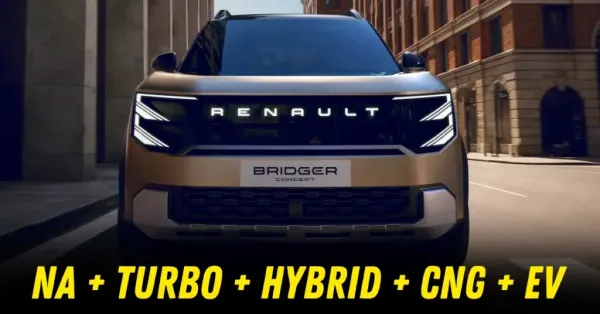
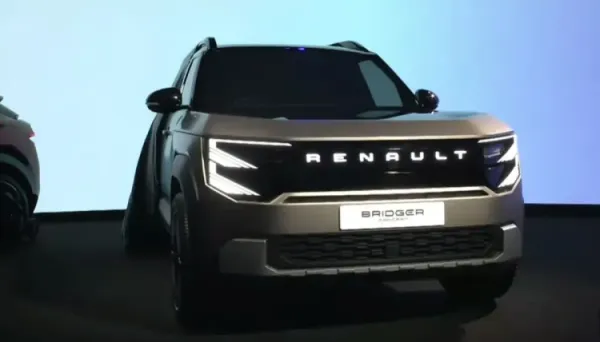
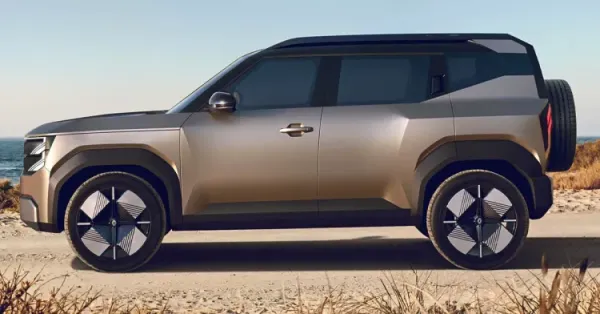
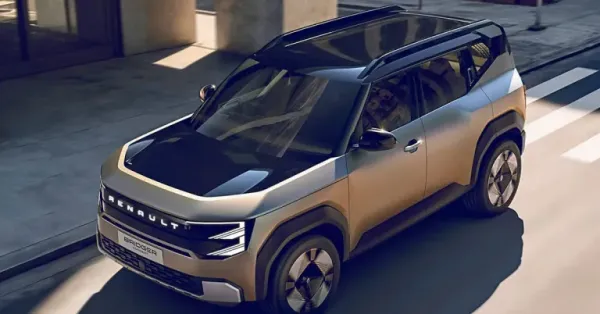
Just a little while ago, Renault took the covers off the concept of its upcoming sub-compact SUV, the Bridger, globally. This new SUV will be a crucial part of Renault’s comeback “FutuREady” strategy for India. Now, recently, it has been reported that the company will be offering the upcoming Bridger with not one, not two, but a total of 5 different powertrain options. Yes, you read that right, and here are all the details of the upcoming Renault Bridger SUV, which is expected to arrive in India by the end of 2027.
Before jumping into the details of the powertrains that the Bridger will be offered with, it has to be noted that this sub-compact SUV will be based on the RGMP Platform (Renault Global Modular Platform). It has been derived from Renault-Nissan’s global CMF-B architecture and will support powertrains such as petrol, turbo petrol, hybrid, CNG, and electric powertrains.
It will also boast SWEET 400 electrical architecture. For those who may not be aware, SWEET stands for Software Electric & Electronic Technology. It has been co-developed with Google. This architecture will provide connected car technology and OTA updates. Additionally, it will also offer better software integration and advanced hybrid and EV management systems.
One of the newest powertrains will be a 1.2-litre naturally aspirated petrol engine with a 4-cylinder setup and an MPFi (Multi-Point Fuel Injection) technology-equipped engine. It is expected to produce power in the range of 80 to 90 bhp. Transmission options for the engine will include a 5-speed manual gearbox and an automatic gearbox.
This will be offered with the affordable Bridger variants, and as it will be lower than 1200cc, it will also qualify for lower GST benefits applicable to small cars in India. We can expect a smooth and refined engine due to its 4-cylinder configuration. It will also have better NVH than small 3-cylinder rivals.
The second engine option, which will specifically entice enthusiasts, will be the new 1.2-litre turbocharged petrol engine. It will also be a 4-cylinder layout, and it will be derived from Renault’s larger 1.3-litre turbo petrol engine seen in the newly launched Duster. Its stroke will be reduced to keep its displacement under 1200cc.
As per the reports, it is expected to produce around 120 bhp and 200 to 220 Nm torque. Gearbox options will include a manual transmission along with a DCT or torque converter automatic. This powertrain will offer a balance between performance and fuel efficiency.
It has recently been reported that Renault India is also working on the development of a new 1.2-litre, 3-cylinder hybrid engine. This engine will run on the Miller cycle. This new powerplant will be offered in a smaller package, which will help in accommodating the battery, hybrid hardware, electric motor, and Miller Cycle Technology.
Renault is using the Miller Cycle technology to improve thermal efficiency, reduce fuel consumption, and also make this powertrain future-proof. It has been reported that Renault is currently studying technology from AVL’s H12 hybrid concept, which was showcased at the Vienna Motor Symposium. The demonstrator vehicle used a modified Dacia Duster platform.
As per AVL, its new engine uses 3.3 litres per 100 km, which is equivalent to almost 30 kmpl, which is very impressive. Its base engine will be built around Horse Powertrain’s HR12 engine architecture. It has been reported that Renault, for the Indian market, will most likely keep displacement below 1200cc.
This will help the Bridger in receiving small-car tax benefits. For those who may not be aware, Horse Powertrain was formed in 2024. It combines Renault and Geely’s ICE engine businesses. Horse currently has 18 manufacturing plants, 5 R&D centres, and it has operations across Europe, China, Latin America, and the USA. As for its customers, the list includes Renault, Nissan, Volvo, Mercedes-Benz, and Geely.
It was recently reported that Horse Powertrain is preparing to enter India. The company has already filed to establish an Indian legal entity. And soon, it could commence its local manufacturing. As for the reason for entry into India, it is that soon after the introduction of reduced GST rates, many automakers are aggressively focusing on efficient sub-1.2-litre engines. Horse Powertrain, as a result, is seeing major demand growth in small turbo engines and hybrid-ready powertrains.
The demand for CNG-powered vehicles in India is going up. Presently, CNG contributes to roughly 22 percent of passenger vehicle sales in India, and Renault wants a jump on this trend. So, it is expected to use the same 1.2L MPFi turbo petrol engine, and it will be offered with a factory-fitted dual-cylinder CNG system.
Instead of offering a single large CNG tank, the Bridger is expected to offer two smaller CNG cylinders, which will most likely be placed under the boot. This will help in offering better boot space, longer driving range, and better weight distribution. As for the performance side of things, this engine is expected to offer 120 bhp in petrol mode and 100 to 105 bhp in CNG mode. As for the mileage, it is expected to offer 30+ km/kg.
The last powertrain option on this list is the electric powertrain. The Bridger with an electric drivetrain is expected to launch soon after the ICE model, around early 2028. As per the reports, it is expected to get two battery pack options, namely 35 kWh and 55 kWh. The 35 kWh variant is expected to offer around 300 to 350 km real-world range.
Meanwhile, the 55 kWh variant is expected to provide around 500 km claimed range. Other features which we can expect will include DC fast charging, regenerative braking, and Vehicle-to-Load (V2L) support. It is expected to get a front-wheel-drive layout.
-
Delhi officials demolish dargah locals claim was built over 100 years ago

-
VCK eyeing Dy CM post in new TN govt formation: Party source

-
Telangana retired teacher duped Rs 82 lakh in digital arrest scam

-
Harish Rao questions Hyderabad CP over ex-IPS officer’s wife’s murder
-
Sudden Blood Sugar Spike? Simple Everyday Habits That May Help Bring It Under Control