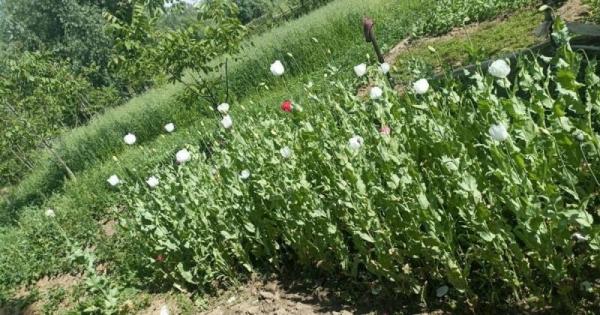
Even as various departments in the Union Territory of Jammu and Kashmir have intensified an aggressive campaign to achieve the target of making the region free from the menace of drug addiction within 100 days, the illegal cultivation of opium poppy in different parts of the Kashmir Valley has emerged as one of the biggest challenges in accomplishing this objective.
In April alone, the Jammu and Kashmir Police, in coordination with the Excise and Revenue Departments, destroyed illegally cultivated poppy crops spread over hundreds of kanals in the districts of Anantnag, Kulgam, Pulwama, Sopore, and Budgam.
As part of the anti-drug drive, authorities have not only mapped drug-prone hotspots across all 20 districts of the Union Territory but have also launched coordinated action against the illicit cultivation of opium poppy. Joint teams comprising officials from the Police, Excise, Revenue, and Agriculture Departments are conducting field operations to identify and destroy such crops and initiate legal proceedings against those involved.
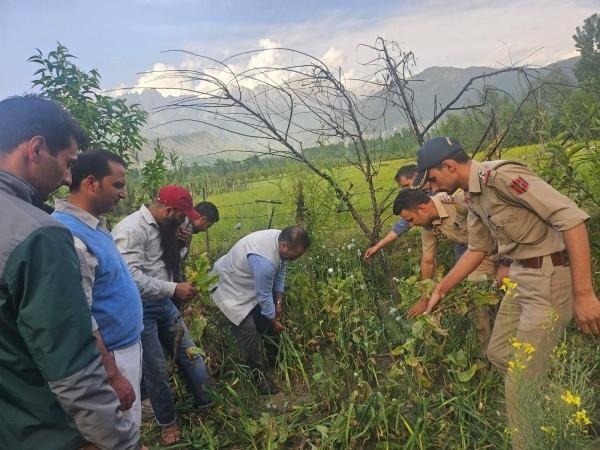
Officials said that large tracts of illegally cultivated poppy have been destroyed in several districts, including Pulwama, Anantnag, Kulgam, Baramulla, and Kathua. Several individuals allegedly involved in illegal cultivation have been arrested, particularly in Pulwama, Kathua, and Anantnag, and booked under relevant provisions of the Narcotic Drugs and Psychotropic Substances (NDPS) Act.
Cases have been registered under Sections 8 and 18 of the NDPS Act, which prohibit the cultivation of opium poppy except for limited medical or scientific purposes permitted by law. Violations attract stringent penalties, ranging from imprisonment of up to one year in minor cases to 10 to 20 years in cases involving commercial quantities.
Authorities acknowledged that the exact extent of land under illegal poppy cultivation remains uncertain because of the covert nature of the activity. However, preliminary estimates suggest that less than 200 hectares may currently be under such cultivation across Jammu and Kashmir.
Officials said the crop is generally sown during winter and harvested by early summer, with its seeds and straw sold through illegal channels. To prevent the produce from entering the illicit drug market, enforcement agencies conduct annual destruction drives during the flowering stage, before the crop matures.
Authorities have also activated an informer reward mechanism to encourage members of the public to share credible information regarding illegal cultivation and drug trafficking networks.
Police have issued a stern warning to those engaged in such activities, reiterating that strict legal action will be taken against violators.
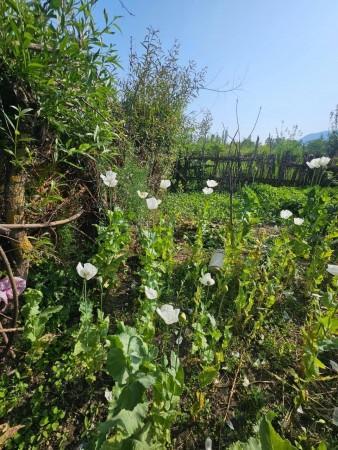
The ongoing campaign forms part of a broader multi-pronged strategy of the Jammu and Kashmir administration to curb drug abuse and dismantle narcotics networks. Alongside enforcement measures, awareness programmes are being conducted to educate people, especially the youth, about the harmful consequences of substance abuse.
Two More Cases Registered; Illegally Cultivated Opium Poppy Destroyed in Anantnag
Continuing its relentless campaign against narcotics and illegal cultivation, Jammu and Kashmir Police achieved another significant breakthrough in Anantnag by destroying illegally cultivated opium poppy in two separate operations carried out within the jurisdictions of Police Station Dooru and Police Station Aishmuqam.
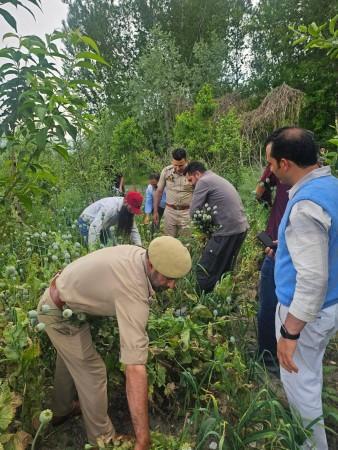
In the first operation, Police Station Dooru received reliable information that Bashir Ahmad Beigh, son of late Ghulam Ahmad Beigh and a resident of Chaango, Dooru, had illegally cultivated poppy. Acting promptly, a police team accompanied by an executive magistrate and officials from the Agriculture Department visited the site, identified the illicit crop, and destroyed it on the spot. In this connection, FIR No. 66/2026 under Sections 8 and 18 of the NDPS Act has been registered, and an investigation has been initiated.
In the second operation, Police Station Aishmuqam received information that Mohammad Ashraf Ahanger, son of Abdul Rehman Ahanger and a resident of Badaran, had also cultivated opium poppy illegally. Acting on the tip-off, a police team, along with an executive magistrate and officials from the Excise and Agriculture Departments, conducted a raid and destroyed the illicit crop on the spot. FIR No. 40/2026 under Sections 8 and 18 of the NDPS Act has been registered, and further investigation is underway.
-
Fire Near Charles de Gaulle Airport Causes Smoke Plumes

-
WWE Backlash 2026: Key Matches and Viewing Details

-
FC Goa and Mohun Bagan Share Spoils in Thrilling 1-1 Draw

-
Controversy Surrounds Yuzvendra Chahal Over Alleged Vaping Incident

-
Bride Disappears After Wedding in Rajasthan, Groom Files Police Complaint