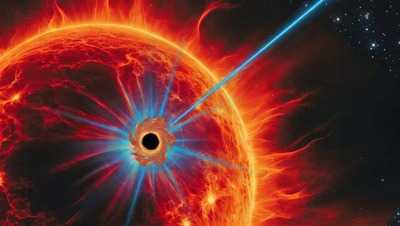
These blue cosmic explosions might not be a mystery anymore
09 May 2026
Luminous Fast Blue Optical Transients (LFBOT), a class of mysterious and powerful bright blue cosmic explosions, have puzzled astronomers since their first observation in 2018.
Now, a new study suggests that these strange blasts could be the result of a compact stellar remnant, such as a black hole or neutron star, colliding with Wolf-Rayet stars.
These massive stellar bodies are considered the hottest class of stars in the universe.
What are LFBOTs?
Cosmic enigma
LFBOTs are different from other cosmic explosions or "transients" because they evolve much faster, peaking and fading within days.
They also have a distinct blue color, indicating that they remain incredibly hot throughout their evolution.
Over the years, scientists have proposed several models to explain these events, including core-collapse supernovas and extreme tidal disruption events (TDEs).
Unraveling the mystery of LFBOTs
Research findings
The research team studied the host galaxies and environments of LFBOTs to understand their origins.
They found that these cosmic explosions come from very different environments than those predicted by some supernova scenarios, and don't occur in places usually associated with tidal disruption events.
"Because LFBOTs are so rare and their light-curve properties are so different than many other transients, it is hard to pin down what their progenitors are!" said Anya Nugent of Harvard University's Center for Astrophysics (CfA).
Stellar remnant and Wolf-Rayet star collision?
Collision theory
The research team proposes that LFBOTs are caused by a collision between a compact stellar remnant and the leftover helium core from a massive star that has lost its outer hydrogen envelope, known as a Wolf-Rayet star.
This model explains both the properties of the transients and their host environments well.
How a Wolf-Rayet star is formed?
Stellar link
The research team suggests that binary systems, which start as two massive stars with one stripping the other of stellar matter, could lead to the formation of Wolf-Rayet stars.
Eventually, these Wolf-Rayet stars and their stellar remnant companions could merge to trigger an LFBOT.
"Many massive stars are in binary systems, but these mergers occur in just the right conditions that they don't merge with each other too early on in their evolution," Nugent said.
Future studies on LFBOTs
Future prospects
The research team believes that their model can be thoroughly tested once astronomers have discovered more LFBOTs.
They expect the Vera C. Rubin Observatory and its decade-long Legacy Survey of Space and Time (LSST) to play a major role in this discovery process.
"Rubin will be amazing for discovering fainter LFBOTs out to even further cosmological distances," Nugent concluded, emphasizing the importance of this observatory in future studies of these cosmic phenomena.
-
Pakistan Cricket: This ‘good man’ is making Pakistan cry, accused of losing 11 tests

-
Cannes 2026: Alia Bhatt showed her beauty in a strapless gown, all eyes were on the neckpiece – PHOTOS Cannes 2026 Alia Bhatt Red Carpet Look In Tamara Ralph Strapless Gown Golconda Diamond Necklace

-
From weakness to increasing strength, this Ayurvedic plant is no less than a miracle for men – News Himachali News Himachali

-
If your partner gets very angry, then this solution will work like magic!

-
Expensive Honeymoon Places: Things to Consider When Planning a Trip