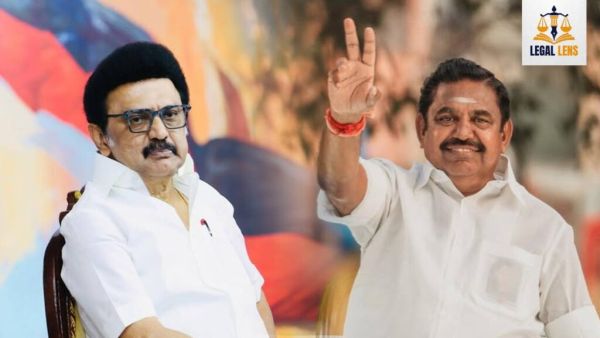
Tamil Nadu Governor Rajendra Vishwanath Arlekar demanded signed letters from 118 MLAs before inviting TVK leader Joseph Vijay to form the government. The demand has now been met. The Congress, CPI, CPI(M) and VCK have extended support, and Vijay’s tally has crossed the majority mark. The constitutional question raised by the Governor’s demand, however, persists.
Also read | Vijay doesn’t have to ‘prove’ his majority since Constitution never asked him to
Although the DMK and the AIADMK, the arch political rivals in the state, have now ruled out coming together to keep TVK out of power, the fact that they were in talks to explore its possibility, shows that the mandate of the just-concluded Assembly elections was on the verge of being distorted purely on the basis of arithmetic. It is also an indication that the prospect of these two arch-rivals coming together will act like the sword of Damocles over the TVK’s rein in power.
The morality of coalitions
Post-poll alliances per se are not unconstitutional, if they are attempted in order to form a government following fractured electoral verdicts. But those formed with the sole intention to keep the single largest party, which is close to a majority, out of power are likely to alienate the electorate.
In this, politics in Tamil Nadu may have a lesson to learn from hung parliaments in the United Kingdom from the last century.
In December 1923, Conservative Prime Minister Stanley Baldwin went to the polls seeking a fresh mandate to introduce tariffs on imported goods. The Liberals, led by HH Asquith, fought the election in defence of free trade. Labour, led by Ramsay MacDonald, fought it on a programme of unemployment relief. Baldwin lost his majority. The Conservatives remained the largest party in the Commons with 258 seats; Labour took 191 and the Liberals 158. The Liberals and the Conservatives together commanded a clear majority. Reuniting against Labour was the arithmetical course.
The arithmetical course was not taken. King George V did not invite a Conservative-Liberal combination. Asquith refused to enter one. Baldwin’s government lost its first confidence test in January 1924. The King invited Ramsay MacDonald, leader of the second-largest party, with Liberal sufferance from the Opposition benches. The first Labour government in British history took office.
Asquith’s calculation was that the inexperienced Labour ministry would flounder. The Liberals would then be returned at the next election to inherit the centre-left vote. The calculation was wrong. Labour fell within the year. The Liberals were reduced to 40 seats in October 1924. Asquith lost his Paisley seat and never returned to the Commons. But the constitutional verdict has settled in his favour. He had refused to use arithmetic to displace the largest plausible claimant from the invitation. The convention he upheld still binds the Westminster system.
Constitutional scholar HM Seervai reads the rejected combination as politically cynical. The Liberals would have allied with the very party they had opposed on the very issue, free trade, which defined the election. The arithmetic was real; the moral cost was higher.
The burden of arithmetic
The British political class has long recognised the same instinct under the rougher label of “a coalition of the losers”. The phrase carries a moral suspicion: an arrangement assembled to displace the largest claimant is illegitimate even if arithmetically possible.
The phrase has a traceable lineage. It crystallised first in Canada in December 2008. Stephen Harper, leading a Conservative minority government, attacked a proposed Liberal-NDP-Bloc Québécois coalition as a backroom arrangement to overturn the election. The phrase travelled to Britain in May 2010. Senior Labour figures and BBC reporters deployed it against a proposed Labour-Liberal Democrat combination, after the Conservatives had won the largest number of seats. It surfaced again in 2017, when Theresa May lost her majority. The implication is consistent. An arrangement assembled to displace the largest claimant carries a stigma that arithmetic cannot dispel.
Also read | No invite for Vijay’s TVK: Why experts say TN Governor is overstepping
The intuition behind the phrase is winner-takes-all. Whoever leads in the count has won the election. Runners-up combining against him have lost it. A combination of the losers, on this view, is an attempt to overturn the verdict at the polls. The parliamentary system does not work that way. Its rule is that whoever can command the confidence of the House governs. The runner-up’s combination, if it has the numbers, is what the system permits. Public opinion has not absorbed the difference.
Britain has since put part of the convention in writing. The hung parliament of May 2010 saw Gordon Brown remain Prime Minister through five days of negotiations. He resigned only when David Cameron emerged as the leader most likely to command confidence. The episode prompted the Cabinet Office to formalise the invitation rule. Vernon Bogdanor’s The Coalition and the Constitution (2011) traces the move from convention to written rule.
The mechanics of invitation
Predictability mattered: party leaders needed to know in advance the terms on which the Sovereign would invite. Paragraph 2.8 of the Cabinet Manual, published the same year, sets the rule. The Sovereign must invite the person most likely to command the confidence of the House. Likelihood, not arithmetic. Paragraph 2.9 places the burden of resolution on the parties, not on the Crown. Where the result is unclear, the parties in Parliament must determine and communicate to the Sovereign who is best placed. The Sovereign identifies; she does not interrogate.
The mechanism worked in May 2010. Sir Gus O’Donnell, the Cabinet Secretary, coordinated the inter-party negotiations. Civil-service support was given to all three parties on an equal basis. The parties themselves communicated the outcome to the Crown. Nick Clegg led the Liberal Democrats, the third-largest party at the time. He announced publicly that the largest party should have the first chance. Gordon Brown resigned only when it became clear David Cameron could command confidence. The Queen invited Cameron on Brown’s resignation. She was not asked to choose, only to act. In strict law, the prerogative is preserved; by convention the Sovereign follows the parties’ communicated determination. That is what protects her from being drawn into politics. An Indian Governor has the same convention available. The parties negotiate, the bureaucracy coordinates, the floor of the House determines.
The Manual did not codify the 1924 corollary, which the second-and-third-largest should forbear from combining against the largest plausible claimant. That leg of the convention rests on political ethics.
Governor’s discretion under scrutiny
The Indian Constitution carries the same convention without need of a Cabinet Manual. One might say that, unlike the Conservatives and Liberals in the UK, there is little to distinguish the two Dravidian parties in Tamil Nadu. But Seervai’s criticism of political cynicism applies with equal force where two erstwhile rivals contemplate combining to keep out a new entrant.
Article 164(2) places the Council of Ministers under the collective responsibility of the Legislative Assembly. The phrase looks forward to the floor, not backward to Raj Bhavan. Collective responsibility is satisfied so long as the House is not arrayed against the government. Toleration suffices; affirmation is not the test.
The Governor’s demand for prior proof collapses the distinction between two stages. The invitation is his discretionary judgment of likelihood. The trust vote is the Assembly’s determinative test of confidence. To require signed proof at the first stage is to perform the second stage in advance, leaving the trust vote with nothing to determine. In other words, the first stage carries the possibility of leaving the second stage largely of academic interest. A judgment is a glance at the visible arithmetic. An audit is the demand for signed paper commitments before the House has even met.
Also read | TN govt formation: ‘Governor should invite Vijay, ask him to prove majority on floor of House’
The smaller parties did what the convention asked them to do. CPI(M) general secretary MA Baby disclosed that the DMK had sought Left support to back an AIADMK-led government. The Left refused, citing the need to avoid an avoidable impasse. They backed Vijay instead. That was the 1924 forbearance leg of the convention in operation. The arithmetic for an alternative combination existed; the moral cost of assembling it against the largest claimant was higher. The smaller parties read that cost correctly.
In Tamil Nadu, the Governor’s demand for signed letters from 118 of 234 MLAs before inviting Vijay fell outside this scheme. It could not be reconciled with the invitation rule, codified in Britain in 2011 and traceable back to 1924. It departed from what the framers wrote into Article 164(2). The smaller parties, declining to assemble against the largest claimant, supplied a corrective the Governor could not resist. The constitutional question, however, is not whether Vijay finally produced his 118 signatures. It is whether he should have been required to.
-
Cancer Daily Horoscope Today (Jun 21 - Jul 22), May 10, 2026: Close ones will be pleased, relationships will strengthen
-
Pisces Daily Horoscope Today (Feb 19 - Mar 20), May 10, 2026: Focus on Learning and Guidance, Love Life to Stay Stable
-
Scorpio Daily Horoscope Today (Oct 23 - Nov 21), May 10, 2026: Stay Practical, Value Experienced Guidance
-
Leo Tarot Horoscope Today, May 10, 2026: Stay focused on joy and make wise choices

-
Libra Tarot Horoscope Today, May 10, 2026: Gain Strength From Good Guidance, Stay Committed to Rules