New Delhi: India's senior living market is transitioning towards the rental model, where the senior avoids putting capital in buying the property and instead rents it.
A convergence of increasing life expectancy and the rise of nuclear family structures is transforming senior living to rental-driven models, experts said. This shift allows seniors to preserve their capital while retaining the flexibility of staying anywhere.
Also Read: Haryana policy change drives developer interest in senior living
"The Indian senior living market is moving away from the 'old-age home' stereotype towards a sophisticated institutionalisation of the asset class. Developers are abandoning traditional outright sales in favour of specialised structures, hospitality integrations and rental-driven models," said Anshuman Magazine, chairman and CEO - India, South-East Asia, Middle East & Africa at real estate consultancy CBRE. "This shift provides developers and institutional funds with a resilient, long-term yield," he said.
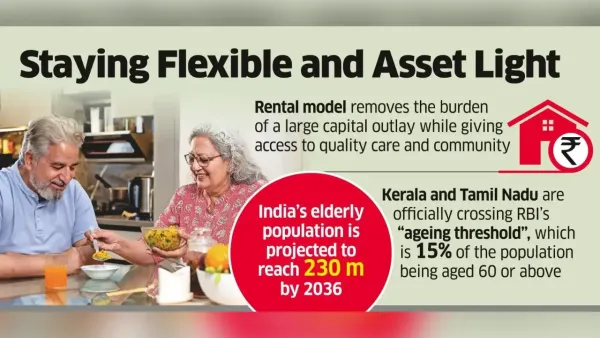
India's elderly population is projected to reach 230 million by 2036. Southern states like Kerala and Tamil Nadu are officially crossing the Reserve Bank of India's "ageing threshold" (15% of the population being aged 60 or above).
"The asset-light, rental, models in senior living projects are a recent phenomenon. This change helps seniors protect their savings while staying flexible enough to invest in promising new opportunities," DS Group Charitable Trust mentor Sunita Gupta said. "Today's seniors are far more financially aware and lifestyle-driven and are increasingly opting for rental-led, managed living formats that offer flexibility, predictable costs, community and a better quality of life."
Key factors driving this preference include the absence of long-term commitments, ease of upgrading and downgrading living spaces and bundled offerings that combine housing with services, healthcare and higher quality of life.
"In Gurugram, this demand is becoming more defined and aspirational. A growing segment of HNIs, NRIs and affluent professionals are now planning their post-retirement living with the same intent and expectations as any other life stage," said Rishabh Periwal, senior vice-president at Pioneer Urban Land & Infrastructure Ltd. "This evolution is also repositioning senior living from a functional need to a more structured, lifestyle-led asset class."
According to CBRE, by adopting professional community management, developers are ensuring that safety, wellness and social engagement remain the core value propositions, moving the segment towards a service-led real estate model.
Also Read: Grey Market: India is ageing faster than its care systems can keep up. A new wave of startups is trying to bridge that gap
"Hospitality-led and rental models are becoming increasingly viable as they enable seniors to move into an environment with high-quality care, security and social engagement support without tying up significant capital. Such an approach reduces the financial burden and gives residents the freedom to adapt their living choices as per their requirements," said Anil Godara, founder and managing director, J Estates.
While Southern India remains the primary hub for these developments due to a combination of an ageing population, favourable rental and capital values, and established healthcare infrastructure, non-metros such as Dehradun and Jaipur are rapidly emerging as preferred hubs.
"For years, outright sale was the default - seniors and their families viewed a purchased home as the only credible form of security. But that logic is shifting," said Adarsh Narahari, founder and managing director, Primus Senior Living. "Interestingly, it's not just elders driving this shift - their children are too. Adult children managing careers, families and finances across cities increasingly prefer a rental arrangement."
The rental model removes the burden of a large capital outlay while giving their parents access to quality care and community.
"This is precisely why senior living REITs (real-estate investment trusts) are one of the largest real estate investment categories globally. India doesn't have one yet," Narahari said. "But the underlying conditions - demographic scale, long lease tenures and recession-resistant demand - are falling into place."
A convergence of increasing life expectancy and the rise of nuclear family structures is transforming senior living to rental-driven models, experts said. This shift allows seniors to preserve their capital while retaining the flexibility of staying anywhere.
Also Read: Haryana policy change drives developer interest in senior living
"The Indian senior living market is moving away from the 'old-age home' stereotype towards a sophisticated institutionalisation of the asset class. Developers are abandoning traditional outright sales in favour of specialised structures, hospitality integrations and rental-driven models," said Anshuman Magazine, chairman and CEO - India, South-East Asia, Middle East & Africa at real estate consultancy CBRE. "This shift provides developers and institutional funds with a resilient, long-term yield," he said.
Stepping Beyond Old Age Homes Preference shifts to rentals as that allows many to save capital
India's elderly population is projected to reach 230 million by 2036. Southern states like Kerala and Tamil Nadu are officially crossing the Reserve Bank of India's "ageing threshold" (15% of the population being aged 60 or above).
"The asset-light, rental, models in senior living projects are a recent phenomenon. This change helps seniors protect their savings while staying flexible enough to invest in promising new opportunities," DS Group Charitable Trust mentor Sunita Gupta said. "Today's seniors are far more financially aware and lifestyle-driven and are increasingly opting for rental-led, managed living formats that offer flexibility, predictable costs, community and a better quality of life."
Key factors driving this preference include the absence of long-term commitments, ease of upgrading and downgrading living spaces and bundled offerings that combine housing with services, healthcare and higher quality of life.
"In Gurugram, this demand is becoming more defined and aspirational. A growing segment of HNIs, NRIs and affluent professionals are now planning their post-retirement living with the same intent and expectations as any other life stage," said Rishabh Periwal, senior vice-president at Pioneer Urban Land & Infrastructure Ltd. "This evolution is also repositioning senior living from a functional need to a more structured, lifestyle-led asset class."
According to CBRE, by adopting professional community management, developers are ensuring that safety, wellness and social engagement remain the core value propositions, moving the segment towards a service-led real estate model.
Also Read: Grey Market: India is ageing faster than its care systems can keep up. A new wave of startups is trying to bridge that gap
"Hospitality-led and rental models are becoming increasingly viable as they enable seniors to move into an environment with high-quality care, security and social engagement support without tying up significant capital. Such an approach reduces the financial burden and gives residents the freedom to adapt their living choices as per their requirements," said Anil Godara, founder and managing director, J Estates.
While Southern India remains the primary hub for these developments due to a combination of an ageing population, favourable rental and capital values, and established healthcare infrastructure, non-metros such as Dehradun and Jaipur are rapidly emerging as preferred hubs.
"For years, outright sale was the default - seniors and their families viewed a purchased home as the only credible form of security. But that logic is shifting," said Adarsh Narahari, founder and managing director, Primus Senior Living. "Interestingly, it's not just elders driving this shift - their children are too. Adult children managing careers, families and finances across cities increasingly prefer a rental arrangement."
The rental model removes the burden of a large capital outlay while giving their parents access to quality care and community.
"This is precisely why senior living REITs (real-estate investment trusts) are one of the largest real estate investment categories globally. India doesn't have one yet," Narahari said. "But the underlying conditions - demographic scale, long lease tenures and recession-resistant demand - are falling into place."