
Chaithania Prakash, a 22-year-old content creator from Kochi, is drowning in data. Her devices are heaving with thousands of images that she needs for her YouTube vlog, the half-a-dozen short videos she posts every week plus the many stories and carousels that light up her socials. Her data sits across two 512 GB iPhones, two 128 GB SD cards and a 2TB iCloud plan that costs her about ₹9,000 a year.
She cannot imagine how she squeezed her videos and photos into a 128 GB phone when she started creating content for TikTok in 2019. Seven years can be staggering in terms of technological advancements, and two decades can be epochal.
For it was just over 20 years ago that Nokia came out with what was a radical device for the time—a phone with a built-in camera. The Nokia 7650, where the keypad slid out to reveal the rear camera in all its glory, had an internal memory all of 4 MB. A 30-second video these days would be at least 50 MB.
“And there is AI now. When I use AI tools for editing, I get multiple outputs and I end up saving everything. AI has increased my storage needs,” says Prakash. She isn’t too worried. She expects to keep paying for more storage.
Archana Dhinakaran, a legal and compliance professional in Puducherry, refuses to do that. “I vouch for minimalism and decluttering, particularly in the digital form. I don’t ever intend to subscribe to any plans. I’d rather take control of what I need and how much to store.” She is among those who religiously delete unwanted images and documents to stay within storage limits. But that discipline is constantly tested. In a LinkedIn post, she describes her “monthly Gmail meltdown” where recurring warnings about “your storage is full” would send her on a spree of deleting emails and files. “Anybody else being emotionally blackmailed by their inbox? Just checking,” she asks. Despite the frustration, she continues to resist paying.
“The maturity of the Indian smartphone user is creating a storage paradox,” says Neil Shah, cofounder, Counterpoint Research. “Consumers are upgrading to devices with pro-grade cameras and AI-capable processors, but base storage—128 GB or 256 GB—cannot keep pace with the exponential file sizes of 4K videos, RAW photos and heavy apps. AI tools, WhatsApp and games naturally create more data, which drives friction for users to go back and delete content. The cloud becomes a functional extension of the phone’s internal memory.”
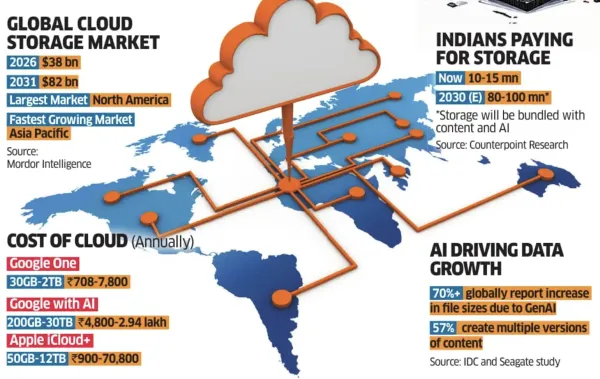
Globally, the personal cloud market is estimated to be over $38.7 billion, according to Mordor Intelligence. This is expected to be $82 billion in 2031, growing at a CAGR of 16.2%. While the largest market is North America, the fastest growing market is Asia Pacific.
Tech companies have turned storage into a lucrative business opportunity. Google One, the company’s subscription service bundling cloud storage with AI features, crossed 150 million subscribers in 2025. In early 2026, Alphabet reported over 325 million paid subscriptions across consumer services, including Google One and YouTube Premium—a signal of how steadily the company has been diversifying beyond advertising, which still accounts for the majority of its revenue.
The shift is unlikely to come from more users suddenly deciding to buy storage. It will come from bundling. The average user will not choose storage as much as find themselves already inside a plan that includes it. Most of the 100 million users in India would be going for storage plans bundled with AI or online content.
Storage is increasingly being packaged with AI tools, content subscriptions and ecosystem services. Last year, Jio bundled a 5G plan with Google’s Gemini Pro and Google One Premium with a 5TB storage.
“There has been a fundamental behavioural shift in the Indian digital middle class warming up to subscription models,” says Shah. “This is expanding towards what you could is expandi call digital peace of mind.” It comes for a price.
Swati Mukund, a Mumbai-based educator and content creator, subscribed to cloud storage to simplify her life and manage her work. As student submissions, presentations and photos accumulated on her phone, she moved them to cloud. She now pays about ₹18,000 annually for 2TB each on iCloud and Google One. Digital cleanup happens occasionally. “I didn’t think I’d be paying for cloud storage or AI apps. But the benefits far outweigh the cost.” She expects her storage needs to only grow.
According to International Data Corporation (IDC), memory accounts for 15-20% of the cost of a mid-range smartphone and 10-15% of a flagship device. As costs rise, IDC estimates the global smartphone market could contract by 2.9% in 2026 in a moderate scenario and by 5.2% in a pessimistic case, even as average prices rise by up to 8%. Computers are facing similar pressures, with companies signalling price hikes of 15-20% amid tightening supply.
Sidhant Mourya, a 26-year-old software engineer in Goa, bought a bundled Google subscription of 2TB storage and AI Pro features but stopped using it after about a year. He is concerned that the platform would be using his photos to train their AI model, although Google says in a blog that “the Gemini app does not directly train its models on your private Google Photos library”.
Mourya uses a self-hosting photo and video-management solution Immich, which is connected to his 4TB hard drive. He knows hard drives can fail: “I don’t have immediate concerns since my hard drive is new, but it’s something I’ve planned for. I’ve set up a system where the data is automatically replicated across drives, so there’s always a backup.”
This stems from a fear of not having control over one’s data. In many cases, users don’t know what data is being collected about them, where it is stored, or how it is used. “As an Indian user, you don’t even know who has your data,” says Raman Chima, Asia Pacific policy director and senior international counsel, Access Now. The Digital Personal Data Protection (DPDP) Act, which is in force, will be fully enforced only by 2027.
It sets a foundational framework to ensure that a corporation respects user consent, says tech lawyer Apar Gupta. “One of the core protections in any data protection framework are user rights, which include the right to limit the amount of personal data that is gathered.” However, Gupta says tech companies will be able to monetise the pre-existing personal data that is with them. “Hope comes with some amount of pessimism, as the Data Protection Board is not a regulatory body. It can only act upon complaints made by members of the public and government. Even then it can play only an adjudicatory role. It doesn’t have investigative powers that other regulatory bodies have. Also, the
Data Protection Board is prescribed to be a virtual office. So how much staff will it have? How will it function, and how effective will it be in enforcing the provisions of the DPDP Act itself?” he asks.
“When users switch devices, they expect continuity not just of files, but of context. That expectation deepens dependence on platforms that store data. It also raises questions about control,” says Shah.
There is a danger of getting trapped in a cloud storage service. “Lock-in effects do exist,” says Chima. “That’s why interoperability matters—can you download and transfer your data easily?” Most large platforms offer export tools, but they are not always simple to use.
At the same time, the narrative around AI is shifting the conversation. With companies pushing for more data to train better models, privacy concerns risk being sidelined in that race. “The AI narrative is being used to call for more and more data to be collected,” says Chima.
That tension between accumulation and control sits at the heart of the storage story.
For companies, the opportunity is clear. Subscription revenue offers a steady, predictable income stream. For users, the equation isn’t so simple. As data grows, storage fills. Either you cut the data down to storage size, or you painstakingly move it periodically to a hard drive and hope it remains safe there, or you let it sit on an ever-growing paid cloud.
There is no easy solution, an Ozempic, in sight for data obesity.
She cannot imagine how she squeezed her videos and photos into a 128 GB phone when she started creating content for TikTok in 2019. Seven years can be staggering in terms of technological advancements, and two decades can be epochal.
For it was just over 20 years ago that Nokia came out with what was a radical device for the time—a phone with a built-in camera. The Nokia 7650, where the keypad slid out to reveal the rear camera in all its glory, had an internal memory all of 4 MB. A 30-second video these days would be at least 50 MB.
Gimme More
The explosion of data in personal devices has been fuelled by the rapid improvement in smartphone cameras that has increased the resolution of every photo and video, and the voracious appetite of people to turn their gadgets into an ever-expanding visual archive of their lives, which would then get shared and consumed on social media.“And there is AI now. When I use AI tools for editing, I get multiple outputs and I end up saving everything. AI has increased my storage needs,” says Prakash. She isn’t too worried. She expects to keep paying for more storage.
Archana Dhinakaran, a legal and compliance professional in Puducherry, refuses to do that. “I vouch for minimalism and decluttering, particularly in the digital form. I don’t ever intend to subscribe to any plans. I’d rather take control of what I need and how much to store.” She is among those who religiously delete unwanted images and documents to stay within storage limits. But that discipline is constantly tested. In a LinkedIn post, she describes her “monthly Gmail meltdown” where recurring warnings about “your storage is full” would send her on a spree of deleting emails and files. “Anybody else being emotionally blackmailed by their inbox? Just checking,” she asks. Despite the frustration, she continues to resist paying.
Storage anomaly
A data obesity epidemic is sweeping through our devices. Their storage just cannot keep up with our love for data. Soon, 100 million Indians would be paying for more storage, according to estimates by Counterpoint Research.“The maturity of the Indian smartphone user is creating a storage paradox,” says Neil Shah, cofounder, Counterpoint Research. “Consumers are upgrading to devices with pro-grade cameras and AI-capable processors, but base storage—128 GB or 256 GB—cannot keep pace with the exponential file sizes of 4K videos, RAW photos and heavy apps. AI tools, WhatsApp and games naturally create more data, which drives friction for users to go back and delete content. The cloud becomes a functional extension of the phone’s internal memory.”
Globally, the personal cloud market is estimated to be over $38.7 billion, according to Mordor Intelligence. This is expected to be $82 billion in 2031, growing at a CAGR of 16.2%. While the largest market is North America, the fastest growing market is Asia Pacific.
Tech companies have turned storage into a lucrative business opportunity. Google One, the company’s subscription service bundling cloud storage with AI features, crossed 150 million subscribers in 2025. In early 2026, Alphabet reported over 325 million paid subscriptions across consumer services, including Google One and YouTube Premium—a signal of how steadily the company has been diversifying beyond advertising, which still accounts for the majority of its revenue.
Bundle Up
In India, paying for more storage is still a minority behaviour. Shah estimates that just 1-2% of smartphone users— roughly 10-15 million people—curroughly 10-15 million people—currently pay for cloud storage. However, that is expected to expand to 10-15% over the next five years—which would mean 80-100 million paid users by 2030.The shift is unlikely to come from more users suddenly deciding to buy storage. It will come from bundling. The average user will not choose storage as much as find themselves already inside a plan that includes it. Most of the 100 million users in India would be going for storage plans bundled with AI or online content.
Storage is increasingly being packaged with AI tools, content subscriptions and ecosystem services. Last year, Jio bundled a 5G plan with Google’s Gemini Pro and Google One Premium with a 5TB storage.
“There has been a fundamental behavioural shift in the Indian digital middle class warming up to subscription models,” says Shah. “This is expanding towards what you could is expandi call digital peace of mind.” It comes for a price.
Swati Mukund, a Mumbai-based educator and content creator, subscribed to cloud storage to simplify her life and manage her work. As student submissions, presentations and photos accumulated on her phone, she moved them to cloud. She now pays about ₹18,000 annually for 2TB each on iCloud and Google One. Digital cleanup happens occasionally. “I didn’t think I’d be paying for cloud storage or AI apps. But the benefits far outweigh the cost.” She expects her storage needs to only grow.
The other problem
It is not just consumers who are having memory problems. Manufacturers of computers and smartphones are impacted by a memory chip shortage. As AI infrastructure booms, memory manufacturers are catering to their gargantuan demands, sidelining the requirements of the personal electronics industry. That would tell on the cost of phones.According to International Data Corporation (IDC), memory accounts for 15-20% of the cost of a mid-range smartphone and 10-15% of a flagship device. As costs rise, IDC estimates the global smartphone market could contract by 2.9% in 2026 in a moderate scenario and by 5.2% in a pessimistic case, even as average prices rise by up to 8%. Computers are facing similar pressures, with companies signalling price hikes of 15-20% amid tightening supply.
Jumping off the cloud
Meanwhile, some savvy users are getting off the cloud, spurred by data privacy concerns.Sidhant Mourya, a 26-year-old software engineer in Goa, bought a bundled Google subscription of 2TB storage and AI Pro features but stopped using it after about a year. He is concerned that the platform would be using his photos to train their AI model, although Google says in a blog that “the Gemini app does not directly train its models on your private Google Photos library”.
Mourya uses a self-hosting photo and video-management solution Immich, which is connected to his 4TB hard drive. He knows hard drives can fail: “I don’t have immediate concerns since my hard drive is new, but it’s something I’ve planned for. I’ve set up a system where the data is automatically replicated across drives, so there’s always a backup.”
This stems from a fear of not having control over one’s data. In many cases, users don’t know what data is being collected about them, where it is stored, or how it is used. “As an Indian user, you don’t even know who has your data,” says Raman Chima, Asia Pacific policy director and senior international counsel, Access Now. The Digital Personal Data Protection (DPDP) Act, which is in force, will be fully enforced only by 2027.
It sets a foundational framework to ensure that a corporation respects user consent, says tech lawyer Apar Gupta. “One of the core protections in any data protection framework are user rights, which include the right to limit the amount of personal data that is gathered.” However, Gupta says tech companies will be able to monetise the pre-existing personal data that is with them. “Hope comes with some amount of pessimism, as the Data Protection Board is not a regulatory body. It can only act upon complaints made by members of the public and government. Even then it can play only an adjudicatory role. It doesn’t have investigative powers that other regulatory bodies have. Also, the
Data Protection Board is prescribed to be a virtual office. So how much staff will it have? How will it function, and how effective will it be in enforcing the provisions of the DPDP Act itself?” he asks.
Next phase
In the near future, the cloud will know it all. Shah describes the next phase of storage as a repository of “personal AI model” and “knowledge graph”—where cloud holds the entire context about a user. What happens when you move out of a service?“When users switch devices, they expect continuity not just of files, but of context. That expectation deepens dependence on platforms that store data. It also raises questions about control,” says Shah.
There is a danger of getting trapped in a cloud storage service. “Lock-in effects do exist,” says Chima. “That’s why interoperability matters—can you download and transfer your data easily?” Most large platforms offer export tools, but they are not always simple to use.
At the same time, the narrative around AI is shifting the conversation. With companies pushing for more data to train better models, privacy concerns risk being sidelined in that race. “The AI narrative is being used to call for more and more data to be collected,” says Chima.
That tension between accumulation and control sits at the heart of the storage story.
For companies, the opportunity is clear. Subscription revenue offers a steady, predictable income stream. For users, the equation isn’t so simple. As data grows, storage fills. Either you cut the data down to storage size, or you painstakingly move it periodically to a hard drive and hope it remains safe there, or you let it sit on an ever-growing paid cloud.
There is no easy solution, an Ozempic, in sight for data obesity.