Image Credit source: Google Gemini
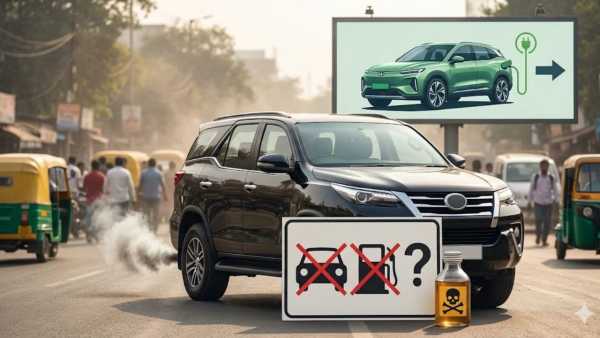
While hatchback and sedan buyers in India may have moved away from diesel, it still remains the fuel of choice for torque-loving sports utility vehicle (SUV) enthusiasts, off-roaders and long-distance travelers. Thanks to this loyal customer base, the market share of diesel passenger vehicles (PVs) has remained largely stable at around 18 per cent for the last three years. However, it has declined from its peak level of 47 per cent in 2012–13, as diesel gradually moved out of urban commuter cars due to tighter pollution standards and the industry's shift towards petrol, CNG and electrification.
However, according to industry experts, now that there is going to be a huge increase in costs due to BS7 emission norms, the next regulatory cycle will decide whether diesel continues to hold the SUV segment or it ultimately loses it. Diesel is no longer competing for entry-level urban buyers. Instead, it is becoming centric to larger vehicles, where customers still prioritize pulling power, highway mileage and driving range over changes in fuel type.
However, investing in small diesel vehicles is no longer economically beneficial for most vehicle makers, hence the dominance of those makers who have continued investing in this fuel is increasing in the market. Mahindra & Mahindra has benefited from this, whose diesel-powered SUVs like Scorpio, Thar and Bolero are seeing tremendous demand.
M&M portfolio remains diversified
Mahindra & Mahindra Company is also now strengthening its position in different technologies instead of betting on a single fuel, amid increasing concentration and regulatory risks. Nalinikant Golagunta, chief executive of Mahindra's automotive division, said in an ET report that our SUV portfolio is based on a variety of powertrain options that reflect the wide diversity in customer needs based on usage patterns, terrain and real-world usage. He further said that while we are committed to accelerating our EV journey, ICE vehicles (which run on fossil fuels) remain relevant for many customers, and we will continue to innovate across all powertrains.
mercedes benz india sale
In the luxury vehicle market, where buyers focus on performance and cost of ownership, demand for diesel-powered models remains strong – makers say – even as they diversify into electric powertrains. Santosh Iyer, MD and CEO of Mercedes-Benz India, said in an ET report that in the last quarter, we saw a huge shift towards diesel, more than 50 per cent of our sales were from diesel models, the main reason for which was the total cost of ownership (total cost of owning the vehicle). Iyer said that customers will decide on the basis of cost of keeping the car, purchase price, running cost and residual value (remaining value of the vehicle). He also added that the company sees equal opportunities for plug-in hybrids, hybrids and EVs.
Performance not fuel cost
This trend shows that the importance of diesel in India has now shifted from economy to better performance. Jato Dynamics President Ravi Bhatia said in the media report that this is not a customer who is choosing diesel after looking at the budget so that he can save money on fuel. He said that this is the customer who is buying a luxury SUV worth Rs 1 crore, and still prefers diesel because it has huge torque, is easy to drive and is more practical for long distance journeys.
How much will the price increase due to regulatory risk?
It is expected that due to BS7 emission norms, the compliance cost for diesel vehicles will increase significantly, which may change the entire economic equation of this segment. Bhatia said in the media report that due to increase in compliance cost, prices of diesel vehicles may increase rapidly. In such a situation, both car manufacturers and customers will have to decide whether the current strong hold of diesel will be able to withstand the next regulatory wave or not.
According to industry estimates, the BS7-related price increase could range from Rs 30,000 to more than Rs 1 lakh per vehicle. For buyers in the Rs 10-20 lakh SUV category—which has traditionally been diesel's biggest market—this could prove to be a turning point. Bhatia said that the question is whether the die-hard diesel customers who are price sensitive will still choose diesel despite this increase in prices? Or will they go for CNG, hybrid or a base-spec EV?


-
Chanakya Niti: If you want to become rich, then mere goodness will not suffice, know the 5 secret ways to become rich.

-
What Happens When You Drink Sabja Seeds Water Every Day For A Month

-
Do you also drink tea on an empty stomach in the morning? Change this habit today itself, otherwise kidney failure may occur.

-
Summer Fitness Tips: ‘Super plan’ of fitness in summer, keep yourself fit and cool with this high-protein diet

-
Lasoda Fal Ke Fayde: This wild fruit, available only for 60 days, is a treasure of health, keeps you young for 100 years, gives strength to fight cancer.