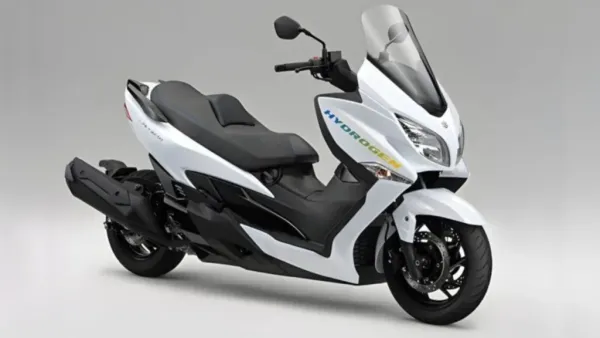
Based on the chassis of an older Suzuki Burgman 400this concept focuses on a “swappable” tank system that could potentially solve the long charging times of electric scooters. We’ve analyzed the unique canister mechanism and the cross-brand collaboration behind this project to bring you the ultimate breakdown.
Swappable Hydrogen
Toyota’s solution to the lack of hydrogen infrastructure is a removable hydrogen tank. Instead of waiting at a specialized high-pressure station, you would simply swap a pre-filled, pressurized canister at a kiosk—identical to how battery swapping works for companies like Gogoro or Honda’s Mobile Power Pack.
-
Placement: The canister sits in a cradle near the floorboard area.
-
The Mechanism: Toyota patented two distinct removal methods:
-
Hinged Mechanism: The cylinder holder swings out to one side for easy access.
-
Scissor Linkage: A retractable arm system that pushes the tank outward from the body of the scooter.
-
-
Purity: Using pre-filled cylinders ensures the hydrogen remains uncontaminated, which is vital for the sensitive membranes in a fuel cell system.
Fuel Cell vs. Combustion
There is a major technical divide in hydrogen two-wheelers. While Suzuki has been testing a Hydrogen ICE (which burns hydrogen in a modified engine), Toyota’s patent is for a Hydrogen Fuel Cell (FC).
-
The Difference: A fuel cell doesn’t “burn” fuel; it uses a chemical reaction to generate electricity, which then powers an electric motor.
-
Emissions: The only by product is pure waterwhich is exhausted through a dedicated vent.
-
Efficiency: Fuel cells are generally more efficient than combustion engines, though they are currently more expensive to manufacture.
The Global Hydrogen Alliance
This project is not a solo effort. Toyota and Suzuki are core members of HySE (Hydrogen Small mobility & Engine technology)alongside Honda, Yamaha, and Kawasaki. This alliance aims to standardize hydrogen tanks and engines for motorcycles, drones, and small boats.
-
Historical Roots: The scooter in the patent is based on a prototype first seen in 2011, which Suzuki even donated to the London Metropolitan Police for real-world trials in 2017.
-
Indian Context: Bajaj Auto (via its Chetak Technology Ltd subsidiary) has also confirmed in early 2026 that it is exploring hydrogen fuel for its future two- and three-wheeler portfolio to hedge against lithium supply chain issues.
Pros & Cons Summary
-
Status: A patent filing. While the technology is proven (from the London police trials), the commercial viability depends entirely on the creation of a “Hydrogen Swapping Network.”
-
Timeline: Don’t expect this in showrooms before 2028–2029. However, the fact that Toyota is refining the practicality of tank removal suggests they are looking at a mass-market execution, not just a lab experiment.
Technical Specifications
-
Kishan, Cummins shine to take SRH into play-offs with five-wicket win over CSK

-
Nationwide update over plan for all branches in the UK

-
UAE pharma sector poised for strong growth as localisation, AI reshape industry dynamics

-
'Masterpiece' series with star-studded cast dropping on ITVX in just days

-
Digital detox: Does it really work or is it just another wellness trend?