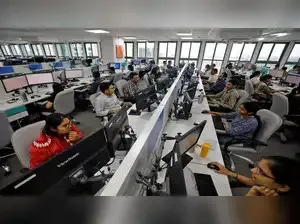
India’s commercial office market is increasingly being shaped by large occupiers as companies prioritise scale, consolidation and long-term campus-style workplaces. The trend highlights a growing preference among corporates for scale and consolation even as demand for smaller workspaces expands at a slower pace.
Large office transactions touched 19.5 million sq ft across the country’s eight major property markets during the first quarter of this year, contributing 65% of overall office leasing during the period. The segment recorded a 3% year-on-year rise from an already elevated base in the corresponding period last year, showed data from Knight Frank India.
In contrast, leasing of smaller offices below 50,000 sq ft grew at 4% year-on-year to 5.2 million sq ft, underscoring the widening preference gap between large occupiers and smaller tenants.
“India’s office market continues to witness strong demand from large occupiers…while Bengaluru remains the dominant market for large office transactions, cities such as Hyderabad and Mumbai are witnessing accelerated growth driven by expanding corporate occupier activity and demand for high-quality office infrastructure,” said Viral Desai, International Partner, Senior ED, Occupier Strategy & Solutions Industrial & Logistics, Capital Markets and Retail Agency, Knight Frank India.
The trend points to continued expansion by global capability centres (GCCs), technology firms, financial services companies and multinational corporations that are increasingly opting for larger, consolidated campuses instead of fragmented office footprints across multiple locations.
“We are clearly seeing occupiers move towards larger, integrated office environments that can support long-term expansion, operational efficiency and employee experience under one roof. Demand is increasingly being driven by GCCs, technology and multinational firms that prefer high-quality campuses with scalability, sustainability features and strong connectivity, rather than fragmented office locations,” said Juggy Marwah, CEO, Prestige Office Ventures.
According to Desai, the sustained momentum in large office leasing reflects occupier confidence in India’s long-term growth story and its position as a global business hub.
Bengaluru retained its position as the country’s largest market for large office deals, recording 7 million sq ft of leasing in transactions above 100,000 sq ft during the quarter. Such deals accounted for 77% of the city’s total office leasing volumes of 9.2 million sq ft.
Marwah is of the view that development of holistic infrastructure including urban mobility and mass rapid transit is the key to the rising commercial property demand.
Hyderabad emerged as the fastest-growing large office market among the leading cities, with leasing in the category rising 69% year-on-year to 4.4 million sq ft from 2.6 million sq ft a year earlier. Mumbai followed with 2.9 million sq ft of large office transactions, registering an 81% annual increase.
The mid-sized office segment, comprising spaces between 50,000 sq ft and 100,000 sq ft, also witnessed strong momentum. Leasing in this category rose 27% year-on-year to 5.2 million sq ft, accounting for 17% of total office transactions during the quarter.
Bengaluru led the mid-sized segment as well with 1.5 million sq ft of leasing activity, followed by Hyderabad and Mumbai at 1 million sq ft each.
Meanwhile, smaller office leasing remained concentrated in Mumbai, which recorded 1.6 million sq ft of transactions in spaces below 50,000 sq ft. NCR followed with 0.9 million sq ft, while Bengaluru and Pune saw 0.7 million sq ft each. The data indicates that India’s office demand is increasingly becoming a large-format play, even as hybrid work models continue to evolve across sectors.
Large office transactions touched 19.5 million sq ft across the country’s eight major property markets during the first quarter of this year, contributing 65% of overall office leasing during the period. The segment recorded a 3% year-on-year rise from an already elevated base in the corresponding period last year, showed data from Knight Frank India.
In contrast, leasing of smaller offices below 50,000 sq ft grew at 4% year-on-year to 5.2 million sq ft, underscoring the widening preference gap between large occupiers and smaller tenants.
“India’s office market continues to witness strong demand from large occupiers…while Bengaluru remains the dominant market for large office transactions, cities such as Hyderabad and Mumbai are witnessing accelerated growth driven by expanding corporate occupier activity and demand for high-quality office infrastructure,” said Viral Desai, International Partner, Senior ED, Occupier Strategy & Solutions Industrial & Logistics, Capital Markets and Retail Agency, Knight Frank India.
The trend points to continued expansion by global capability centres (GCCs), technology firms, financial services companies and multinational corporations that are increasingly opting for larger, consolidated campuses instead of fragmented office footprints across multiple locations.
“We are clearly seeing occupiers move towards larger, integrated office environments that can support long-term expansion, operational efficiency and employee experience under one roof. Demand is increasingly being driven by GCCs, technology and multinational firms that prefer high-quality campuses with scalability, sustainability features and strong connectivity, rather than fragmented office locations,” said Juggy Marwah, CEO, Prestige Office Ventures.
According to Desai, the sustained momentum in large office leasing reflects occupier confidence in India’s long-term growth story and its position as a global business hub.
Bengaluru retained its position as the country’s largest market for large office deals, recording 7 million sq ft of leasing in transactions above 100,000 sq ft during the quarter. Such deals accounted for 77% of the city’s total office leasing volumes of 9.2 million sq ft.
Marwah is of the view that development of holistic infrastructure including urban mobility and mass rapid transit is the key to the rising commercial property demand.
Hyderabad emerged as the fastest-growing large office market among the leading cities, with leasing in the category rising 69% year-on-year to 4.4 million sq ft from 2.6 million sq ft a year earlier. Mumbai followed with 2.9 million sq ft of large office transactions, registering an 81% annual increase.
The mid-sized office segment, comprising spaces between 50,000 sq ft and 100,000 sq ft, also witnessed strong momentum. Leasing in this category rose 27% year-on-year to 5.2 million sq ft, accounting for 17% of total office transactions during the quarter.
Bengaluru led the mid-sized segment as well with 1.5 million sq ft of leasing activity, followed by Hyderabad and Mumbai at 1 million sq ft each.
Meanwhile, smaller office leasing remained concentrated in Mumbai, which recorded 1.6 million sq ft of transactions in spaces below 50,000 sq ft. NCR followed with 0.9 million sq ft, while Bengaluru and Pune saw 0.7 million sq ft each. The data indicates that India’s office demand is increasingly becoming a large-format play, even as hybrid work models continue to evolve across sectors.