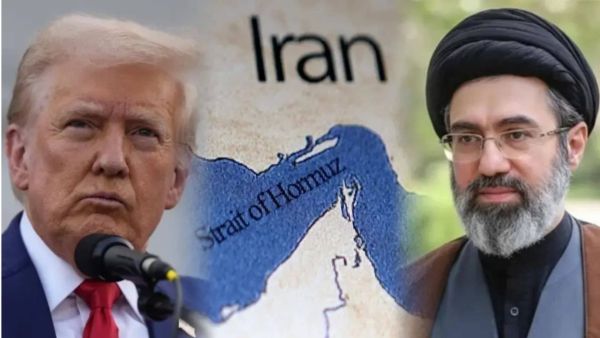
Tehran: Iran formally delivered its response to the latest American proposal to end the war in the Persian Gulf, but the overture was dismissed by US President Donald Trump as “TOTALLY UNACCEPTABLE!”. The rejection, posted on social media on Sunday, served as another setback in efforts to defuse a standoff that has already choked commercial shipping through the Strait of Hormuz and driven energy prices sharply higher across the globe.
According to Iranian state television, Tehran views Washington’s offer as equivalent to surrender. Instead, the Iranian officials demanded war reparations from the United States, full control over the Strait of Hormuz, the lifting of all sanctions and the return of seized assets. The US plan had sought a deal to halt hostilities, reopen the waterway and curb Iran’s nuclear programme, but Trump offered no specifics on why he found the Iranian reply unacceptable.
In a separate online post, he accused Tehran of “playing games” with Washington for nearly half a century and warned, “They will be laughing no longer!”
Despite escalating tensions over the Strait of Hormuz, the US officials insisted that diplomacy is still being pursued. Washington’s ambassador to the United Nations (UN), Mike Waltz, stated that the administration was giving talks “every chance we possibly can before going back to hostilities". Meanwhile, Iran’s new supreme leader, Mojtaba Khamenei, has remained out of public view since the conflict began. State media reported that he met the head of the joint military command and issued “new and decisive directives for the continuation of operations and the powerful confrontation with the enemies,” though no further detail was provided.
US And Iran Exchange Blows At Sea
Meanwhile, the US-Iran fragile ceasefire came under fresh strain over the weekend after a drone strike caused a small fire on a vessel off Qatar. The United Arab Emirates (UAE) and Kuwait both reported unidentified drones entering their airspace, with the UAE saying that it had shot down 2 and blaming Iran. No casualties were reported and no group has claimed responsibility.
The Qatar Foreign Ministry termed the attack on the ship as a “dangerous and unacceptable escalation that threatens the security and safety of maritime trade routes and vital supplies in the region". The UK Maritime Trade Operations Center stated that it was monitoring the incident but gave no information on the vessel’s ownership. Kuwait’s Defence Ministry spokesperson, Brig. Gen. Saud Abdulaziz Al Otaibi, confirmed that forces had responded to drone activity without specifying the source.
Purportedly, Iran and its allied groups, including Lebanon’s Hezbollah, have carried out hundreds of drone strikes since hostilities began on February 28 following US and Israeli attacks. In response, the US military has maintained a blockade of Iranian ports since April 13, claiming to have redirected 61 commercial vessels and disabled 4. On Friday, US forces struck 2 Iranian oil tankers, which were allegedly attempting to breach the blockade. Iran’s Revolutionary Guard Navy has warned that any attack on its tankers or merchant ships would trigger a “heavy assault” on US bases and enemy vessels in the region.
Nuclear Tensions And The Uranium Question
The analysts suggested that despite all the efforts, the central obstacle in negotiations remains Iran’s stockpile of highly enriched uranium. The UN’s nuclear watchdog estimated that Iran holds more than 440 kg enriched to 60% purity, a level only a short technical step from weapons-grade. An Iranian military spokesperson, Brig. Gen. Akrami Nia informed IRNA that forces were on “full readiness” to defend sites where uranium is stored, warning that infiltration or heli-borne operations could not be ruled out.
On the other hand, Israeli Prime Minister Benjamin Netanyahu stated that the conflict was not over until the material was removed from Iran. “Trump has said to me, ‘I want to go in there,’ and I think it can be done physically,” he said in an excerpt released on Sunday. In the meantime, Russian President Vladimir Putin said that Moscow’s offer to take Iran’s enriched uranium as part of a negotiated settlement remained on the table.
The bulk of Iran’s highly enriched uranium is believed to be at the Isfahan nuclear complex, which was struck by US and Israeli airstrikes during a 12-day war last year and again in lighter attacks this year. The International Atomic Energy Agency’s director-general asserted last month that Isfahan remained the likely storage site.
Western Naval Presence Draws Iranian Warning
Amidst efforts by Western countries to reopen the waterway, Iran has also signalled it will not tolerate expanded Western naval operations in the Strait of Hormuz. Deputy Foreign Minister Kazem Gharibabadi warned that the presence of French and British vessels, or any others cooperating with what he called “illegal US actions", would be met with a “decisive and immediate response from the armed forces".
French President Emmanuel Macron responded that the planned mission was not a military deployment but an international effort to protect shipping once conditions allowed. Multiple attacks on vessels in the Persian Gulf have occurred in the past week, prompting a US initiative to “guide” ships through the strait that was immediately suspended. South Korea announced preliminary findings that 2 unidentified objects struck the South Korean-operated HMM NAMU while it was anchored in the strait, causing an explosion and fire. However, the investigating agencies are yet to ascertain the cause of the explosion and fire.
Diplomacy On Knife Edge
The analysts stressed that the path to de-escalation looks increasingly narrow with both sides hardening their positions. Iran’s 14-point counter-proposal, submitted via Pakistani mediators, outlined a 3-stage roadmap beginning with a 30-day phase to turn the current ceasefire into a permanent truce. Tehran is also seeking sanctions relief, the reopening of its ports, the withdrawal of US troops from the region and a halt to Israeli operations in Lebanon.
On the other hand, Washington’s proposal focuses on ending the war, restoring free navigation and rolling back Iran’s nuclear activities. Trump has repeatedly threatened to resume full-scale bombing if Iran refuses to accept terms that would reopen the strait and dismantle its nuclear programme. Amidst the ongoing tussle between the US and Iran over the truce proposal, the waterway remains largely closed, disrupting the global flow of oil, gas and fertiliser and keeping markets on edge.
-
Sharjah court order valid in India, Telangana High Court rules in fraud case

-
Jaishankar to inaugurate UN exhibition on India’s mathematical contributions
-
Saudi: Aramco sees 25 pc more profit after shifting exports from Hormuz

-
PSEB 10th Result 2026: Punjab Board Matric Results Today At 12:30 PM, Direct Link Here

-
Former Thai Prime Minister Thaksin let out of prison early