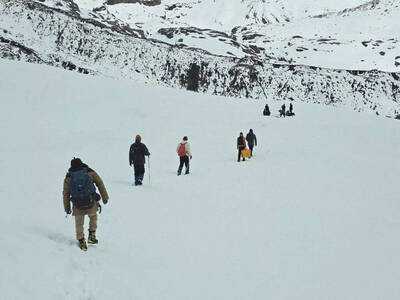
Scientists during the 5th Khangri Glacier Expedition in the transboundary Mago Chu Basin of Tawang district. (Photo:@TannaTage/X)
Itanagar, May 11: Recent studies on the Khangri glacier in Arunachal Pradesh's Tawang district have revealed alarming rates of melting, the formation of unstable terrain, and the emergence of a potentially hazardous glacial lake that could threaten downstream areas in the Mago Chu basin.
The discoveries were made during the fifth Khangri glacier expedition, which was organized by the Centre for Earth Sciences and Himalayan Studies (CESHS) in partnership with the National Centre for Polar and Ocean Research and the North Eastern Regional Institute of Science and Technology, as reported on Monday.
This scientific expedition commenced on May 4 in the Mago Chu basin, a crucial headwaters area of the Brahmaputra Basin system, aimed at assessing glacier health, monitoring the cryosphere, and studying climate hazards in the eastern Himalayas.
(Photo:@TannaTage/X)
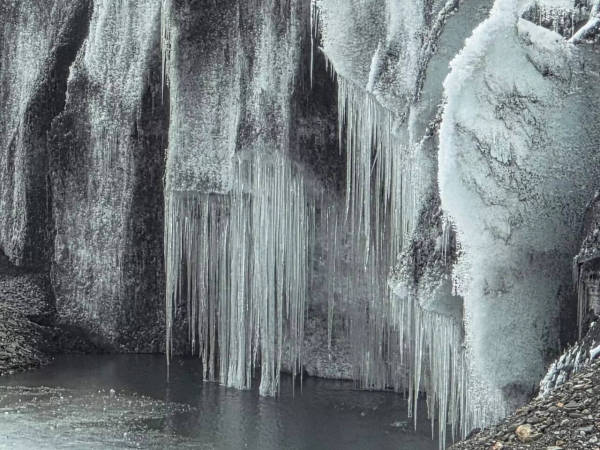
According to CESHS director Tage Tana, the expedition team noted "significant geomorphological changes in the Khangri glacier" during their field studies, highlighting the increasing effects of climate variability in this high-altitude Himalayan region.
One of the critical findings was the emergence of a large glacier sinking zone where the glacier's front is rapidly collapsing, leading to unstable terrain conditions.
Researchers cautioned that such instability could heighten landscape hazards and increase vulnerability for communities downstream in the Mago Chu basin.
The team also discovered a newly formed proglacial lake situated at approximately 16,500 feet in elevation.
Scientists indicated that this lake has the potential to cause a glacial lake outburst flood (GLOF), which could adversely affect downstream communities and river systems, including those in transboundary areas.
Despite experiencing relatively good snowfall this winter, researchers observed that glacier melting persists at a concerning rate due to rising temperatures and ongoing climate variability in the eastern Himalayas, Tana noted.
To enhance long-term glacier monitoring, the team installed five new scientific monitoring stakes at nearly 17,000 feet using an ice-core drilling system combined with Differential Global Positioning System (DGPS) technology.
These installations are intended to facilitate the monitoring of glacier mass balance and surface movement in the years ahead.
The expedition team also collected vital data from the existing automatic weather station (AWS) and automatic water level recorder, along with performing maintenance and calibration of these systems to ensure continuous environmental monitoring in this high-altitude region.
PTI
-
Fitkari: Remove facial freckles with alum, the method of use should be correct, know here

-
Chanakya’s policies and strategies to become rich

-
Bumble removes swiping and women messaging first features

-
True colors: The legacy, luminosity and lore behind four gorgeous gemstones

-
NMDC has announced recruitment for 180 posts, selection will be done without examination, know the eligibility here.