New Delhi: Industry leaders don't see any signs of panic in Prime Minister Narendra Modi's remarks about cutting back on expenditures that could be reduced, such as fuel, foreign travel and gold. On the contrary, they pointed to his reflections as a message for the country to be more self-reliant and move towards moderating types of consumption that could raise India's import bill and have an impact on currency reserves and exchange rates.
"Generally, things are looking very, very good, but there are situations that develop which are beyond anybody's control," Bharti Enterprises chairman Sunil Bharti Mittal said. The West Asia crisis is "creating a tremendous pressure on global economies, and India is no different in that aspect", he said.
Addressing a gathering at CII's annual business summit in New Delhi on Monday, he stressed on the need to "double down" on investments locally.
"I fully support the fact that the PM has spoken out on what was required," said Naresh Trehan, chairman of the Medanta group of medical institutions. "With hope of lasting peace gone for the US and Iran, costs are going to go up. Unless the public is rallied, it will become a problem," he said.
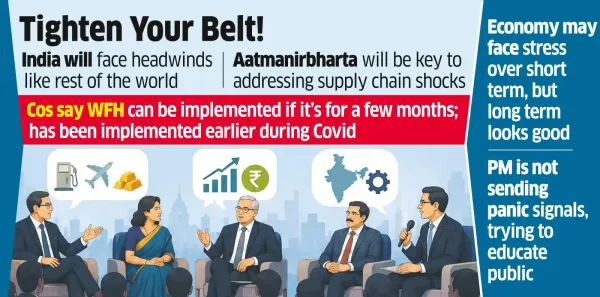
Modi's appeal on Sunday came as global energy costs surged due to the West Asia crisis, driving up the country's import bill.
Mittal urged against spending on gold, one of India's biggest import items in terms of value, and called upon industry to spend domestically.
"We need to get away from this obsession of import of gold. We need to lower our energy costs, move faster towards renewable energy.... And importantly, we need to vote with our feet within our country. Spend more here, put more capex here," he said.
Other industry leaders who spoke at the CII event also termed this as an opportunity to focus domestically. "This is a way of ensuring India becomes atmanirbhar," said Shashwat Goenka, vice-chairman of the RP-Sanjiv Goenka Group. "It is a call for being self-reliant. Geopolitical tensions will continue to exist. Between that we need to ensure we meet our GDP targets of 7-8% or more." Goenka said he didn't think there was any cause for panic.
Rajiv Memani, EY India chief executive officer, said the PM's message should be taken seriously. "I don't view it as a crisis. I view this as a sensible and pragmatic ask to the country to ensure we are mindful of the current geopolitical challenges," he said.
"One way is to moderate consumption and the PM's request is to say that if we can moderate consumption, especially in areas where we are importing, we should take necessary measures," said Memani.
"It would hurt business a little bit, but it is good for the country. "We will all collaborate (with the PM's directions)," said Vir S Advani, chairman and managing director at AC maker Blue Star.
"Generally, things are looking very, very good, but there are situations that develop which are beyond anybody's control," Bharti Enterprises chairman Sunil Bharti Mittal said. The West Asia crisis is "creating a tremendous pressure on global economies, and India is no different in that aspect", he said.
Addressing a gathering at CII's annual business summit in New Delhi on Monday, he stressed on the need to "double down" on investments locally.
"I fully support the fact that the PM has spoken out on what was required," said Naresh Trehan, chairman of the Medanta group of medical institutions. "With hope of lasting peace gone for the US and Iran, costs are going to go up. Unless the public is rallied, it will become a problem," he said.
Leaders call for increasing capex, reducing imports, strengthening local supply chains
Modi's appeal on Sunday came as global energy costs surged due to the West Asia crisis, driving up the country's import bill.
Mittal urged against spending on gold, one of India's biggest import items in terms of value, and called upon industry to spend domestically.
"We need to get away from this obsession of import of gold. We need to lower our energy costs, move faster towards renewable energy.... And importantly, we need to vote with our feet within our country. Spend more here, put more capex here," he said.
Other industry leaders who spoke at the CII event also termed this as an opportunity to focus domestically. "This is a way of ensuring India becomes atmanirbhar," said Shashwat Goenka, vice-chairman of the RP-Sanjiv Goenka Group. "It is a call for being self-reliant. Geopolitical tensions will continue to exist. Between that we need to ensure we meet our GDP targets of 7-8% or more." Goenka said he didn't think there was any cause for panic.
Rajiv Memani, EY India chief executive officer, said the PM's message should be taken seriously. "I don't view it as a crisis. I view this as a sensible and pragmatic ask to the country to ensure we are mindful of the current geopolitical challenges," he said.
"One way is to moderate consumption and the PM's request is to say that if we can moderate consumption, especially in areas where we are importing, we should take necessary measures," said Memani.
"It would hurt business a little bit, but it is good for the country. "We will all collaborate (with the PM's directions)," said Vir S Advani, chairman and managing director at AC maker Blue Star.
( Originally published on May 11, 2026 )