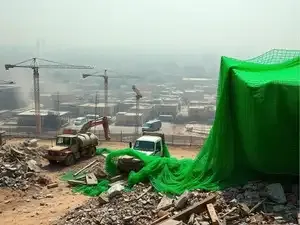
In a fresh move to tackle Delhi’s worsening dust pollution problem, the Delhi Pollution Control Committee (DPCC) has now fixed a minimum quality standard for the green nets used at construction and demolition (C&D) sites across the city.
From now on, all construction sites in Delhi must use green nets with a minimum thickness of 100 grams per square metre (100 GSM).
The order comes after a recent assessment by the DPCC reportedly found that several low-quality green nets being used at sites were too thin, allowing dust particles to easily pass through them.
Delhi environment minister Manjinder Singh Sirsa said the new rule is meant to ensure that dust barriers are not just “symbolic” but actually effective in controlling pollution at the source.
As per TOI, according to a 2018 joint study by The Energy and Resources Institute (TERI) and the Automotive Research Association of India (ARAI), dust from roads, soil and construction activities contributes significantly to Delhi’s air pollution levels.
The study found that:
That loophole meant many sites could technically follow the rule while still using low-quality nets that barely blocked dust.
The latest DPCC order aims to close that gap.
The directive has been issued to several major agencies and departments, including:
Sunil Dahiya, founder of think tank Envirocatalyst, told TOI that the move was a positive example of policy being based on scientific assessment and real-world data.
However, he also noted that many sites fail to install green nets correctly, reducing their effectiveness even further.
Meanwhile, the Delhi government is also working on Dust Portal 2.0 — a centralised platform aimed at monitoring construction and demolition sites across the city more closely.
Officials said registration of construction sites on the dust portal has already been made mandatory as part of Delhi’s broader anti-pollution efforts.
(With TOI inputs)
From now on, all construction sites in Delhi must use green nets with a minimum thickness of 100 grams per square metre (100 GSM).
The order comes after a recent assessment by the DPCC reportedly found that several low-quality green nets being used at sites were too thin, allowing dust particles to easily pass through them.
Delhi environment minister Manjinder Singh Sirsa said the new rule is meant to ensure that dust barriers are not just “symbolic” but actually effective in controlling pollution at the source.
Why this matters in Delhi
Dust remains one of Delhi’s biggest pollution problems, especially during summer and winter months.As per TOI, according to a 2018 joint study by The Energy and Resources Institute (TERI) and the Automotive Research Association of India (ARAI), dust from roads, soil and construction activities contributes significantly to Delhi’s air pollution levels.
The study found that:
- During winter, dust contributed around 25% of PM10 pollution and 17% of PM2.5 pollution
- In summer, the numbers rose sharply to 42% in PM10 and 38% in PM2.5
What changes now
The installation of green nets is already part of Delhi’s mandatory 14-point anti-dust guidelines for construction sites. But until now, there was no minimum technical specification for the material itself.That loophole meant many sites could technically follow the rule while still using low-quality nets that barely blocked dust.
The latest DPCC order aims to close that gap.
The directive has been issued to several major agencies and departments, including:
- MCD
- NDMC
- DDA
- DMRC
- CPWD
- PWD
Experts say enforcement matters more now
Environmental experts have welcomed the decision but also pointed out that proper installation matters just as much as the quality of the net.Sunil Dahiya, founder of think tank Envirocatalyst, told TOI that the move was a positive example of policy being based on scientific assessment and real-world data.
However, he also noted that many sites fail to install green nets correctly, reducing their effectiveness even further.
Meanwhile, the Delhi government is also working on Dust Portal 2.0 — a centralised platform aimed at monitoring construction and demolition sites across the city more closely.
Officials said registration of construction sites on the dust portal has already been made mandatory as part of Delhi’s broader anti-pollution efforts.
(With TOI inputs)