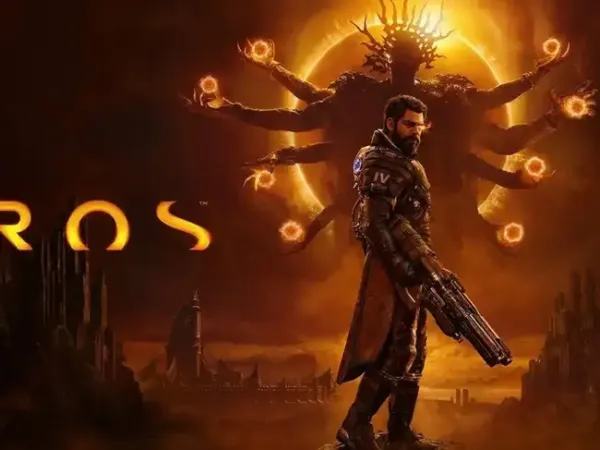
It is rare to see an RPG shooter receive this level of aggressive backing from both a studio and a platform. Housemarque and Sony Interactive Entertainment clearly want Saros to stand as one of the defining PlayStation exclusives in the current generation, and the ambition shows almost immediately.
If you grew up playing titles like Gears of War, Saros feels like a modern reckoning of that formula, only far more chaotic, punishing and psychologically unsettling. It combines third-person shooting with roguelite survival mechanics, throws players into a hostile sci-fi world and constantly forces them to adapt under pressure.
Set on the ominous planet Carcosa, the game thrives on repetition, experimentation and failure. Every run feels unpredictable, every enemy encounter escalates rapidly, and death itself becomes part of progression. At the centre of it all is Arjun Devraj, played by Rahul Kohli, whose performance helps ground an otherwise deeply mysterious and often surreal narrative.
While the storytelling occasionally struggles to fully pay off the intrigue it builds, Saros succeeds where it matters most: making players want to jump back in after every brutal defeat.
Plot
Players step into the role of Arjun Devraj, an expeditioner working for a powerful space corporation called Soltari. Devraj arrives on the mysterious planet Carcosa to investigate why previous expeditions have disappeared without explanation. From the very beginning, Saros establishes a deeply uneasy tone. Something feels wrong on Carcosa long before the action properly begins. The opening run serves as both a tutorial and an introduction to the game’s central mechanic: death is inevitable.
Each time Devraj dies, he respawns at a strange home base while the planet itself reshapes around him. The world constantly changes, forcing players to relearn routes and adapt strategies with every run.
The game leans heavily into psychological ambiguity. Are these loops real? Is Devraj trapped in some form of nightmare or time distortion? Why do strange visions appear between deaths? Saros repeatedly raises intriguing questions, but unlike Returnal, it does not always provide satisfying answers.
That becomes one of the game’s biggest weaknesses. The world-building and exposition create expectations for deeper revelations, yet much of the mystery remains unresolved. While ambiguity can strengthen sci-fi storytelling, Saros occasionally overextends itself, leaving players with more confusion than payoff.
Still, the eerie atmosphere, morally grey characters and the looming presence of Soltari’s AI-driven systems help maintain tension throughout the experience.
Failure is not treated as punishment here. Instead, every death becomes part of the progression system. Players lose portions of their collected resources, retain certain upgrades and head back into the cycle with a better understanding of enemy behaviour, level layouts and combat timing.
The gameplay loop itself is deceptively simple: push deeper into the world, gather resources, survive increasingly hostile encounters, defeat bosses and repeat the process after every collapse.
What helps Saros stand apart is its restraint. Rather than flooding players with endless loot tiers, crafting menus and complicated inventory systems, the game keeps upgrades streamlined. There are enough permanent and temporary enhancements to make progression meaningful without distracting from the actual combat experience. And combat is relentless.
Enemy encounters quickly escalate into visually overwhelming firefights filled with different projectile types and attack patterns. Each colour-coded attack demands a different reaction from the player. Blue attacks can be absorbed to build energy, red attacks require quick parries or complete avoidance, while yellow attacks introduce risk-reward mechanics that can either damage health capacity or temporarily strengthen weapons.
Initially, the sheer volume of incoming attacks can feel chaotic. But the game gradually trains players to read movement patterns, anticipate enemy behaviour and improve spatial awareness. Over time, what once felt impossible starts becoming manageable through repetition and timing.
Boss encounters are especially satisfying because they rely heavily on execution rather than luck. Success comes from recognising patterns, reacting quickly and staying composed under pressure.
The experience also heavily benefits from the responsiveness of the DualSense Wireless Controller. Dodging, movement precision and reaction timing become increasingly important as enemy density ramps up during later runs.
Saros is intentionally unforgiving. It does not constantly hand out rewards or cinematic moments to keep players comfortable. Instead, the game thrives on tension, pressure and repetition. For some players, that structure may eventually feel exhausting or repetitive, especially if they prefer story-driven experiences with less grinding.
But that repetition is also what defines the game. Saros is less interested in telling a perfectly structured cinematic story and more focused on creating a gameplay rhythm players slowly learn to control.
Eventually, the chaos stops feeling random.
The game shifts from being about surviving Carcosa to fully understanding how to dominate it.
Its storytelling does not always land, and the constant mystery can become exhausting. Yet the gameplay remains deeply rewarding for players willing to embrace repetition, failure and gradual mastery. At its best, Saros delivers a tense sci-fi roguelite experience that feels punishing, chaotic and incredibly satisfying all at once.
If you grew up playing titles like Gears of War, Saros feels like a modern reckoning of that formula, only far more chaotic, punishing and psychologically unsettling. It combines third-person shooting with roguelite survival mechanics, throws players into a hostile sci-fi world and constantly forces them to adapt under pressure.
Set on the ominous planet Carcosa, the game thrives on repetition, experimentation and failure. Every run feels unpredictable, every enemy encounter escalates rapidly, and death itself becomes part of progression. At the centre of it all is Arjun Devraj, played by Rahul Kohli, whose performance helps ground an otherwise deeply mysterious and often surreal narrative.
While the storytelling occasionally struggles to fully pay off the intrigue it builds, Saros succeeds where it matters most: making players want to jump back in after every brutal defeat.
Price
Saros is priced at ₹5,199 in India. The game is available digitally through the PlayStation Store and can also be purchased offline as a physical disc edition for PlayStation 5.Plot
Players step into the role of Arjun Devraj, an expeditioner working for a powerful space corporation called Soltari. Devraj arrives on the mysterious planet Carcosa to investigate why previous expeditions have disappeared without explanation. From the very beginning, Saros establishes a deeply uneasy tone. Something feels wrong on Carcosa long before the action properly begins. The opening run serves as both a tutorial and an introduction to the game’s central mechanic: death is inevitable.Each time Devraj dies, he respawns at a strange home base while the planet itself reshapes around him. The world constantly changes, forcing players to relearn routes and adapt strategies with every run.
The game leans heavily into psychological ambiguity. Are these loops real? Is Devraj trapped in some form of nightmare or time distortion? Why do strange visions appear between deaths? Saros repeatedly raises intriguing questions, but unlike Returnal, it does not always provide satisfying answers.
That becomes one of the game’s biggest weaknesses. The world-building and exposition create expectations for deeper revelations, yet much of the mystery remains unresolved. While ambiguity can strengthen sci-fi storytelling, Saros occasionally overextends itself, leaving players with more confusion than payoff.
Still, the eerie atmosphere, morally grey characters and the looming presence of Soltari’s AI-driven systems help maintain tension throughout the experience.
Gameplay
Gameplay is where Saros delivers its strongest punch. Beneath the surface of what first appears to be another sci-fi action shooter lies a deeply demanding roguelite that revolves around persistence, learning curves and mechanical precision.Failure is not treated as punishment here. Instead, every death becomes part of the progression system. Players lose portions of their collected resources, retain certain upgrades and head back into the cycle with a better understanding of enemy behaviour, level layouts and combat timing.
The gameplay loop itself is deceptively simple: push deeper into the world, gather resources, survive increasingly hostile encounters, defeat bosses and repeat the process after every collapse.
What helps Saros stand apart is its restraint. Rather than flooding players with endless loot tiers, crafting menus and complicated inventory systems, the game keeps upgrades streamlined. There are enough permanent and temporary enhancements to make progression meaningful without distracting from the actual combat experience. And combat is relentless.
Enemy encounters quickly escalate into visually overwhelming firefights filled with different projectile types and attack patterns. Each colour-coded attack demands a different reaction from the player. Blue attacks can be absorbed to build energy, red attacks require quick parries or complete avoidance, while yellow attacks introduce risk-reward mechanics that can either damage health capacity or temporarily strengthen weapons.
Initially, the sheer volume of incoming attacks can feel chaotic. But the game gradually trains players to read movement patterns, anticipate enemy behaviour and improve spatial awareness. Over time, what once felt impossible starts becoming manageable through repetition and timing.
Boss encounters are especially satisfying because they rely heavily on execution rather than luck. Success comes from recognising patterns, reacting quickly and staying composed under pressure.
The experience also heavily benefits from the responsiveness of the DualSense Wireless Controller. Dodging, movement precision and reaction timing become increasingly important as enemy density ramps up during later runs.
Saros is intentionally unforgiving. It does not constantly hand out rewards or cinematic moments to keep players comfortable. Instead, the game thrives on tension, pressure and repetition. For some players, that structure may eventually feel exhausting or repetitive, especially if they prefer story-driven experiences with less grinding.
But that repetition is also what defines the game. Saros is less interested in telling a perfectly structured cinematic story and more focused on creating a gameplay rhythm players slowly learn to control.
Eventually, the chaos stops feeling random.
The game shifts from being about surviving Carcosa to fully understanding how to dominate it.
Verdict
Saros is not an easy game to recommend universally, but it is absolutely a game worth experiencing.Its storytelling does not always land, and the constant mystery can become exhausting. Yet the gameplay remains deeply rewarding for players willing to embrace repetition, failure and gradual mastery. At its best, Saros delivers a tense sci-fi roguelite experience that feels punishing, chaotic and incredibly satisfying all at once.