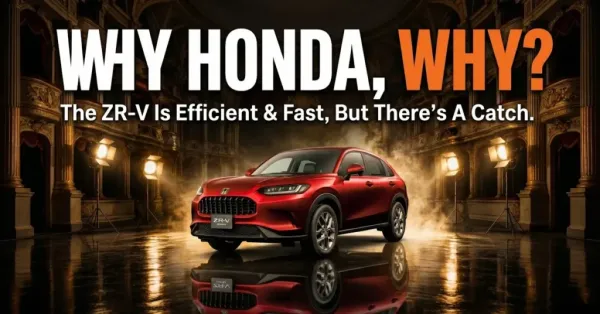
Honda is launching the ZR-V in India market on May 22, 2026, and is expected to be priced somewhere between Rs 40 lakh and Rs 50 lakh ex-showroom. It arrives as a fully imported CBU, which already tells you something about what to expect on the pricing front. But pricing is actually the second problem. The first is design, and it is a real one.
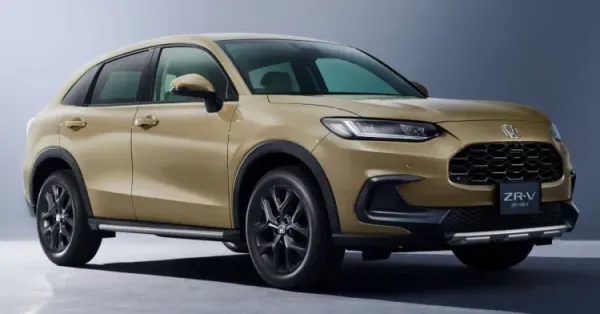
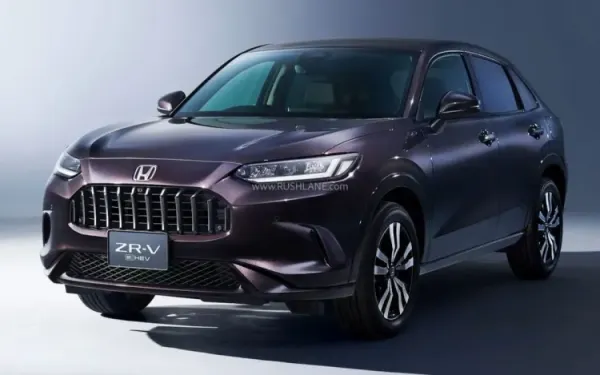
Put the ZR-V on a wall and stare at it for a while. The front: Despite drawing inspiration from Maserati-Mercedes-Benz AMG coupe actually manages to look dull. Then as your eyes move to the side, the cohesion starts to unravels further. The roofline, the haunches, the lower cladding.
It is as if two different designers worked on each end of the car without ever having a conversation. The rear lights, with their wraparound shape, carry a passing resemblance to what Porsche used on the first-generation Cayenne – that was early 2000s if we are not mistaken. In short, you have new car that looks a decade old!
But, it’s a Honda…it can’t be all bad!
Let us get the good stuff out early, because there is genuinely good stuff here. The ZR-V uses Honda’s e:HEV system, a 2.0-litre naturally aspirated petrol engine running on the Atkinson cycle. In normal driving, this engine acts almost entirely as a generator, charging a battery that then powers a separate electric motor to drive the front wheels. Only at higher speeds does the petrol engine connect directly to the wheels through the e-CVT. The result, combined system output of 184 PS and 315 Nm, feels more like an EV than a conventional hybrid in everyday use. The throttle response is crisp, pickup is instantaneous, and the whole experience is impressively refined.
That architecture is genuinely clever. Honda has been running versions of this two-motor hybrid system across its lineup, from the City Hybrid to the Elevate’s e:HEV variant. The ZR-V represents the fuller, more premium expression of that technology. Real-world fuel consumption figures from international markets suggest roughly 22-23 km per litre, which in the context of a near-50-lakh petrol SUV is a compelling number. A full tank range approaching 1,000 km is the figure doing the rounds, and that number alone would silence a lot of objections in any other car.
So far, so good. Now for the but.
Honda has historically been brilliant at extracting usable space from modest dimensions. The Jazz built its entire legend on that skill. The current City does it. The ZR-V, at 4,570 mm in length, does not. Boot space is just 380 litres with seats up, which is a surprisingly modest number.
Compare that to the Honda Civic hatchback, which is a smaller car and yet offers 410 litres. The rear seats, because the hybrid battery pack is mounted under the floor, sit somewhat lower and closer to the floor, which means thigh support in the back is not great.
With the panoramic sunroof fitted, headroom in the rear also takes a hit. The rear window does not go all the way down. The car is also not particularly wide, so three adults in the back feel squeezed.
None of these things alone would be a dealbreaker. Together, in a category where practicality is table stakes, they add up to a noticeable shortcoming.
And this is a big problem. At Rs 45-50 lakh, the ZR-V will go up against the Volkswagen Tayron R-Line, priced at Rs 46.99 lakh, and the Skoda Kodiaq, ranging from Rs 39.99 lakh to Rs 46.49 lakh. Both are aimed at buyers who want something refined, well-equipped, and more discreet than the bulky Fortuner or Legender. That is precisely the buyer the ZR-V is also targeting.
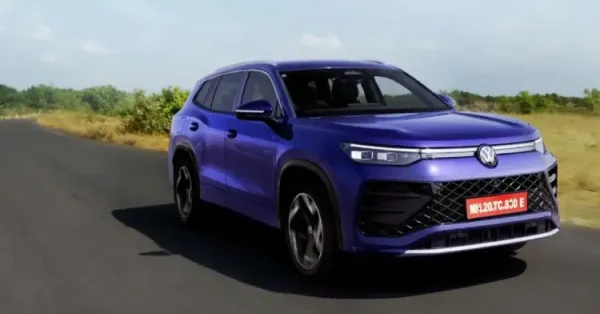
The Tayron R-Line is a seven-seater offering a 2.0-litre TSI making 204 PS, 4MOTION AWD, and a 7-speed DSG. It is assembled via the CKD route, which keeps it competitive. The Kodiaq offers the same 2.0-litre TSI engine with 204 PS, a 7-speed DSG, AWD, and either five or seven seats. The Kodiaq’s boot capacity starts at 281 litres with all rows up, but expands dramatically to 786 litres with the third row folded.
The Kodiaq also gets a 12.9-inch touchscreen, 360-degree camera, nine airbags, five-star Euro NCAP ratings, and panoramic sunroof. The Tayron brings seven seats, the R-Line sporty trim, and solid VW build quality. Both feel like they have been put together with a clear idea of what the customer at this price point expects.
The ZR-V does not offer seven seats. Its space credentials, as discussed, are underwhelming for the price. Its design does not have the clean, cohesive premium look that the Kodiaq or Tayron pull off. It comes as a full import, meaning residuals will be harder to predict, service costs will be higher, and parts availability will be a long-term consideration.
Against all that, you have a genuinely impressive hybrid powertrain, a strong quality feel inside, good safety kit, and Honda reliability. Those are real reasons to consider it. But they are not reasons that hold up at a price point where both rivals give you more space, more seats, a turbocharged motor with sharper performance, and a design that does not look like it had an identity crisis partway through development.
Honda has done harder things than build a great mid-size premium SUV. The ZR-V proves the company can do the engineering. The rest of the package makes you wish someone had pushed harder at the drawing board too.
So dear Honda, why do you keep doing this: The last Civic was a stunner with a dud engine. And now, we have a good powertrain but the rest…why!
-
'Gripping' series with 'twisty mysteries' perfect for crime drama fans is returning

-
Royal gives rare glimpse inside major family celebration with behind the scenes pictures

-
Trump Administration Officials Under Fire for Candid Remarks

-
GB News abruptly halted for bombshell David Lammy announcement

-
Princess Kate health update issued ahead of first overseas trip since cancer diagnosis