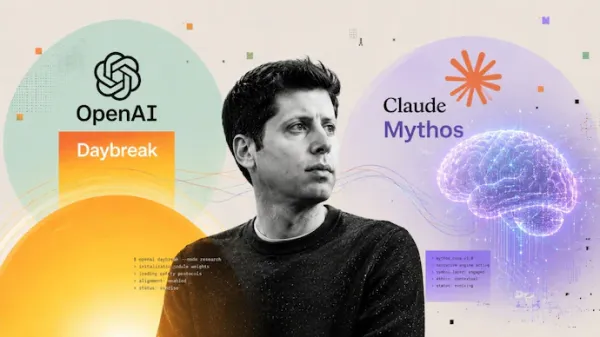
Artificial Intelligence is rapidly transforming industries across the world, but cybersecurity may soon become one of its most important battlegrounds. In a major announcement, Sam Altman revealed a new AI-powered cybersecurity initiative called “Daybreak”, aimed at helping organisations identify and fix software vulnerabilities before hackers can exploit them.
The initiative marks OpenAI’s latest push beyond chatbots and productivity tools, placing the company directly into the fast-growing AI cybersecurity race. Tech experts are already comparing Daybreak to Anthropic’s highly discussed cybersecurity-focused AI system, Claude Mythos.
In a post on X, Altman wrote, “OpenAI is launching Daybreak, our effort to accelerate cyber defence and continuously secure software.”
Credits: The Verge
What Exactly Is Daybreak?
According to OpenAI, Daybreak is designed to help developers and cybersecurity teams detect software risks early and strengthen digital security systems using advanced AI models.
The platform combines OpenAI’s latest GPT-5.5 models with Codex, the company’s coding-focused AI system. Together, these tools are expected to automate and accelerate several critical cybersecurity tasks that traditionally require large human teams and significant time.
OpenAI says the larger goal behind Daybreak is to make software “resilient by design.” Instead of fixing vulnerabilities only after cyberattacks happen, the system focuses on identifying weaknesses during the software development process itself.
That shift could become increasingly important as cyberattacks continue growing in sophistication across governments, enterprises, financial systems, and cloud infrastructure worldwide.
What Can Daybreak Actually Do?
OpenAI has outlined multiple cybersecurity use cases for Daybreak, positioning it as a defensive AI system for organisations and security professionals.
Some of the key functions include:
- Secure code reviews
- Threat modelling
- Malware analysis
- Vulnerability detection
- Patch validation
- Detection engineering
- Identification of risky software dependencies
The company claims the system can significantly reduce the time required to discover and fix vulnerabilities inside complex software systems.
For enterprises managing large-scale infrastructure, that could potentially mean faster security updates, fewer breaches, and lower operational risks.
The platform may also help developers identify coding issues earlier in the development cycle, reducing the chances of security flaws reaching production environments.
Three Versions Of The AI Model Introduced
Interestingly, OpenAI has introduced Daybreak with multiple access layers and security configurations.
The first version is the standard GPT-5.5 model, designed for general-purpose developer tasks and knowledge work with regular safeguards enabled.
The second version, called “GPT-5.5 with Trusted Access for Cyber,” is specifically tailored for verified cybersecurity professionals operating in authorised environments. This model offers expanded cyber capabilities for specialised defensive tasks such as malware analysis, vulnerability triage, and secure code review.
OpenAI says stricter identity verification and additional security controls will be used before granting access to these advanced tools.
This reflects the growing concern within the AI industry about balancing powerful cybersecurity capabilities with misuse prevention.
AI Cybersecurity Race Is Heating Up
The launch of Daybreak also highlights the intensifying competition between major AI companies in the cybersecurity sector.
Recently, reports surrounding Anthropic’s Claude Mythos gained significant attention after claims emerged that the AI system identified hundreds of vulnerabilities across major software systems. However, Anthropic reportedly chose not to release Mythos publicly due to concerns over its powerful cyber capabilities.
Now, OpenAI appears to be entering the same space aggressively, but with a structured access framework focused on defensive use cases.
Industry experts believe AI-powered cybersecurity systems could become essential in the coming years as organisations face increasingly advanced ransomware attacks, software exploits, and state-backed cyber threats.

Credits: Fast Company
Cisco, Intel, SentinelOne Among Expected Partners
Several major technology and cybersecurity firms are expected to collaborate with OpenAI to evaluate Daybreak’s capabilities.
These reportedly include Cisco, Intel, SentinelOneand Sneak.
Such partnerships could help OpenAI test the platform across enterprise environments and real-world cybersecurity operations.
With cyberattacks becoming more sophisticated every year, AI-driven defence systems like Daybreak may soon become a standard part of enterprise software development and digital security strategies worldwide.
-
Rose mother-in-law is irritable! With this unmistakable claim of Vastu, the bitterness will be forgotten and peace will return to the world

-
World Cocktail Day: How Cocktail Bars, Zero-Proof Drinks And Bar Takeovers Are Changing The Way Indians Drink

-
Pocket pull? Be careful before buying cheap second hand AC

-
AI Takes Over? Meta to Lay off 8,000 Employees as Zuckerberg pushes ‘Ultra-Flat’ workforce model

-
GT vs SRH: Gujarat reached top with 16 points, defeated Hyderabad by 82 runs