
 MobiKwik’s Q4 Financial Scorecard
It was a mixed Q4 for MobiKwik. Revenue contraction marred the full FY26 picture, but the company managed to cling on to its profitability in Q4, helped by improving payments margins and a stabilising financial services arm.
Here’s a quick glance at MobiKwik’s Q4 FY26 numbers:
- Profit stood at ₹4.4 Cr against a loss of ₹56 Cr in Q4 FY25
- Operating revenue rose 7.8% YoY to ₹288.7 Cr
- Expenses declined 14% YoY to ₹278.6 Cr
Payments Holds The Core: The payments business remained the company’s backbone, yet saw a clear tradeoff. While the vertical’s revenue saw very little growth YoY in Q4, gross profit and margins improved sharply. What helped were declining payment gateway costs and higher-margin merchant activity that helped offset the drag from the soaring zero-MDR UPI volume.
Will Lending Tweaks Pay Off? MobiKwik continued to take a measured approach to its financial services vertical. While disbursed GMV saw a slight dip in Q4, gross profit for the segment jumped 18X YoY. This was attributed to the company moving away from risky, high-volume lending toward its ZIP EMI model focused on repeat customers and better credit quality.
However, with its recently acquired NBFC license, the company expects to capture more of the lending value chain, potentially expanding margins without chasing high disbursals.
The Road Ahead: The company appears to be re-engineering its revenue mix. Realising that consumer payments offer low margins, MobiKwik is banking on the ₹55 Cr already invested in QR and PoS infrastructure to clock a 10X revenue surge in merchants business by FY28. The reason? The merchant side offers stickier revenue and better margins through hardware and gateway fees.
Nevertheless, as margin-led execution takes centrestage at the fintech major, here is how MobiKwik fared on the financial front in Q4…
From The Editor’s Desk- The Indian government’s restrictions on uncertified internet-connected CCTV cameras last month has locked out dominant Chinese brands like Hikvision and Dahua from the market. Now, Indian companies are scrambling to fill their gap.
- Semiconductor startups like BigEndian and Mindgrove are using the policy shift to build surveillance-specific chips. They argue that domestic SoCs can power AI cameras and eventually reduce dependence on Chinese supply chains.
- At the software layer, homegrown startups are transitioning to intelligence-led deployments as data residency, audit logs, local deployment and AI analytics become the new buying criteria.
- The gaming major’s consolidated net profit zoomed multifold to ₹55.7 Cr in Q4 FY26 from ₹4.1 Cr in the year-ago quarter. This came despite operating revenue declining 23.5% YoY to ₹397.8 Cr.
- The healthy profits came on the back of the company trimming its total expenses by 29% YoY to ₹375.5 Cr during the quarter, while EBITDA improved 52% YoY to ₹78 Cr. EBITDA margin stood at 19.5% during the quarter.
- For the full FY26, Nazara’s revenue from operations grew 12.6% YoY to ₹1,829 Cr, while profits zoomed 60.8% YoY to ₹82 Cr during the period under review.
- The semiconductor startup has raised about ₹124 Cr in its Series A round led by Ideaspring Capital to accelerate the development of its AI-native SoC and scale customer engagements in global markets.
- Founded in 2023, HrdWyr is a fabless semiconductor startup that is building end-to-end AI-native semiconductor products. It caters to segments like consumer electronics, EVs and data centres. It claims to be already working with D2C audio giant boAt.
- Home to more than 130 semiconductor startups, India is witnessing rising investor interest in the sector on the back of policy push, growing domestic demand and deep talent pool. The sector is projected to become a $155 Bn opportunity by 2031.
- InCred Group’s wealth management arm has acquired the Singapore-based fund management company for an undisclosed amount. As part of the deal, S Cube Capital’s Balaji Swaminathan and Hemant Mishr will join InCred Global Wealth.
- With the deal, InCred Capital plans to strengthen its offshore capabilities in the Singapore-GCC-India investment corridor and add regulated fund vehicles to its Singapore-based platform.
- The transaction comes close on the heels of the company also acquiring Dubai-based financial advisory firm Arrow Capital.
- The acquisition comes a week after InCred Capital’s sister concern, InCred Holdings, filed its updated DRHP with SEBI for an IPO, which will comprise a fresh issue of up to ₹1,250 Cr and an OFS of up to 9.9 Cr shares.
 Swish Club Pivots To AI
- The IT asset management platform has rebranded itself as SwishX and pivoted to an agentic AI platform for pharma and medtech companies. In its new avatar, the startup will offer AI tools to help enterprises streamline operations.
- The Bengaluru-based startup is targeting $5 Mn in contracted ARR and 100+ enterprise clients by FY27-end. It also plans to expand into other emerging markets like Latin America, Middle East, Africa, and Eastern Europe.
- Founded in 2023, Swish Club used to enable enterprises to rent laptops and lease smartphones. However, the startup’s earlier avatar was sunsetted at the end of last year. It had raised $4.5 Mn last year.
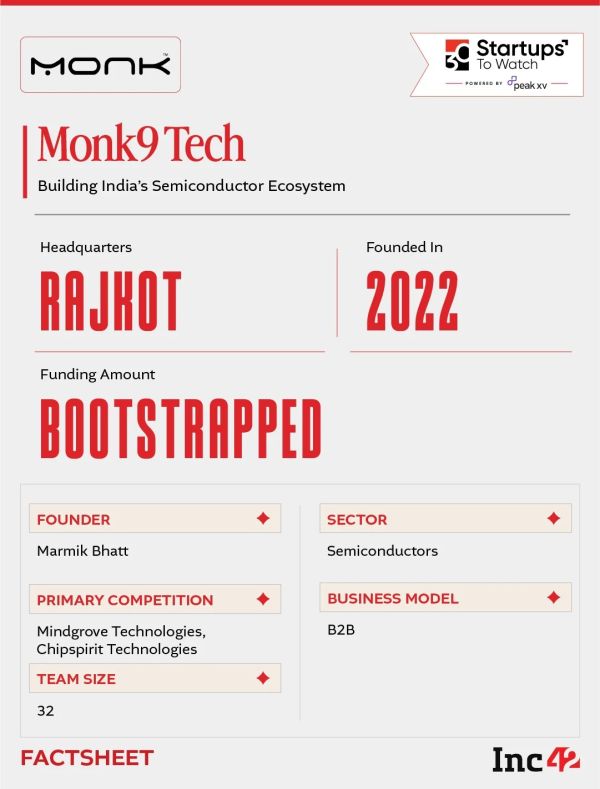
In India, small players still struggle to get affordable fabrication services for prototypes and low-volume runs. This leaves startups, researchers and MSMEs stuck when they need chips for IoT, sensors and power electronics. Monk9 Tech wants to fix this.
Built For Early Needs: Founded in 2022, Monk9 Tech is building a domestic chip design and fabrication stack for small-batch manufacturing. Its full-stack model is aimed at small players that do not need massive foundry capacity, but require reliable access to chips.
Monk9’s Mature Nodes: The Rajkot-based startup works across 350 nm to 130 nm node chips, focusing on mature-node use applications such as IoT devices, sensors, analogue systems and power management. Its foundry produces 6-inch wafers that also supports use cases like power ICs, display drivers and automotive electronics.
Lowering Entry Barrier: Monk9 uses open-source tools and process design kits to make chip development more accessible. This matters in a market where high design costs and specialised expertise often keep smaller innovators from moving beyond the idea stage. Monk9 also works on specialised chips such as MEMS and photonics, using advanced techniques to balance cost and performance.
As the demand for low-volume and application-specific chips soars, can Monk9 become the go-to foundry partner for India’s hardware builders?
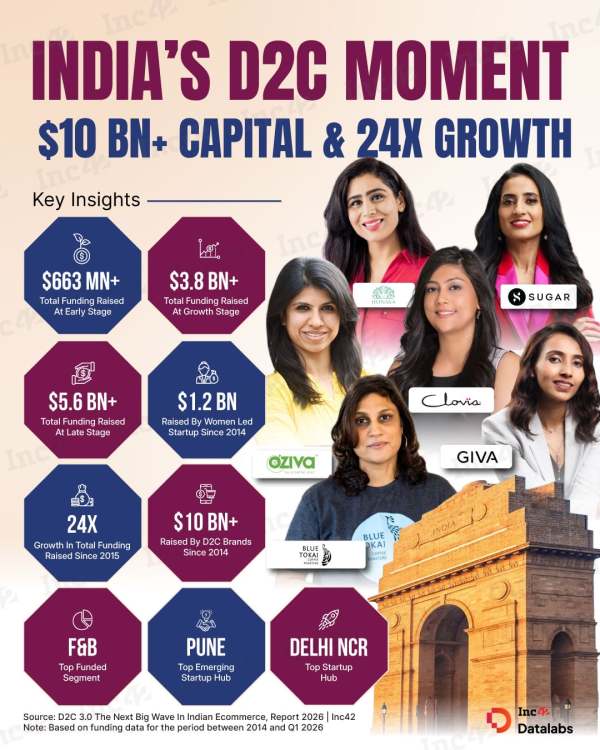
D2C startups have raised over $10 Bn since 2015. Delhi NCR has emerged as India’s top D2C hub, while F&B continues to lead as the most funded segment in the ecosystem. Here is how the numbers stack up…
The post MobiKwik’s Profitable Q4, India’s CCTV Shake-Up & More appeared first on Inc42 Media.
-
RBI to pay biggest-ever dividend to central government, decided May

-
India hikes gold and silver import duty to 15%

-
Bayer's FarmRise app reaches over 50L farmers in India

-
RBI Governor Sanjay Malhotra warns Indian fuel prices could rise

-
Anthropic nearing Stainless acquisition and seeking at least $30B funding