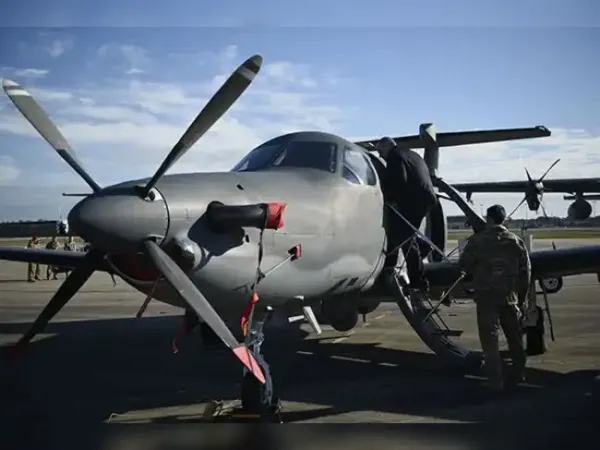
Two US Air Force turboprop aircraft flying over the Alps set off an unusually serious response from Austria’s military this week, after they were detected inside the country’s airspace without the diplomatic clearance Vienna requires for any foreign military overflight. On consecutive days, Austria launched Eurofighter Typhoons to identify the planes, a move officials described as routine under their rules, but rare in cases involving US aircraft.
The incidents were confirmed by the Austrian Ministry of Defence, whose spokesperson Michael Bauer said the first detection occurred on May 10 over the Totes Gebirge in Upper Austria. It prompted Austria to launch two Eurofighters after radar identified a pair of PC-12 aircraft operating without authorization. After the Austrian jets made visual contact, the planes reversed course and headed back toward Munich, Germany.
A day later, at 12:31 pm, another two Eurofighters were dispatched when two more US Airforce PC-12s appeared in Austrian airspace. This response was classified as a Priority A intercept, the highest alert level for Austria’s Quick Reaction Alert force.
Unlike the previous day’s confirmed violation, Bauer noted that officials were still determining whether the US aircraft on this second occasion had obtained the required overflight permissions.
Austria is not a NATO member and has maintained permanent neutrality since 1955. That neutrality comes with strict airspace rules: every foreign military aircraft, including those from close partners, must receive advance diplomatic approval before crossing Austrian skies.
It does participate in the Partnership for Peace program and has observer status in various NATO activities.
Austria enforces that policy with Quick Reaction Alert fighters. When an aircraft appears without the right paperwork, the response is automatic: launch, identify, and escort if necessary.
The planes were identified as PC-12s, a type the United States Air Force uses under the designation U-28A. These single-engine turboprops are typically assigned to intelligence, surveillance and reconnaissance missions because they can fly long hours at low altitude and operate discreetly compared with jets or large transports.
Austrian officials did not comment on the aircrafts’ mission or origin, only that their presence without confirmed authorization required a response under standing rules.
Bauer said the matter is being handled through diplomatic channels between governments. Austria regularly approves US and other NATO military overflights when requests are submitted correctly, and such transits are common across Central Europe.
The incidents were confirmed by the Austrian Ministry of Defence, whose spokesperson Michael Bauer said the first detection occurred on May 10 over the Totes Gebirge in Upper Austria. It prompted Austria to launch two Eurofighters after radar identified a pair of PC-12 aircraft operating without authorization. After the Austrian jets made visual contact, the planes reversed course and headed back toward Munich, Germany.
A day later, at 12:31 pm, another two Eurofighters were dispatched when two more US Airforce PC-12s appeared in Austrian airspace. This response was classified as a Priority A intercept, the highest alert level for Austria’s Quick Reaction Alert force.
Unlike the previous day’s confirmed violation, Bauer noted that officials were still determining whether the US aircraft on this second occasion had obtained the required overflight permissions.
Why this matters in Austria
Austria is not a NATO member and has maintained permanent neutrality since 1955. That neutrality comes with strict airspace rules: every foreign military aircraft, including those from close partners, must receive advance diplomatic approval before crossing Austrian skies.
It does participate in the Partnership for Peace program and has observer status in various NATO activities.
Austria enforces that policy with Quick Reaction Alert fighters. When an aircraft appears without the right paperwork, the response is automatic: launch, identify, and escort if necessary.
The aircraft involved
The planes were identified as PC-12s, a type the United States Air Force uses under the designation U-28A. These single-engine turboprops are typically assigned to intelligence, surveillance and reconnaissance missions because they can fly long hours at low altitude and operate discreetly compared with jets or large transports.
Austrian officials did not comment on the aircrafts’ mission or origin, only that their presence without confirmed authorization required a response under standing rules.
Bauer said the matter is being handled through diplomatic channels between governments. Austria regularly approves US and other NATO military overflights when requests are submitted correctly, and such transits are common across Central Europe.