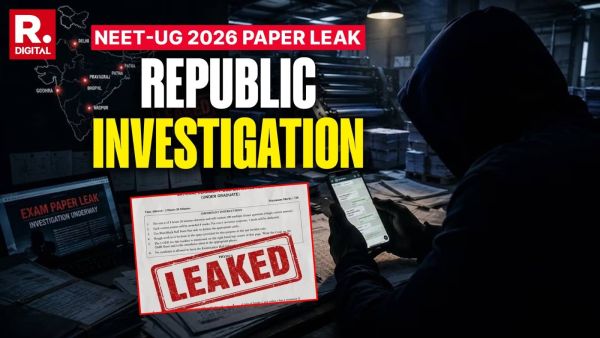
New Delhi: The NEET-UG 2026 exam, the gateway to the nation's medical future, has become the centre of a systemic crisis following widespread allegations of a coordinated paper leak after the Centre on Tuesday cancelled the NEET-UG 2026 examination conducted on May 3.
The country's largest undergraduate medical entrance test will be re-conducted on dates to be announced separately.
As the investigation into the massive NEET-UG 2026 paper leak deepens, shocking details have emerged regarding the digital networks and 'private mafias' that bypassed national security to sell question papers to thousands of aspirants.
A Republic investigation has uncovered exclusive access to chat logs and screenshots, revealing a blatant and sophisticated operation that betrayed the hopes of the 22 lakh students who appeared for the examination.
NEET Paper Leak - Republic Investigation | Dark web of NEET 2026 exam leak cracked open. EXCLUSIVE Instagram & Telegram DM and group chat logs accessed proving how question papers were traded as early as late April.
— Republic (@republic) May 13, 2026
Tune in for fastest #BREAKING alerts - https://t.co/swTv8Zn3xx pic.twitter.com/tOVFGuLkUZ
Paper for Sale
The investigations spanning Jaipur and the rest of the country have laid bare the inner workings of the leak. Reports indicate that middlemen operated brazenly via Telegram and WhatsApp, openly peddling documents they asserted were the authentic NEET question papers.
NEET 2026 scrapped | How many more dreams will corruption kill? As NTA cancels NEET (UG) 2026 examination after paper leak in Rajasthan, millions of students are left in limbo.
— Republic (@republic) May 12, 2026
Our lines are OPEN and we want to hear from students and parents across India. Dial: 0120-3235206… pic.twitter.com/0HHzsNRWqe
The going rate for a paper was approximately Rs 50,000, with some "urgent" slots selling for as high as Rs 75,000, stated reports.
The transaction model
The transaction model was strategically engineered to entice students through a structured payment plan and psychological triggers.
#ArrestNEETCheats REPUBLIC SUPER EXCLUSIVE | @shawansen brings you the explosive details of NEET 2026 paper leak trail. It wasn't just Rajasthan, 5 different sets of question papers were made in Haryana. NEET conspirators met in Nashik and 10 copies of each leaked paper sent to… pic.twitter.com/wVtGSmzI47
— Republic (@republic) May 12, 2026
This involved a split-fee arrangement requiring an initial Rs 25,000 payment upfront, with the remaining Rs 25,000 settled only after the examination.
To establish a sense of credibility, the sellers implemented an aggressive "10X refund guarantee," promising to repay ten times the original amount if the provided questions failed to match the actual exam paper.
Evidence suggests the operation was well-established weeks in advance, with the leak surfacing as early as April 29 and prices fluctuating dynamically as the exam date drew closer.
"I have witnessed the tears of thousands...what is NTA doing?": Dr. Bhupendra Chaurasia, the 2024 NEET scam petitioner joins LIVE to demand accountability.
— Republic (@republic) May 12, 2026
From the 2024 scam to the 2026 leak, when does the nightmare end for our students?
Were you a NEET 2026 aspirant? The… pic.twitter.com/cQI0La6MLK
Art of the Cheat
The cartel leaders built credibility by claiming an "exemplary record" of leaking papers for five consecutive years. In a chillingly calculated move, one seller- identified in chats as Rishi Maharaj- advised students not to attempt 100% of the questions.
"If everybody gets 720 out of 720, it will raise eyebrows and get us all in trouble," the seller warned.
"Paper leak is a game being played with the future of our youth": A protesting NSUI member lashes out as NEET 2026 dreams turn into a nightmare.
— Republic (@republic) May 12, 2026
Tell us your story. The lines are open NOW.
Dial us: 0120-3235206
WhatsApp us: +91-8929746957#NEET #NEET2026 #NEETExam #NTA… pic.twitter.com/eKDB204c8n
Instead, they shared roughly 80-90% of the paper to ensure students scored high enough to clear the cut-off without triggering a fraud investigation. To prove authenticity, these groups managed separate "Proof Channels" where they shared past scorecards and testimonials from satisfied "clients."
Transition to Private Networks
While some groups were identified as "fakes" by disgruntled students who found the questions didn't match, at least two authentic groups remained highly active. Following the government’s decision to investigate and the NTA's subsequent moves, these groups- previously public with thousands of subscribers were immediately turned "private."
#ArrestNEETCheats | WhatsApp, Telegram link emerges in NEET 2026 paper leak: Questions were circulated in group chats on messaging apps #BREAKING
— Republic (@republic) May 12, 2026
Were you an aspirant? Your future is on the line. Dial us now: 0120-3235206 | WhatsApp: +91-8929746946#NEET #NEET2026 #NEETExam… pic.twitter.com/y0bAHMaVHV
The illicit activity remains ongoing, with the most recent messages intercepted as late as May 12. Investigators highlighted a disturbing trend, noting that involvement wasn't limited to students as parents were also found actively participating in these chat groups to secure leaked papers for their children.
The Investigation: From SOG to CBI
Before the case was officially handed over to the Central Bureau of Investigation (CBI), the Special Operations Group (SOG) made 16 arrests and compiled a list of 45 individuals involved in the cartel.
The investigation is currently centered on several critical leads, most notably the "Kerala-Sikar connection," involving a student from Kerala who reportedly sent the leaked paper to his father- a PG owner in Sikar, Rajasthan- for distribution among residents.
Jaya from Mumbai joins us LIVE to speak for the thousands of aspirants and their families devastated by the NEET 2026 cancellation, calls for the total destruction of 'paper leak lobby'.
— Republic (@republic) May 12, 2026
Tune in here - https://t.co/DaeFoQ6V2B #NEET #NEET2026 #NEETExam #NTA… pic.twitter.com/WbuY3IuD74
Simultaneously, the CBI is working to pinpoint the exact source of the breach, examining whether the document was scanned at the printing press or intercepted during transit in cities such as Nashik or Pune.
Investigators are also scrutinizing the "guest paper" defense to determine if the sellers possessed the genuine leaked exam or an unnervingly accurate replica. As the federal agency takes the lead, the primary objective remains the total dismantling of the sprawling criminal network that successfully commodified one of India’s most rigorous competitive examinations.
#NEET Paper Leak: Opposition Leaders Fire Shots Against PM Modi And #NTA | Students Protest
— Republic (@republic) May 12, 2026
Tune in to LIVE TV for all the fastest #BREAKING alerts - https://t.co/sd02M7w7Fp#NEETUG2026 #NEETCancelled #PaperLeak #NTAUpdate #MedicalEntrance #NEET2026 #BreakingNews #EducationNews… pic.twitter.com/jwA27i2ZCP
CBI team reaches NTA office
The corridors of India's premier coaching hubs, once filled with the rhythmic chanting of biology mnemonics and physics formulae, have been replaced by the roar of slogans as the National Testing Agency (NTA) cancelled the NEET UG 2026 examination on Tuesday for over 22 lakh students after reports emerged that the question paper had been leaked before the test.
Amid the ongoing probe, Central Bureau of Investigation (CBI) team on Wednesday reached the National Testing Agency office in Delhi as they investigate the alleged NEET-UG 2026 paper leak and irregularities, sources said on Wednesday.
The National Testing Agency (NTA) has stated that the decision to cancel the exam was taken after inputs were examined in coordination with central agencies, and findings shared by law enforcement agencies raised concerns over the integrity of the examination process.
The agency also clarified that the registration data, candidature details, and examination centres chosen by candidates for the May 2026 cycle would remain valid for the re-test. No fresh registration will be required, and no additional fee will be charged.
-
Jane Fonda makes emotional Cannes return after personal loss

-
Is it right or wrong to put salt on watermelon and eat it? If this question also arises in your mind then know the answer here…
-
Mom Is Told Her Son Is Pheromone Maxxing After He Refused To Shower For 10 Days

-
3 Zodiac Signs Attract Major Luck & Prosperity On May 14, 2026

-
Vietnam province, home to world’s largest cave Son Doong, boosts tourism promotion through international television