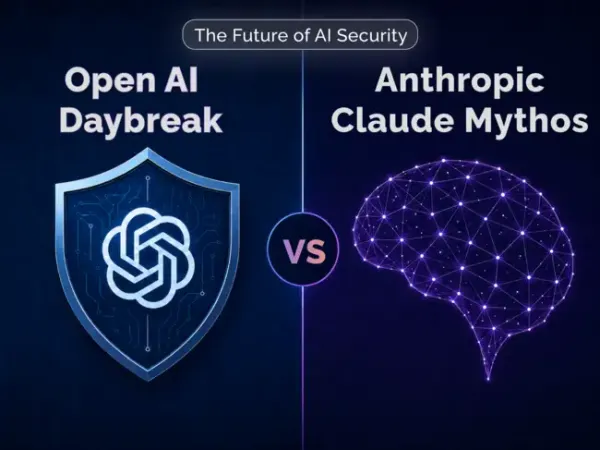
A significant change is unfolding with the AI landscape as cybersecurity rapidly becomes one of the most important arenas for frontier model development. OpenAI’s Daybreak and Anthropic’s Claude Mythos sit at the center of this change, not just as competing systems, but as two very different ways of thinking about how AI should understand, reason about, and secure software.
OpenAI’s Daybreak introduces tiered AI capability controls that define how different levels of intelligence are accessed and used, while also acting as a continuous security layer in development. GPT-5.5 supports general safe use, Trusted Access for Cyber is for verified defensive applications, and GPT-5.5-Cyber runs in controlled environments for advanced security simulations.
Alongside this structure, Daybreak is designed to keep security running in the background as software is built and updated, identifying issues, suggesting fixes, and validating them early. Overall, it reflects a system where security is continuous, and higher capability is paired with stronger verification, tighter permissions, and greater oversight.
In contrast, Anthropic’s Claude Mythos takes a more open-ended and analytical approach, focusing less on layered access controls and more on deep reasoning about how systems behave and where they might fail. Instead of primarily integrating into development workflows, it is oriented toward understanding complex vulnerability patterns, how different components interact, and how small weaknesses can escalate into larger risks.
While Daybreak emphasizes structured deployment and controlled usage, Mythos emphasizes exploration and system-level insight, making the two approaches complementary rather than directly overlapping. Together, they create a balance between speed and understanding.
As both systems continue to evolve, they also highlight a broader shift in how AI is being used in the current day and age. Security no longer depends on just finding flaws or preventing cyber attacks. It’s becoming a more integrated practice where understanding , prevention and response all exist in the same flow.
Taken together, both OpenAI’s Daybreak and Anthropic’s Claude Mythos reflect a broader evolution in how AI is being woven into cybersecurity itself. Instead of treating security as a separate layer or a final checkpoint, it is becoming something continuous, adaptive, and deeply embedded in how systems are built and reasoned about.
The real shift is not about choosing between them, but about how these perspectives collectively raise the baseline for software safety. As both continue to evolve, they point toward a future where security is not just faster or smarter, but more naturally built into the way technology is created in the first place.
Nominate now for ET AI Awards 2026.
OpenAI’s Daybreak introduces tiered AI capability controls that define how different levels of intelligence are accessed and used, while also acting as a continuous security layer in development. GPT-5.5 supports general safe use, Trusted Access for Cyber is for verified defensive applications, and GPT-5.5-Cyber runs in controlled environments for advanced security simulations.
Alongside this structure, Daybreak is designed to keep security running in the background as software is built and updated, identifying issues, suggesting fixes, and validating them early. Overall, it reflects a system where security is continuous, and higher capability is paired with stronger verification, tighter permissions, and greater oversight.
In contrast, Anthropic’s Claude Mythos takes a more open-ended and analytical approach, focusing less on layered access controls and more on deep reasoning about how systems behave and where they might fail. Instead of primarily integrating into development workflows, it is oriented toward understanding complex vulnerability patterns, how different components interact, and how small weaknesses can escalate into larger risks.
While Daybreak emphasizes structured deployment and controlled usage, Mythos emphasizes exploration and system-level insight, making the two approaches complementary rather than directly overlapping. Together, they create a balance between speed and understanding.
As both systems continue to evolve, they also highlight a broader shift in how AI is being used in the current day and age. Security no longer depends on just finding flaws or preventing cyber attacks. It’s becoming a more integrated practice where understanding , prevention and response all exist in the same flow.
Taken together, both OpenAI’s Daybreak and Anthropic’s Claude Mythos reflect a broader evolution in how AI is being woven into cybersecurity itself. Instead of treating security as a separate layer or a final checkpoint, it is becoming something continuous, adaptive, and deeply embedded in how systems are built and reasoned about.
The real shift is not about choosing between them, but about how these perspectives collectively raise the baseline for software safety. As both continue to evolve, they point toward a future where security is not just faster or smarter, but more naturally built into the way technology is created in the first place.
Nominate now for ET AI Awards 2026.
Disclaimer Statement: This content is authored by a 3rd party. The views expressed here are that of the respective authors/ entities and do not represent the views of Economic Times (ET). ET does not guarantee, vouch for or endorse any of its contents nor is responsible for them in any manner whatsoever. Please take all steps necessary to ascertain that any information and content provided is correct, updated, and verified. ET hereby disclaims any and all warranties, express or implied, relating to the report and any content therein.