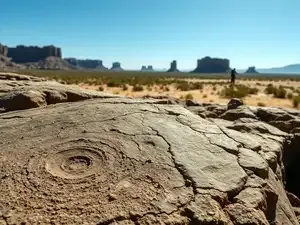
For years, scientists believed strange microscopic patterns preserved in ancient Brazilian rocks were the evidence that tiny animals had already started moving across the seafloor over half a billion years ago. But a new fossil reanalysis is currently overturning that interpretation and focusing on to a very different comprehension: the structures were likely created by microbial life, not animals.
The study, published in Gondwana Research, analyzed fossils dating back roughly 540 million years to the Ediacaran period, a mysterious chapter in Earth’s history that came shortly before the Cambrian explosion dramatically extended complex life in the oceans.
Researchers currently argue that the marks previously connected to primitive wormlike creatures were actually produced by colonies of bacteria and algae living in shallow marine environments. The discovery leads to fresh questions about when the earliest small animals truly appeared and whether ancient oceans had enough oxygen to help them at the time.
The research was led by Bruno Becker-Kerber during postdoctoral work at the University of São Paulo’s Institute of Geosciences and the Brazilian Center for Research in Energy and Materials (CNPEM), with funding support from FAPESP. Becker-Kerber is now continuing research at Harvard University.
"Using microtomography and spectroscopy techniques, we observed that the microfossils have cellular structures -- sometimes with preserved organic material -- consistent with bacteria or algae that existed during that period. These aren't traces of animals that may have passed through the area," states Bruno Becker-Kerber, the first author of the study.
The researchers combined microtomography and nanotomography, techniques capable of disclosing details as small as billionths of a meter.
"When you have a large sample and want to image a structure inside it, the resolution obtained is often insufficient. The MOGNO beamline is one of the few in the world that performs so-called zoom tomography, in which we focus on something inside the sample and analyze it at the nanoscale without destroying the sample," cited Becker-Kerber.
As per the researchers, previous studies that interpreted the structures as animal traces lacked access to this level of imaging capability.
Many fossils also had pyrite, an iron-sulfur mineral commonly linked with sulfur-based microbial procedures. Researchers believe some of the specimens may belong to sulfur-oxidizing bacteria, organisms that survive by processing sulfur compounds.
"This group of bacteria is surprising. Some of the largest ever recorded belong precisely to this category. Unlike the common image we have of microscopic bacteria, certain species can reach diameters larger than a strand of hair and are visible to the naked eye," stated Becker-Kerber.
Scientists discovered preserved cellular divisions, curved partitions, coiled filament-like shapes, and traces of organic matter in several samples across various fossil sites.
"There are concave and convex partitions, coiled filaments, cells without sediment but containing organic matter. This evidence is much closer to bacteria or algae than to mere marks of disturbance caused by animals," the researcher mentioned.
Source: ScienceDaily
The study, published in Gondwana Research, analyzed fossils dating back roughly 540 million years to the Ediacaran period, a mysterious chapter in Earth’s history that came shortly before the Cambrian explosion dramatically extended complex life in the oceans.
Researchers currently argue that the marks previously connected to primitive wormlike creatures were actually produced by colonies of bacteria and algae living in shallow marine environments. The discovery leads to fresh questions about when the earliest small animals truly appeared and whether ancient oceans had enough oxygen to help them at the time.
Scientists Used Nanoscale Imaging to Reexamine the Fossils
The fossils were collected from places in Mato Grosso do Sul, that includes Corumbá and the Serra da Bodoquena region near Bonito. These formations developed along an ancient continental shelf in the final assembly of Gondwana, the prehistoric supercontinent that later separated into regions like South America and Africa.The research was led by Bruno Becker-Kerber during postdoctoral work at the University of São Paulo’s Institute of Geosciences and the Brazilian Center for Research in Energy and Materials (CNPEM), with funding support from FAPESP. Becker-Kerber is now continuing research at Harvard University.
"Using microtomography and spectroscopy techniques, we observed that the microfossils have cellular structures -- sometimes with preserved organic material -- consistent with bacteria or algae that existed during that period. These aren't traces of animals that may have passed through the area," states Bruno Becker-Kerber, the first author of the study.
Sirius Particle Accelerator Helped Scientists Analyze Fossils
To examine the specimens, scientists utilized the MOGNO beamline at Sirius, CNPEM’s advanced particle accelerator complex in Campinas. The equipment enabled the team to peer inside fossils at microscopic and nanoscale resolution while keeping the samples intact.The researchers combined microtomography and nanotomography, techniques capable of disclosing details as small as billionths of a meter.
"When you have a large sample and want to image a structure inside it, the resolution obtained is often insufficient. The MOGNO beamline is one of the few in the world that performs so-called zoom tomography, in which we focus on something inside the sample and analyze it at the nanoscale without destroying the sample," cited Becker-Kerber.
As per the researchers, previous studies that interpreted the structures as animal traces lacked access to this level of imaging capability.
Fossil Evidence Points to Ancient Microbial Life Instead of Animals
The team also performed Raman spectroscopy to examine the fossils’ chemical composition. The scans found preserved organic compounds in fossilized cell walls, reinforcing the conclusion that the specimens featured ancient microorganisms rather than tracks made by moving animals.Many fossils also had pyrite, an iron-sulfur mineral commonly linked with sulfur-based microbial procedures. Researchers believe some of the specimens may belong to sulfur-oxidizing bacteria, organisms that survive by processing sulfur compounds.
"This group of bacteria is surprising. Some of the largest ever recorded belong precisely to this category. Unlike the common image we have of microscopic bacteria, certain species can reach diameters larger than a strand of hair and are visible to the naked eye," stated Becker-Kerber.
Scientists discovered preserved cellular divisions, curved partitions, coiled filament-like shapes, and traces of organic matter in several samples across various fossil sites.
"There are concave and convex partitions, coiled filaments, cells without sediment but containing organic matter. This evidence is much closer to bacteria or algae than to mere marks of disturbance caused by animals," the researcher mentioned.
Source: ScienceDaily