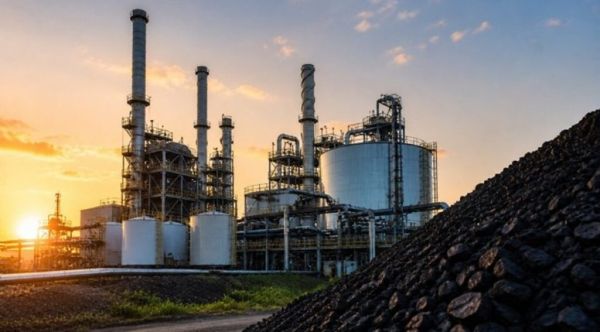
Amid the West Asia crisis and the long-running blockage in the Strait of Hormuz, the Indian government has taken a big step towards energy self-reliance. The Union Cabinet chaired by Prime Minister Narendra Modi has approved an ambitious ₹37,500 crore scheme to promote surface coal and lignite gasification projects.
The government aims to gasify 100 million tonnes of coal by the year 2030, so that domestic production of synthetic gas (Syngas) can be increased in the country. The objective of this scheme is to reduce India’s dependence on imported LNG, urea, ammonia and methanol to a large extent.
According to the government, under the new scheme, surface coal and lignite gasification projects will be incentivized through a competitive bidding process. Financial assistance will be provided up to a maximum of 20 percent of the cost of plant and machinery used in the projects.
This assistance amount will be released in four equal installments, which will be linked to different phases of the project. The government has also set a financial limit to ensure participation of maximum companies. The limit is capped at a maximum of ₹5,000 crore for a single project, ₹9,000 crore for a single product category and a maximum of ₹12,000 crore for a single corporate group.
The government has described this decision as a big step towards self-reliant India in the energy sector. India has about 401 billion tonnes of coal and 47 billion tonnes of lignite reserves, but despite this the country imports more than 50 percent of its requirement of LNG, almost all of the ammonia and 80-90 percent of the methanol. India’s total expenditure on import of these products in FY 2025 had reached approximately ₹2.77 lakh crore.
The closure of the Strait of Hormuz due to the US-Iran conflict has severely affected global oil and LNG supplies. A large part of the world’s seaborne oil and LNG trade passes through this route. According to experts, this crisis exposed the weakness of India’s energy dependence. Crude oil import expenses increased and the availability of raw materials in the fertilizer and petrochemical sectors was affected.
The government believes that the impact of these external shocks can be reduced to a great extent by converting domestic coal into synthetic gas through gasification. This will increase domestic production of urea, methanol, synthetic natural gas and other chemicals.
According to government estimates, this scheme may attract private investment of ₹2.5 to ₹3 lakh crore. Also, there is a possibility of creation of about 50,000 direct and indirect jobs in coal producing areas. The government expects the gasification of 75 million tonnes of coal to generate revenue of about ₹6,300 crore annually for the Center and states, besides increasing GST collections.
The initiative is considered an extension of the National Coal Gasification Mission launched in 2021 and the ₹8,500 crore plan approved in January 2024. Work on eight projects is already underway under that scheme. Analysts say that amid the current global energy crisis, this decision can prove to be an important step towards strengthening India’s energy security, reducing the import bill and promoting “Make in India”.
During this time, Prime Minister Modi has recently appealed to the citizens to reduce unnecessary imports and expenditure to save foreign exchange, which is being discussed across the country.
Aditya Thackeray’s allegation, electric vehicles are being bought only for show!
Indian stock market recovered from continuous decline, Sensex gained 50 points!
Gorakh Mian and his sons beat a 12 year old Hindu to death for plucking lemon from a tree.
NEET Paper Leak: Kejriwal wants to incite ‘Nepal like violence’?
-
S&P 500 Holds Near Record Highs As Chip Stocks Rally Despite Inflation Concerns

-
Nagaland State Lottery Result: May 13, 2026, 8 PM Live - Watch Streaming Of Winners List Of Dear Dream Sambad Night Wednesday Weekly Draw

-
'Fill Up Seats Based On Class 12 Marks': Tamil Nadu CM Vijay Demands End To NEET-Based Medical Admissions After NEET-UG 2026 Cancellation

-
UPSC CSE Prelims Answer Key 2025 Released At upsc.gov.in; Download GS Paper 1 & CSAT PDFs
-
US SEC, Elon Musk to argue for Twitter settlement before DC judge