
Britain's best-selling sarnie options harbour "alarmingly high" quantities of salt, with one packing more than nearly five McDonald's cheeseburgers worth, new research has revealed. Action on Salt and Sugar examined 546 sandwiches, wraps, rolls and baguettes from supermarkets and high street outlets, discovering that one in 10 surpass health targets for salt and calories.
Nearly half (44%) would display a red or "high" salt alert on front-of-pack labels, while 32 provide half or more of an adult's maximum daily allowance in just one portion, the investigation uncovered. Action on Salt and Sugar stated that the results expose the extent of concealed salt in typical lunchtime picks and highlight the "failure" of the Government's voluntary strategy to enhance food's nutritional standards.
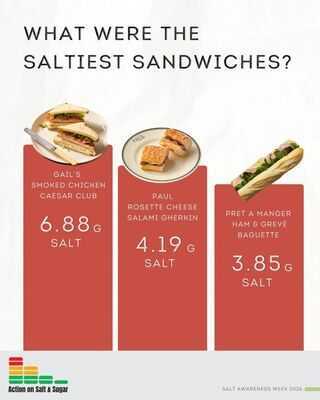
The campaign group identified the Smoked Chicken Caesar Club from upmarket cafe chain Gail's as what it claimed was the "worst offender", saying it held a "staggering" 6.88g of salt, comparable to almost 10 bacon rashers or five McDonald's cheeseburgers. UK health guidance recommends adults consume no more than 6g of salt daily - roughly one level teaspoon.
Moreover, it said the sarnie packs a hefty 1,067 calories and a whopping 90% of an adult's maximum daily saturated fat allowance, while delivering a mere 20% of the recommended fibre intake, according to the research. The broader findings painted an equally worrying picture, with investigators discovering that a third of sandwiches examined would warrant a red alert on front-of-pack labelling for saturated fat, and over one in seven scoring high in fat, saturated fat and salt all at once.
Nearly every sandwich assessed (97%) fell short of providing even a third of the daily recommended fibre intake, they said. A quarter of the sarnies (25%) are deemed "less healthy" under the existing 2004/5 Nutrient Profiling Model, restricting how and where they can be marketed to consumers, reports Lancs Live.
The investigation revealed that sandwiches purchased out-of-home (OOH) were typically saltier than those purchased in supermarkets. Among the worst offenders featuring naturally salty or heavily processed ingredients were Gail's Smoked Salmon Bagel with Schmear and Pickled Pink Onions, containing 4.2g of salt, and Paul's Rosette Cheese Salami Gherkin, containing 4.19g of salt, the study claimed.
Next up was Pret A Manger's Ham and Greve Baguette, packing 3.85g per portion, they said. The research said other particularly salty offenders included Tesco's Fully Loaded Hot Honey Halloumi, Falafel and Pickled Slaw at 3.78g, Tootoomoo's Sriracha Pork Sando at 3.67g, and Sainsbury's Kitchen Deli Pastrami, Cheddar Cheese and Gherkin Mustard Mayo at 3.67g - each containing more salt than a dozen standard packets of ready salted crisps, they said.
Yet, Action on Salt and Sugar uncovered stark variations in salt levels across comparable sandwiches and fillings, such as Pret A Manger's Chicken Salad Sandwich, holding 2.22g of salt, while Greggs' Roast Chicken Salad Sandwich contained roughly half that amount at 1.1g, they said. Likewise, they claimed that an M&S All Day Breakfast Sandwich contained 2.65g of salt, compared with 1.54g in Sainsbury's All Day Breakfast Sandwich.
Action on Salt and Sugar highlighted that numerous lower-salt options demonstrated reformulation was "both possible and practical", citing examples like Subway's Veggie Delite Sub with merely 0.60g of salt, Pret A Manger's Avo, Olive and Toms Half Baguette at 0.82g, Caffe Nero's Chicken, Tomato and Basil Hot Wrap at 1.08g, and Greggs' Tuna Mayonnaise and Cucumber Sandwich at 1.1g per serving.
The report also highlighted "clear examples of companies getting it right", with every product examined from Pollen + Grace, The Gym Kitchen, and Urban Rajah meeting calorie and salt reduction targets, displaying no red warning labels on packaging, and none of their sarnies classified as high in fat, sugar or salt (HFSS).
Looking at retailers, Asda and Lidl achieved complete compliance with salt targets for sandwiches, while Starbucks and Greggs delivered the lowest average salt content in the out-of-home sector, fully meeting both salt and calorie targets. Research indicates that UK adults consume an average of 8.4g of salt daily, 40% above the maximum recommended limit, with much of it concealed in processed, pre-packaged and out-of-home foods such as sandwiches.
Excessive salt intake elevates blood pressure, a leading trigger of stroke and a significant contributor to heart and kidney disease. Brits purchase 11.5 billion sandwiches across the country annually.
Sonia Pombo, head of research and impact at Action on Salt and Sugar, remarked: "Most people choose sandwiches for lunch for their simplicity, convenience and affordability. But what they're actually eating can be a full day's worth of salt hidden between two slices of bread.
"More than 20 years after the first set of salt reduction targets were introduced, it's frankly unacceptable that some companies continue to sell sandwiches that exceed an adult's daily limit in one go. Voluntary action has been allowed to drift for too long, and the result is a food environment that continues to put public health at risk. The Government must now step in with tough, mandatory measures, because leaving this to industry goodwill has clearly failed."
-
Scottie Scheffler 'doesn't need' Rory McIlroy after skipping PGA Championship dinner

-
Welfare uncertainty grips Bengal despite BJP government's assurances

-
Karnataka to celebrate International Yoga Day with statewide events on June 21

-
ISSO and DP World PGTI Join Forces to Enhance Golf in Schools

-
Yonex Sunrise India Enhances Racquet Sports with Stringing Workshop in Mumbai