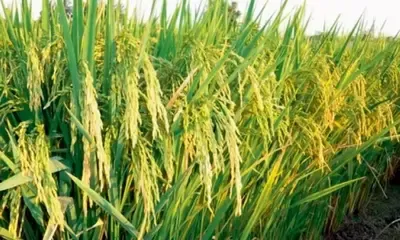
Government Increases MSP for Kharif Crops With Focus on Oilseeds, Pulses and Farmers’ Income
The Central government has approved an increase in the Minimum Support Price (MSP) for 14 kharif crops for the 2026-27 marketing season, with paddy receiving a 3 percent hike ahead of the upcoming monsoon sowing cycle.
The decision, cleared by the Union Cabinet on Wednesday, raises the MSP for paddy by ₹72 per quintal, taking the new procurement price to ₹2,441 per quintal. The revised rates will come into effect from the new marketing season beginning on October 1, 2026.
The move is being seen as part of the government’s broader strategy to strengthen farmer income, encourage crop diversification, and reduce India’s dependence on imported edible oils. Officials indicated that oilseed crops received some of the sharpest increases to motivate farmers toward higher domestic production.
Kharif crops are generally sown during the southwest monsoon season between June and September and harvested in October and November.
Oilseeds Receive Highest MSP Increase
Among all crops covered under the new MSP announcement, sunflower seed recorded the highest absolute increase of ₹622 per quintal over the previous season. This was followed by cotton with a hike of ₹557 per quintal, niger seed with ₹515 per quintal, and sesamum with ₹500 per quintal.
Agricultural experts believe the government is clearly signaling its intent to promote oilseed cultivation as India continues to face a heavy edible oil import burden. The country imports a substantial portion of its cooking oil requirements every year, making domestic oilseed production a key policy priority.
Officials say increasing MSP for crops such as sunflower and sesamum could encourage farmers to shift toward oilseed farming in states where climatic conditions support diversified cultivation.
The emphasis on oilseeds also aligns with the government’s long-term food security and import reduction objectives, especially amid volatile global commodity markets and international supply chain disruptions.
Pulses and Millets Continue to Receive Policy Push
The government has also maintained a strong focus on pulses and millets through the latest MSP revision.
According to official estimates, farmers are expected to receive the highest margins over production costs in crops such as moong, bajra, maize, and tur/arhar. Moong is projected to provide an estimated 61 percent margin over production cost, while bajra and maize are expected to provide around 56 percent margins. Tur/arhar is estimated to generate around 54 percent returns over cost.
The government has repeatedly emphasized crop diversification in recent years, encouraging farmers to move beyond water-intensive crops toward pulses, coarse grains, and millets.
Millets have received special policy attention following India’s aggressive promotion of nutrient-rich grains globally. Officials believe higher MSP support for millets can strengthen nutritional security while also supporting climate-resilient agriculture.
Despite the broader increase, maize and moong reportedly witnessed the lowest MSP hikes both in percentage and absolute terms compared to other crops in the kharif basket.
Cabinet Says MSP Fixed Above Production Costs
Information and Broadcasting Minister Ashwini Vaishnaw said the revised MSP structure ensures remunerative prices for farmers and guarantees support prices that are at least 50 percent higher than the all-India weighted average cost of production for all notified crops.
The calculation of production costs includes multiple farming expenses such as labor charges, seeds, fertilizers, irrigation, machinery depreciation, electricity or diesel use, land rent, and family labor contributions.
Government officials argued that the revised MSP structure reflects continued efforts to protect farmer profitability despite inflationary pressure on agricultural inputs and global economic uncertainty.
The MSP mechanism remains one of the most significant agricultural support policies in India, particularly for staple crops such as paddy and wheat. It guarantees farmers a minimum procurement price for selected crops even if market prices fall below those levels.
Government Estimates ₹2.6 Lakh Crore Farmer Payout
The Centre estimates the total payout to farmers under the revised MSP system at nearly ₹2.6 lakh crore, based on projected procurement volumes of around 824.4 lakh tonnes during the upcoming marketing season.
The procurement system plays a crucial role in stabilizing farm incomes while also supporting the country’s food distribution and public welfare programs.
Agricultural economists note that higher MSP announcements ahead of sowing seasons often influence cropping decisions across major farming states. The latest increases may encourage farmers to allocate more acreage toward oilseeds, pulses, and selected coarse grains depending on rainfall patterns and market conditions.
The announcement comes at a time when policymakers are balancing multiple agricultural priorities, including food inflation management, farmer welfare, import reduction, and climate sustainability.
Farmers and Markets Closely Watch Monsoon Outlook
The MSP revision also arrives ahead of a critical monsoon season, which remains one of the biggest factors affecting India’s agricultural production.
A favorable monsoon could support higher sowing activity and improve production levels across kharif crops. Conversely, uneven rainfall patterns could affect acreage decisions and output despite increased support prices.
Farmer groups are expected to study the revised MSP structure carefully before finalizing sowing choices in different regions. Market analysts believe crops receiving higher MSP incentives may witness increased cultivation in states with suitable irrigation and climatic conditions.
The government’s continued emphasis on diversification, edible oil self-sufficiency, and sustainable farming suggests that future agricultural pricing policies may increasingly favor crops beyond traditional rice and wheat cultivation.
As the kharif season approaches, the revised MSP announcement is likely to shape agricultural planning, procurement expectations, and rural economic activity across the country.
The post Centre Hikes MSP for 14 Kharif Crops, Paddy Price Raised Ahead of Monsoon Season appeared first on CliQ INDIA.
-
Is the mood of the boss always seventh? You have to be Chanakya to stay calm

-
Why Fermented Rice Is the Best Thing You Can Eat This Summer
-
Jio vs Airtel: Same price but different benefits, who is winning in the ₹349 plan?

-
Super Chess Classic: Praggnananda beats World Championship challenger Sindarov

-
IPL 2026: Lucknow won the toss and decided to bowl first against Chennai, both the teams…