To be honest, if there’s one bike that shook the electric scene, it’s the Harley-Davidson LiveWire. It is a genuinely impressive machine, and as respectable as 100 horsepower with 83 lb-ft for around $16,499 minus fees sounds especially coming from an electric motorcycle, it is really just the starting point of this conversation. Because out there in the market right now, sitting in showrooms and on dealer lots, are production motorcycles, both gas-powered and electric, that would beat those figures hands down.
There are bikes that can churn out about 200+ horsepower and push all the way to a top speed of 218 mph. Some of them run on gasoline, some carry MotoGP DNA so deep in their bones that the engineers who built their engines also build race bikes for a living, while one forces air into its motor using an in-house technology borrowed straight from the aerospace industry. But what they all have in common is simple — they’ve got more power than a LiveWire, and they’re available to anyone willing to write the check, with no tuning kits, no modifications, and no asterisks attached. Without further ado, below are five bikes packing more serious horsepower and speed than the Harley-Davidson LiveWire, and every single one of them is something you can ride home today.
BMW M 1000 RR
If horsepower is your language, the M 1000 RR is one of those fast bikes every pro rider has on their list. Since it launched in 2020, four generations of refinement have gone into this homologation special that competes in WorldSBK and FIM Championships, and at $35,395 plus a $1,095 destination fee, you can get the latest base model dressed in either Light White or Blackstorm Metallic M Motorsport livery.
Under that bodywork is a 999cc liquid-cooled inline-four built around BMW’s ShiftCam variable valve timing technology that does the work. In U.S. trim, that’s possibly 205 horsepower and 83 lb-ft of torque, all thanks to BMW for reworking almost all internals from the combustion side to the mounts and exhaust. On the road now, all of that translates to an 189 mph top-end pull through a six-speed gearbox with a multi-plate oil-bath slipper clutch and 525 chain drive, and all out of a machine that weighs just 423 lbs.
Electronically, it’s stacked up with seven riding modes paired with dynamic traction control, slide control, ABS Pro with full cornering sensitivity, brake slide assist, wheelie control, a TFT display, dynamic brake control, and even cruise control for the stretches between circuits. And that’s before the M Competition Package enters the picture with stuff like the M Billet pack, M carbon wheels, M lightweight battery, M chassis kit, M Endurance chain, M titanium exhaust, and M brake ducts, making it quicker than almost any bike the brand has ever put out on the street or on any racetrack.
Aprilia RSV4 Factory 1100
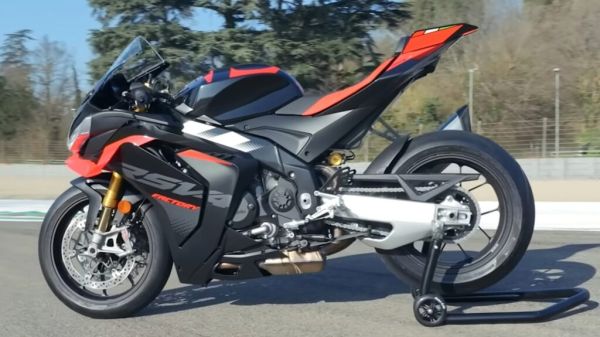
Next is the Aprilia RSV4 Factory 1100, and if this one isn’t on your radar and you’re in the market for a superbike faster than the Livewire, it’s time to recalibrate. Refined through 54 world championships’ worth of MotoGP technology, the RSV4 carries genuine racing DNA in every single bolt. It is one of the most potent street-legal bikes you can buy right now, and $26,499 is all that it will cost you with a maintenance fee of about $545 to keep the 2026 model running every year. Under that aggressive bodywork sits a 1,099cc liquid-cooled V4 whose roots traces as far back as to Aprilia’s original RSV4 that debuted in the late 2000s. Apart from the fact that it claims 220 horsepower and 92.2 lb-ft of torque to keep to Euro 5+ compliance, the engineers had to make some tweaks like enlarging the throttle bodies and upgrading the radiator fans.
In fact, where the standard RSV4 leaves you app-shopping for features that honestly should come standard, the Factory 1100 arrives fully loaded with things like Öhlins Smart EC 2.0 semi-active suspension front and rear, metal brake hoses, and forged aluminum wheels. Feeding everything is a six-axis IMU synced to cornering ABS with rear wheel lift-up mitigation, and eight levels of adaptive traction control paired with a three-level predictive slide control, a pit limiter, cruise control, and a bi-directional quickshifter.
All of it ties together seamlessly through a 5-inch TFT display and Aprilia MIA connectivity that pairs the entire system directly to your smartphone whether you’re riding on any of the three modes (User, Street, and Sport).
Kawasaki Ninja H2
When talking about street-legal supercharged liter bikes that can flat-out outgun the LiveWire, the Kawasaki Ninja H2 should belong to the list without question. The 2026 model comes in three different versions, and whichever one you pick, the same 998cc inline-four with a factory supercharger is waiting under the skin. At $34,400 plus an $840 delivery fee, the H2 ABS is one of the most capable all-rounders in hypersport territory you can actually get your hands on, pushing around 240 horsepower and 104.9 lb-ft of torque. Want more than that? The closed-course H2R ABS churns out 322 horsepower and 121.5 lb-ft of torque, tops out at 216 mph, and carries a $62,100 price tag that puts it comfortably among the fastest machines Kawasaki has ever built.
Wrapped around a lightweight high-tensile steel trellis frame, what really sets the H2 apart from anything else in its class is how much technology Kawasaki packed underneath that mirror-coated Spark Black bodywork. You’d get stuff like nine-mode traction control through KTRC, three-setting launch control, bidirectional quick shifting via KQS, intelligent ABS, an IMU-enhanced chassis orientation system, Kawasaki’s Cornering Management Function, engine brake control, and an Öhlins steering damper. On the ownership side, Kawasaki backs the H2 with a year of limited warranty straight out of the gate, but the real peace of mind comes from its Protection Plus program, which lets you extend that coverage to as much as six years before the original warranty runs out.
Honda CBR1000RR-R Fireblade SP
Honda’s CBR1000RR-R Fireblade SP is one of those track-born, street-legal bikes that carries a legacy stretching all the way back to the ’90s – a lineage so deep you can actually trace its original roots to Honda’s CB92 Benly from 1959. Although along the way it racked up wins in multiple racing series including MotoAmerica’s Stock 1000, and for the 2025 version, Honda went straight to MotoGP’s RC213V for cues, borrowing everything from the bore and combustion design down to the intake and exhaust architecture. What came out on the other side is a special 1000cc liquid-cooled 16-valve inline-four punching out around 214 horsepower through a manual six-speed gearbox, all wrapped in a Grand Prix Red package that tips the scales at just 445 pounds, making it able to run at a top speed of about 186 mph. Honda didn’t stop there; it even tightened the gear ratios to clean up corner exits, which then shaved roughly 2.1 lbs from the aluminum twin-spar frame in the process
Instead of a Showa suspension, the Triple R steps into an entirely different league with the Öhlins Smart EC 3.0 third-gen semi-active suspension that manages both ends of the chassis while the six-axis IMU threads the entire electronics package together. At $28,999 plus $775 in delivery fees and backed by a 12-month factory warranty, you’re also getting nine levels of Honda Selectable Torque Control, five power modes, and three levels each of engine braking and wheelie control — all accessible through a full-color TFT cluster with a Smart Key system and throttle-by-wire.
Lightning LS-218
Since the Lightning LS-218 kicked off in the US in 2014, the conversation around electric motorcycles has never been the same; it all started after the bike came first in the Pikes Peak International Hill Climb over gas-powered superbikes. On top of that, it also wears the crown of the world’s highest-performing production electric motorcycle, which means it can go zero to sixty in under two seconds flat with a claimed speed of 218 mph max. Under its carbon fiber and aluminum frame sits an IPM liquid-cooled motor running on a 380-volt architecture, paired with a single-speed direct drive system and a chain final drive that produces around 244 horsepower and a torque of 220 lb-ft.
Range-wise, its base configuration runs a 15 kWh battery, which is good for around 188 miles of highway riding, and if you step up to the 20 kWh pack, that will stretch to roughly 255 miles. Meanwhile, the flagship 28.3 kWh Xtreme Fast Charge system can push that figure to as much as 335 miles depending on how you ride it. When it’s time to refill that battery, the Lightning Fast Charge System gets you to 80% in as little as 12 mins, plus the LS-218 plays well with CCS, J1772, and NACS standards, so you’d not be left hunting for a specific plug. On the hardware side, Öhlins suspension and Brembo brakes handle the chassis duties, all for a base price at around $38,988.
Methodology
The goal behind this piece was pretty straightforward — find five motorcycles that would make the Harley-Davidson LiveWire look slow on paper, and then actually make a case for why each one belongs on the list.
The LiveWire became the reference point for a simple reason: It’s the most recognizable name in electric motorcycles right now, and its 100 horsepower figure is specific enough to set the bar. So anything making more than that, either via a traditional gas engine or an electric power plant, qualified for consideration, although there was one ground rule applied from the very beginning, and that is only production models you can actually walk into a dealership and buy. Nothing tuned, modified, built as a one-off, or living exclusively on a dyno shop floor made the cut.
From there, the research pulled from a combination of manufacturer official pages, independent reviewers, and spec sheets to pin down the most accurate and up-to-date horsepower figures, pricing, warranty info and feature sets for each bike. For each model, the priority was always the manufacturer’s own claimed numbers first, with third-party reviews used to add real-world context and color to what those numbers actually feel like in practice.