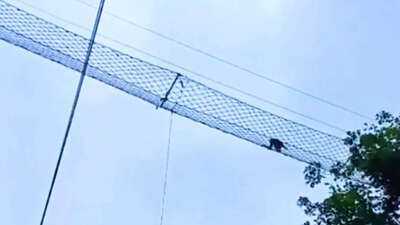
Screengrab capturing a hollock gibbon crossing a canopy bridge in Jorhat (Photo: @byadavbjp/X)
New Delhi, May 15: A remarkable achievement in wildlife conservation has been recorded at the Hollongapar Gibbon Sanctuary in Jorhat district, Assam, where a male Western Hoolock Gibbon has successfully crossed a canopy bridge that spans a railway line within the sanctuary.
This event marks the first confirmed instance of a gibbon utilizing a canopy bridge over a railway line, as reported by the Wildlife Institute of India (WII).
Union Environment Minister Bhupendra Yadav commended this initiative, referring to it as a prime example of 'tech-led conservation'. He expressed his satisfaction on social media, stating, 'It is encouraging to see that mitigation measures like this canopy bridge are being utilized by the Hoolock Gibbon, demonstrating that science-driven small-scale efforts can significantly aid biodiversity conservation.'
The WII views this successful crossing as a hopeful sign for conservation initiatives aimed at safeguarding this endangered ape species, which relies heavily on uninterrupted forest canopy for its mobility.
These specially designed bridges were constructed in February and March to mitigate the effects of electrification work on the single-track Lumding-Dibrugarh railway line that traverses the sanctuary.
Canopy bridges serve as elevated pathways connecting treetops, enabling arboreal animals to navigate fragmented habitats safely without descending to the ground.
Western Hoolock Gibbons are the only ape species found in India and are classified as endangered on the International Union for Conservation of Nature Red List.
In India, these gibbons inhabit various northeastern states, particularly in forested areas south of the Brahmaputra and east of the Dibang River. They are also present in parts of eastern Bangladesh and northwestern Myanmar.
However, the species faces numerous threats, including habitat encroachment, the expansion of tea plantations, and illegal wildlife trade.
The WII has stressed the importance of long-term conservation strategies, advocating for the reconnection of isolated forest patches to ensure the survival of arboreal species like gibbons.
They stated, 'Long-term solutions, thoughtful infrastructure planning, and eco-conscious development of reforested corridors to link isolated populations are essential for the enduring survival of exclusively arboreal and threatened species like gibbons.'
-
If I've to prove my worth and value, that place is not for me: Virat Kohli on 2027 ODI World Cup plans

-
Ankur Warikoo course business closure: Rs 100 crore in sales, yet he’s shutting it down? Internet debates whether it’s real or a marketing move

-
Why HR says “we’re still finalizing”, and why employees often feel trapped by the uncertainty afterward

-
Are quiet achievers doomed? The unfair reality of office visibility bias

-
Baby at Christmas, breakup by Mother's Day: Pete Davidson and Elsie Hewitt are done