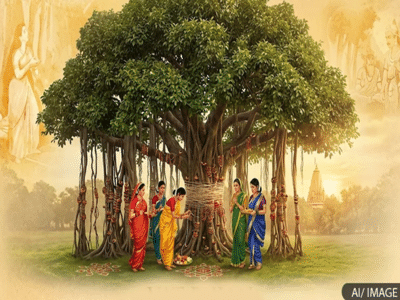
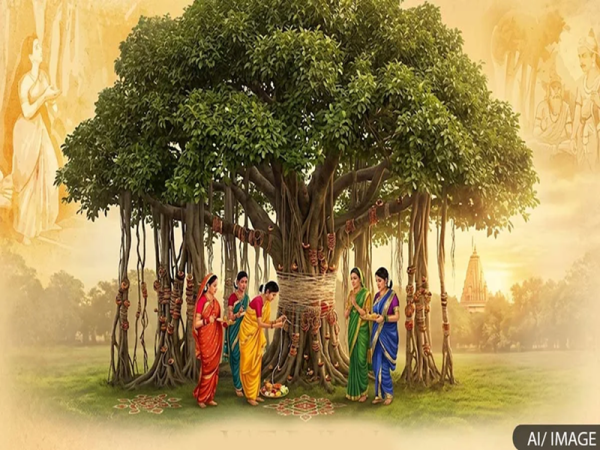
Vat Savitri Vrat 2026 Puja Rules: Vat Savitri Vrat falls on May 16th. On this day, women observe a fast and perform worship rituals. The Banyan tree (*Vat Vriksha*) holds special significance in the worship associated with this fast, as devotees worship the tree and wrap raw cotton thread around it at least seven times. While many women observe the Vat Savitri Vrat, how should they perform the worship if they are traveling or if there is no Banyan tree located in the vicinity of their home? What alternative options for worship are available to them in such situations?

Devotees observing the fast are generally well-versed in the rules and rituals of the Vat Savitri Vrat; consequently, they typically arrange the necessary worship materials in advance. However, how does one make arrangements for the Banyan tree itself?
1. **Worshiping a Banyan Tree Twig**
If there is no Banyan tree located near your home or at a nearby temple, do not be concerned. One day before the fast, procure a twig from a Banyan tree. Plant this twig in a clean pot filled with soil and ensure it is kept watered. On the day of the fast, during the auspicious *muhurat* (propitious time), treat this twig as the actual Banyan tree; perform the worship rituals according to scriptural guidelines and wrap the raw cotton thread around it. On the day following the worship, you may either immerse the twig in flowing water or simply leave it in the pot.
2. **Mental Worship**
Your second option is to perform a mental worship (*Manasik Puja*) of the Banyan tree. During the auspicious *muhurat*, visualize a Banyan tree in your mind's eye and perform the worship internally, within your thoughts. The practice of mental worship is well-documented and described in the scriptures.
3. **Worshiping a Picture of Vat Savitri**
Your third option is to procure a picture or image of the Vat Savitri Vrat from the market, specifically one that depicts Savitri, Satyavan, and the Banyan tree. Perform your worship rituals before this picture during the auspicious *muhurat*.
4. **Worshiping a Drawn Image of the Banyan Tree**
Your fourth option is to spread a piece of red or yellow cloth over a *Chowki* (a low wooden stool or platform). Subsequently, use turmeric to draw the outline or image of a Banyan tree upon the cloth. Proceed to complete your worship rituals in accordance with the prescribed scriptural guidelines. As for the rituals of circumambulation and wrapping the thread, you should perform the circumambulation around the specific image or altar, and then wrap the thread around it.
5. The Abode of the Trinity (Tridev) in the Banyan Tree
According to mythological beliefs, the Banyan tree serves as the abode of the Trinity (Tridev). Lord Brahma resides in the roots of the Banyan tree, Lord Vishnu in its main trunk, and Lord Shiva in its branches. Therefore, you should perform your worship while invoking the Trinity as your witnesses. While the thread is traditionally wrapped around the trunk of the Banyan tree itself, you may also perform a circumambulation in honor of Lord Vishnu and place the raw cotton thread at His feet.
Benefits of Worshipping the Banyan Tree
Worshipping the Banyan tree bestows upon women the blessing of *Akhand Saubhagya* (unbroken marital bliss). It ensures a harmonious and joyful married life and grants longevity to the husband.

The Banyan is considered an *Akshaya Vriksha* (imperishable tree) because its roots spread far and wide, allowing multiple new trees to sprout from a single source. Consequently, one's lineage never diminishes; rather, it continues to grow and flourish. It is believed that worshipping the Banyan tree facilitates the blessing of progeny and ensures the expansion of one's family lineage.
Furthermore, worshipping the Banyan tree helps to pacify planetary afflictions (*Graha Doshas*). It is believed to alleviate the negative effects associated with the planets Saturn, Rahu, and Ketu; for this reason, devotees engage in the devoted service and worship of the Banyan tree.
PC Social Media
-
From Semma To Temple Canteen, 4 Indian Cuisine Eateries Are Among 100 Best NYC Restaurants

-
What will happen if you give up sugar for just 60 days?

-
Skin Care Tips: Applying ‘rice water’ for Korean glass skin? Learn the correct method

-
End of curiosity! Attractive looks and powerful features… the first Motorola foldable phone has finally entered India, at a price that is so high

-
Lucknow’s victory gave advantage to Rajasthan