The plan, formalized through a decision signed by Hanoi People’s Committee Chairman Vu Dai Thang on May 13, lays out a phased relocation. About 442,000 residents are expected to move out from areas along the Red River, around West Lake and from several inner-city streets between 2026 and 2035. Another 420,000 will follow from the Old Quarter and other areas inside Ring Road 3 between 2036 and 2045.
City authorities are using financial and policy incentives to draw residents into new urban developments built around metro stations on the city’s edge. The receiving areas, including Dong Anh, Gia Lam and the Hoa Lac science and technology hub west of the city, are being upgraded as part of the same plan, with infrastructure designed to integrate housing, transit and employment.
The goal is to ease pressure on the historic core, where the densest inner-city wards pack more than 20,000 people into every sq.km, while preserving the architectural character of areas like Hoan Kiem and the French Quarter. The Old Quarter’s resident population has already fallen by 30-50% over the past 20 years through spontaneous outmigration, according to estimates from the Hanoi Association of Architects.
For housing development, Hanoi is targeting at least 35 sq.m of floor space per person between 2026 and 2030, with a stretch goal of 40 sq.m, rising to at least 45 sq.m per person during 2031-2035. The housing strategy is tied to a transit-oriented development (TOD) model that concentrates new construction around metro stations.
|
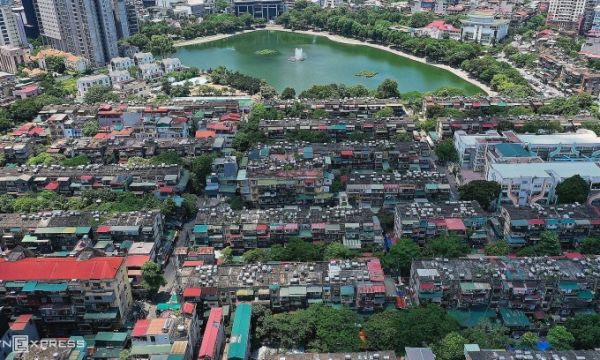
An aerial view of Thanh Cong collective housing complex in Giang Vo Ward, Hanoi. Photo by Read/Ngoc Thanh |
Within Ring Road 2, the city will comprehensively redevelop aging apartment buildings and deteriorating collective housing blocks under an integrated TOD-CBD model that combines public transit with commercial and financial centers. Hanoi currently has about 2,160 old apartment buildings and collective housing units, most built between the 1960s and 1980s. Renovation has progressed slowly, reaching only 1-2% of plan despite years of attempts. Industry experts say the capital faces a dual challenge of ensuring safety in the aging blocks while meeting housing demand and keeping the property market stable.
Outside Ring Road 3, Hanoi will develop multi-purpose urban zones along metro corridors under a compact development model clustered around stations. Social and worker housing will be prioritized for large-scale, concentrated planning and construction, with projects required to sit at sites well-connected to the metro network to serve low-income residents and factory workers in the city’s industrial parks.
On market management, Hanoi plans to establish financial and planning tools to curb property speculation. The city is also pushing the rental housing market and promoting green, energy-efficient real estate tied to TOD infrastructure.
The 100-year master plan covers Hanoi’s entire administrative area of about 3,359 sq.km. It envisions the city’s population growing from about 8.5 million today to 14-15 million by 2035 and 17-19 million by 2065, with a long-term cap of 20 million.
Hanoi will develop along a multi-tier, multi-layer, multi-pole, multi-center structure with the Red River as the main ecological and cultural landscape axis.
By 2035, the city aims to reach a gross regional domestic product of around $200 billion and per capita GRDP exceeding $18,800, positioning itself as a regional center for finance, commerce and innovation.
-
These two banks issued downtime alert, many services will remain closed on May 17, transactions will be disrupted

-
Delhi BLO Survey 2026: Rules changed! Getting voter card made or corrected in Delhi has become easier, see new government order

-
Chinese night market vendor makes $7,400 a month selling fried rice in suit

-
Even my room isn’t mine: my life in a joint family

-
Neuroscience Says Quantum Jumping Timelines Can Genuinely Change Your Life