
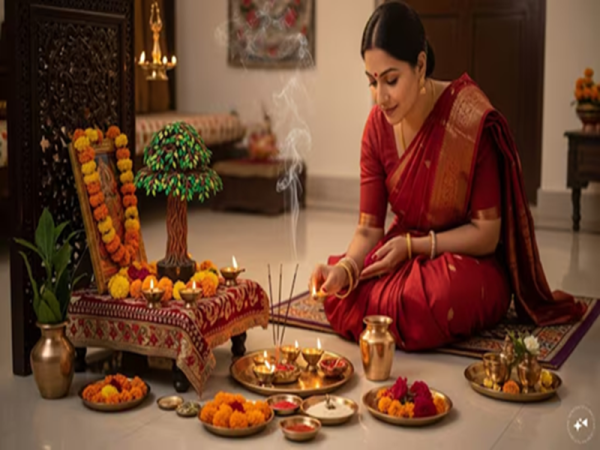
Vat Savitri Puja: The mere mention of the Vat Savitri *Vrat* (fast) conjures up images of women performing rituals around a banyan tree; however, amidst changing urban landscapes, the rise of "flat culture," and the hustle and bustle of modern life, finding a banyan tree everywhere is no longer an easy task. Consequently, a question arises in the minds of many women every year: How does one observe the fast and perform the *puja* if there is no banyan tree (*Vat Vriksha*) in the vicinity? Would the worship be considered incomplete without the presence of a banyan tree?

This year, the Vat Savitri *Vrat* will be observed on Saturday, May 16, 2026. On this day, married women observe a *Nirjala* (waterless) fast to pray for their husbands' longevity and a blissful married life. While religious traditions certainly ascribe special significance to the banyan tree, the scriptures ultimately prioritize one's inner sentiment and devotion above all else. For this very reason, Vat Savitri *Puja* can now be performed at home—either by worshipping a picture of the tree or through symbolic representation. Women residing in metropolitan areas and smaller towns, in particular, have increasingly begun to adopt this method.
When will the Vat Savitri *Vrat* be observed in 2026?
According to the Hindu *Panchang* (calendar), the Vat Savitri *Vrat*—traditionally observed on *Jyeshtha Amavasya* (the New Moon day of the month of Jyeshtha)—will fall on May 16 this year. The *Amavasya Tithi* (lunar phase) will commence at 5:11 AM on May 16 and conclude at 1:30 AM on May 17. On this day, women prepare for worship after their morning bath; they perform rituals beneath the banyan tree (or its representation) and listen to the sacred legend of Savitri and Satyavan. In various regions, this observance is also known by the names *Badmavas* and *Bargadahi*.
Why is the Banyan Tree considered special?
Its Significance is Rooted in Religious Beliefs
In Hinduism, the banyan tree is revered as a symbol of longevity and stability. Its deep-seated roots and sprawling branches are believed to signify enduring and strong relationships. Legend has it that it was beneath this very banyan tree (*Vat Vriksha*) that Goddess Savitri successfully reclaimed her husband Satyavan's life from Yama, the God of Death. Since that time, this fast has been inextricably linked with prayers for a husband's long life and eternal marital bliss (*Akhand Saubhagya*). In villages, women even today traditionally perform worship by tying a thread around a banyan tree. However, in cities, this is often no longer feasible.
**What to do if a banyan tree is unavailable?**
**The entire ritual can be performed right at home**
According to religious scholars, if a banyan tree (*Vat Vriksha*) is not available in the vicinity, the worship can be performed at home. For this purpose, a picture of a banyan tree, a small idol, or a symbolic representation made of clay can be used. Many women nowadays print out an image of the banyan tree from the internet to perform the worship. Some individuals also choose to perform the ritual near a small potted plant or a *Tulsi* (Holy Basil) plant. It is believed that worship performed with a sincere heart and deep faith yields the full spiritual reward.
**How to perform Vat Savitri Puja at home?**
**A Simple Worship Method**
First, spread a red or yellow cloth in a clean area of your home. Place the picture or idol of the banyan tree upon it. Then, light a lamp and offer *Roli* (vermilion), *Akshat* (unbroken rice grains), flowers, and fruits. Subsequently, take a length of raw cotton thread and wind it around the picture or symbol seven times. Afterward, read or listen to the legend of Savitri and Satyavan. Finally, pray for your husband's longevity and for peace and harmony within the family. Many women break their fast in the evening after completing the worship. In some regions, the tradition of offering *Bayna* (ritual gifts) to one's mother-in-law is also observed.
**Worship Practices Evolve with Changing Times**
In the modern era—characterized by social media and the availability of online worship materials—religious traditions are also beginning to manifest in new forms. Women residing in large cities, who may be unable to visit a temple, are now performing their worship from the comfort of their homes. Interestingly, many temples now conduct online sessions for religious storytelling (*Katha*) and worship rituals. This allows women living far away to easily learn and follow the proper procedures for observing the fast. Religious experts emphasize that the most essential elements of worship are faith and devotion. If one's heart is pure, a symbolic act of worship is considered just as spiritually fruitful as a ritual performed beneath an actual banyan tree.

The Vat Savitri fast is not merely a tradition; it is regarded as a profound symbol of trust, dedication, and love within the relationship between a husband and wife. Even if you cannot find a banyan tree nearby, there is no need to worry. Worship performed at home—with true devotion and adherence to rituals—is considered equally auspicious.
PC Social Media
-
27 buffaloes rescued from illegal transport vehicle near Jappinamogaru

-
Concerns Rise Over Weather Patterns as Early Monsoon Approaches India

-
Tourists fined Rs 2,000 for littering near Saanur on Karkala–Moodubidri highway

-
New data 'shows common drink slashes heart disease risk by 22%'

-
'Exceptional' BBC series starring musician makes splash on Rotten Tomatoes