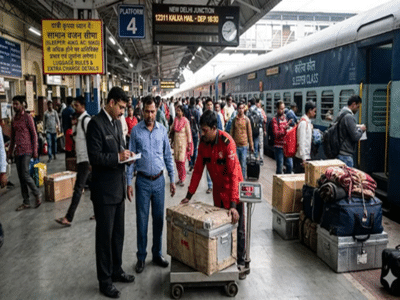
Railway Luggage Rules: Are you planning to travel by train and have already packed your bags? Make sure to check their weight once; otherwise, you might end up paying a hefty sum at the station. Indian Railways has once again clarified that traveling with luggage exceeding the prescribed limit is a direct invitation for a fine. Many passengers—either unknowingly or due to negligence—board trains carrying more luggage than necessary; however, if caught during an inspection, they are required to pay heavy charges calculated based on the distance of travel and the excess weight. In such scenarios, a little caution before commencing your journey can save you from significant trouble.
According to railway regulations, a distinct luggage limit is prescribed for each class of travel. Within this limit, you may carry your luggage without incurring any additional charges; however, the moment the weight exceeds this threshold, it immediately results in a penalty.
What to do in the event of a gas leak? This information could save your life and your home—simply follow these steps.
How much luggage is permitted in each coach?
As per railway rules, every coach category has a specific 'free allowance' limit for luggage weight. If you are caught carrying luggage that exceeds this limit, you may be liable to pay a fine that is several times higher than the standard rates. Let's take a look at the weight limits permitted for each coach category:
AC First Class (1A): You are permitted to carry up to 70 kg of luggage in this class.
AC 2-Tier (2A): A limit of 50 kg has been prescribed for passengers traveling in this coach.
AC 3-Tier (3A) and Sleeper Class: In these categories—which are popular choices among the middle class—you are allowed to carry a maximum of 40 kg of luggage.
General or Second Sitting (2S): This category has the lowest allowance, permitting passengers to carry only 35 kg of luggage.
How are charges levied if the limit is exceeded?
If a passenger is found traveling with luggage that exceeds the prescribed limit, the Railways levies a charge on the excess weight, calculated based on the distance of the journey. For long-distance travel, this amount can be quite substantial; therefore, even a small amount of excess luggage could end up costing you dearly. What to Do If You Have Excess Luggage?
If you suspect that your luggage exceeds the prescribed limit, it is advisable to visit the railway parcel office in advance and book it there. Booked luggage is securely stored in the train's luggage van and can be collected upon your arrival at your destination station. This allows you to avoid both fines and arguments. Luggage limits are determined on a per-passenger basis. This means that if three people are traveling in Third AC, a combined total of up to 120 kg of luggage may be carried. However, the rules regarding tickets for small children may differ; therefore, caution is advised when calculating the total weight.
Why Are These Rules Necessary?
The railways state that these rules have been established to ensure the comfort and safety of passengers. Excess luggage reduces available space within the coach, creates difficulties during boarding and alighting, and increases risks in the event of an emergency. Therefore, passengers are advised to "travel light" and ensure that their luggage remains within the prescribed limits.
Disclaimer: This content has been sourced and edited from NDTV India. While we have made modifications for clarity and presentation, the original content belongs to its respective authors and website. We do not claim ownership of the content.
-
Karnataka govt forms cabinet sub-committee to study State Education Policy

-
Boy killed, several seriously injured after lorry overturns near Konandur in Thirthahalli

-
Minister Atul Bora Reviews Border Development Initiatives Amid Tensions

-
FC Goa and Kerala Blasters Set for Thrilling Season Finale in Kochi

-
Thirthahalli student Anagha secures state first rank after SSLC revaluation