Japanese investment giant SoftBank Group has delivered one of the biggest profit performances in corporate Japan’s history, thanks largely to its massive bet on artificial intelligence. The company reported a staggering net profit of 1.83 trillion yen ($11.6 billion) for the January–March quarter, more than tripling its earnings from the same period last year.
Even more striking, SoftBank said its annual profit crossed 5 trillion yen, which Chief Financial Officer Yoshimitsu Goto described as the highest-ever annual profit recorded by a Japanese company. The surge was driven primarily by gains linked to OpenAIthe creator of ChatGPT, where SoftBank has rapidly become one of the most aggressive investors.
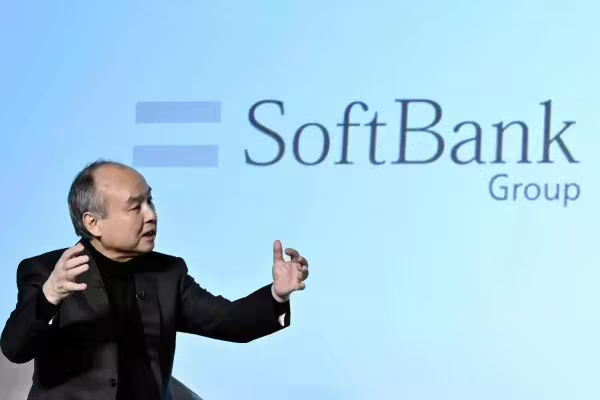
For Masayoshi Son, the charismatic founder and CEO of SoftBank, the results are a strong validation of his renewed AI-focused vision after years of criticism surrounding failed startup bets through the Vision Fund.
Credits: Reuters
OpenAI Becomes SoftBank’s Golden Asset
At the center of this financial turnaround is OpenAI. SoftBank’s Vision Fund booked a 3.1 trillion yen gain during the quarter, largely due to the rising valuation of the AI powerhouse.
SoftBank claims its cumulative gains from OpenAI investments have already reached an astonishing $45 billion. The Japanese conglomerate has gone all-in on the belief that generative AI will transform industries worldwide, much like the internet and smartphones did in previous decades.
The company had previously announced plans to invest another $30 billion into OpenAI through 2026. If completed, SoftBank’s total investment in the AI company would rise to nearly $65 billion, giving it around a 13% stake.
That makes OpenAI one of the largest and boldest investments SoftBank has made since launching its Vision Fund strategy in 2017.
But the AI Race Is Getting More Competitive
Despite the impressive gains, not everyone is convinced that SoftBank’s giant AI gamble is risk-free.
OpenAI is no longer the only dominant force in the generative AI market. Rivals such as Google’s Gemini, Anthropic’s Claude, and several emerging AI labs are rapidly improving their models and attracting enterprise customers.
At the same time, the cost of training and running large AI models continues to skyrocket. Investors and analysts worry that AI companies may need enormous amounts of capital for years before generating stable profits.
Still, SoftBank executives remain optimistic. CFO Yoshimitsu Goto argued that increasing competition is actually good for the industry because it expands adoption and creates new use cases for AI technologies.
For SoftBank, the bigger vision is clear: dominate the infrastructure and ecosystem powering the next AI revolution.
Financing the Biggest AI Bet in the World
The scale of SoftBank’s OpenAI investment has also raised questions about how the company plans to fund such aggressive spending.
Over the past few years, SoftBank has sold stakes in valuable holdings like Nvidia and T-Mobileissued bonds, and taken loans backed by its ownership in Arm Holdings and SoftBank Corp.
In March, the company arranged a massive $40 billion bridge loan agreement. SoftBank confirmed that $20 billion had already been drawn in April, mainly to support its OpenAI investment plans. Interestingly, the company has already repaid $2.5 billion of that amount.
Goto also hinted that SoftBank may use its OpenAI stake itself as collateral for future financing. That possibility highlights just how valuable the AI investment has become for the company’s balance sheet.
Credits: inkl
Beyond AI: SoftBank’s Robotics Push
SoftBank is not stopping at AI software alone. The group is also building a strong robotics portfolio, betting that AI-powered machines could become the next major growth engine.
Last year, SoftBank agreed to acquire the robotics business of Swiss engineering giant ABB in a $5.4 billion deal. The company has since created a dedicated robotics subsidiary to manage these investments.
Additionally, SoftBank reported gains from its investment in Intelnow led by former SoftBank board member Lip-Bu Tan.
For investors, the message is becoming increasingly clear: SoftBank is transforming itself from a traditional tech investor into one of the world’s biggest AI and robotics powerhouses. And for now, the market appears to be rewarding that strategy.
-
Investigation Continues into Nancy Guthrie's Disappearance: Authorities Analyze Digital Evidence

-
Once-thriving airline opened in 1927 declared bankruptcy and shut down

-
Penny Lancaster makes rare Rod Stewart admission after 'ratbag' comments

-
Kamala Harris Sparks Controversy Over Supreme Court Expansion Proposal

-
Controversial Streamer Dalton Eatherly's Fundraiser Takes a Dark Turn After Arrest