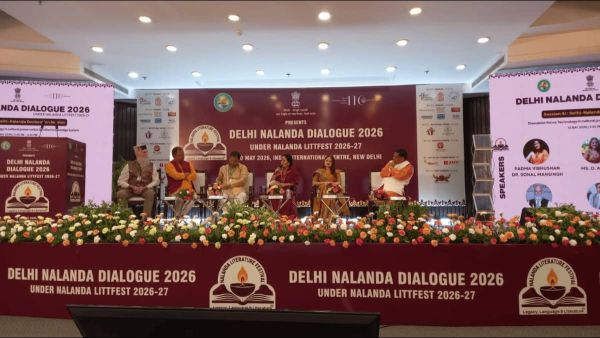
New Delhi: In the heart of New Delhi, where the gentle hum of a modern metropolis meets the quiet resonance of centuries past, the India International Centre’s Kamaladevi Complex transformed into a luminous crossroads of civilisation on May 9-10. Over two days, the Delhi–Nalanda Dialogue 2026 unfolded like a living manuscript--its pages turned not by wind, but by the voices of India’s finest minds. Here gathered the who’s who of governance, academia, diplomacy, and bureaucracy: seasoned policymakers and emerging thinkers, distinguished diplomats and devoted civil servants, celebrated writers and profound scholars. They came not merely to speak, but to listen, to reflect, and to rediscover the eternal flame of India’s knowledge traditions. Under the banner of the Nalanda Literature Festival 2026–27, they engaged in conversations that wove ancient wisdom with contemporary challenges--threads of heritage and modernity intertwined with grace and purpose.
What made this gathering truly magnificent was not only the depth of discourse but the quiet mastery with which it was orchestrated. Organised by Dhanu Bihar in close collaboration with the Department of Art, Culture & Languages, Government of NCT of Delhi, and the India International Centre, the Dialogue stood as a shining testament to vision, professionalism, and heartfelt commitment. Seamless in execution, inclusive in spirit, and rich in participation, with over a hundred senior delegates alongside fresh, vibrant voices, the event maintained a rare balance: honouring Nalanda’s glorious legacy while illuminating its living relevance to today’s world.
Building upon the triumphant first edition held in the historic soil of Rajgir, Nalanda District, where substantive sessions and grand cultural performances had already stirred the nation’s imagination, the Delhi chapter carried forward that same energy with even greater institutional momentum. Just five months later, the organisers have already set in motion an ambitious series of multi-city dialogues, paving the way for a grand second edition of the festival in October 2027.
In an age often distracted by the ephemeral, the Delhi–Nalanda Dialogue reminded us of something enduring: that India’s greatest contribution to the world has always been the light of knowledge--generous, timeless, and profoundly human. Through this festival, the organisers have lit a lamp along the path that connects our ancient universities of wisdom to the aspirations of a rising Bharat.
Sanjay Kumar, Executive Director of Nalanda LittFest, set an early tone in the inaugural session: “Nalanda’s destruction did not end its legacy... The real continuity of Nalanda lies not in its ruins, but in the intellectual journeys it enabled.” His remarks captured the event’s spirit--shifting focus from monuments to the movement of ideas.
Amitabh Kant, former CEO of NITI Aayog and India's G20 Sherpa, who visited the ruins of Nalanda during the first edition of Nalanda Literature Festival in 2025, emphasised strategic dimensions: “Nations today are not defined by economics alone... civilizational depth and cultural confidence shape global influence. Literature becomes a powerful instrument in positioning India as a knowledge leader.”
Padma Vibhushan Dr. Sonal Mansingh, Chairperson of Nalanda LittFest, brought philosophical depth: “In our traditions, knowledge was never transactional, it was experiential, evolving through dialogue, devotion, and dissent.”
Festival Chairperson D. Aaliya reinforced the platform’s purpose of breaking silos between governance, culture, and literature, with youth as active participants.
Prof Sachin Chaturvedi, Vice-Chancellor, Nalanda University noted, “Nalanda’s model reminds us that institutions cannot exist in isolation--its strength came from its embeddedness within society, where knowledge and community evolved together.”
The sessions delivered a rich, multi-layered exploration. IIC Director KN Srivastava and Nalanda LittFest Director Ganga Kumar contributed to the administrative and cultural framing that grounded these conversations.
Subsequent panels examined governance ethos, with Amarjeet Sinha, Kavita Sharma, and Mugdha Sinha reflecting on decentralised traditions, institutional discipline, and vigilance--lessons drawn from Nalanda’s history. On culture, diplomacy, and soft power, Ritu Sharma observed that “Cultural diplomacy... travels through stories, memory, and lived experiences,” echoed by Sanjeev Chopra, Varsha Das, and Anju Ranjan, who spoke of organic expansion, plurality as strength, and authenticity.
The diaspora session offered poignant insights. Sarita Boodhoo from Mauritius explained how the diaspora “does not merely preserve culture, it reshapes it,” while Suman Keshari noted that “Distance does not dilute identity, it often deepens it.” Contributions from Anil Sooklal and Ajay Dubey added layers on forged identities and hybrid expressions.
Youth innovation and cultural leadership featured Sachchidanand Joshi of IGNCA, who praised the National Education Policy 2020 for centering Indian knowledge. Shovana Narayan cautioned on AI’s role as a tool rather than replacement for creativity, joined by Mukul Kumar and Nitishwar Kumar on digital revival and experiential depth. Tajender Singh Luthra stressed culture’s place among the people, not just elites.
Day two deepened these themes. Sessions on Indian languages featured A.J. Alphons, M.J. Warsi, Kaushal Kishore, and Surekha Sahu on linguistic diversity as living archives. Public engagement discussions included Vishwapati Trivedi on translation and Chaitanya K. Prashad on digital access.
Nalanda as a global tradition came alive through Prof. Siddharth Singh, Vice-Chancellor of Nava Nalanda Mahavihara, who called it “a living tradition of wisdom,” alongside Anand Singh and Himanshu Prabha Ray on manuscripts and archaeology. Eminent author William Dalrymple provided vivid historical context: “Nalanda was like modern AI--you could access immense knowledge instantly,” while noting that only about 20 percent has been excavated and urging stronger conservation.
"Once Nalanda was established, it became the undisputed centre of learning and authority," Dalrymple said, emphasising the importance of India's contribution to the world.
The AI and future learning session, moderated by Aditi Maheshwari, included Uma Kanjilal on a “Digital Nalanda,” Amit Pandey, Aquil Ahamad, and Anand Kumar on balancing technology with consciousness and human creativity.
The concluding plenary, moderated by Sanjay Kumar with Sonal Mansingh, D. Aaliya, and K. Mahesh, synthesised outcomes. Dr. K. Mahesh, Secretary (Art & Culture), Government of NCT of Delhi, called for urgent manuscript access, revival of gazetteers, and recognition of languages like Bhojpuri. Dr. Sonal Mansingh reaffirmed: “Art, culture, and knowledge remain India’s strongest pillars.”
The well-curated event blended rigorous discussion with cultural warmth. Evenings featured Vidya Shah’s “Sur, Shabd aur Taal” on Tagore Jayanti and Taskeen Ali Khan’s energetic Qawwali, leaving participants energised.
Organisers managed the Dialogue with notable professionalism--tight scheduling, inclusive participation, and a clear thread connecting ancient wisdom to modern challenges without overstatement. As a distinctive Delhi edition following Rajgir’s acclaimed debut, it demonstrated growing institutional momentum. With multi-city dialogues already in motion ahead of the October 2027 festival, the Nalanda initiative is evolving into a sustained platform for civilizational engagement.
-
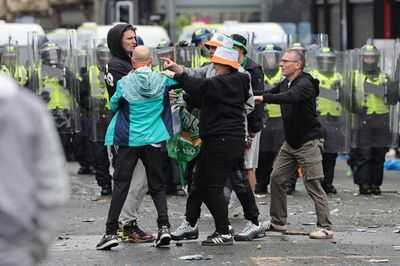
Police responding to medical emergency pelted with bottles by rowdy Celtic fans
-
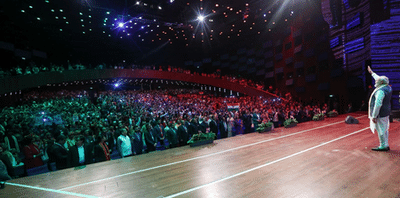
Indian diaspora is a living bridge of India-Netherlands partnership: PM Modi
-
Rory McIlroy makes dramatic PGA Championship U-turn and plans to 'forget about things'

-
Vernon Kay's dad breaks silence on cheating rumours after Tess Daly split
-
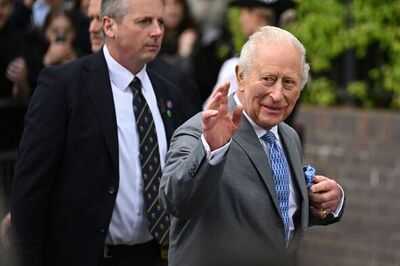
Armed police guarding King Charles 'fall asleep on the job'