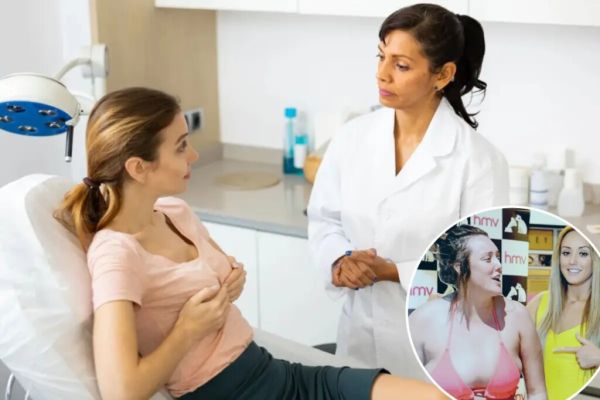
For some, the dreaded “uniboob” isn’t just a side effect of a too-tight sports bra or a fashion mishap that resolves once you get home.
In rare cases, it’s a real medical condition that can alter the natural shape of the chest, sometimes merging what are typically two distinct breasts into a single, continuous mound.
Here’s everything you need to know about symmastia.
What is symmastia?
Also known as “bread-loafing,” it’s a condition where the breasts meet or fuse in the center of the chest, leaving little to no cleavage and creating the appearance of a single “uniboob.”
What causes it?
That depends on the type.
Congenital symmastia is rare and present from birth. It happens when a web of skin, fat and tissue naturally extends over the sternum, blurring the separation between the breasts.
Doctors aren’t entirely sure why it happens, but genetics are believed to play a role.
There’s also acquired — or iatrogenic — cases of symmastiawhich are still rare but more common than the congenital type.
These typically show up as a complication after breast augmentation or reconstructive surgery, when implants drift toward the center of the chest and eventually touch or merge.
That can happen for a few reasons: implants that are too large for the patient’s frame, placement that’s too close together or surgical missteps that stretch or disrupt the tissue between the breasts.
It can also stem from over-dissection of breast tissue or an improperly created implant pocket, which allows the implants to migrate inward.
Women with a naturally narrow breastbone or conditions like chest hollowed out — where the sternum sinks inward — may be at higher risk for acquired symmastia.
And here’s the tough part: it may not be obvious right away. Post-surgery swelling can temporarily hide the issue in the early stages of recovery.
Is symmastia dangerous?
Not typically. Symmastia isn’t considered life-threatening, and doesn’t usually affect the functioning of organs like the heart or lungs.
But it can still cause problems. For example, the skin in the center of the chest may rub together, leading to chafing, irritation or discomfort.
The bigger impact is often emotional. For many patients, the condition can take a serious toll on confidence and body image.
English TV personality Charlotte Crosbywho rose to fame on MTV’s “Geordie Shore” and later won “Celebrity Big Brother” (UK series 12), has spoken openly about her congenital condition.
In an interview with OK! Magazine in 2017Crosby said the condition — which her mother also has — makes her feel “under-confident” and causes wardrobe challenges, including not being able to wear “low-cut things with a deep V.”
She has also described the trolling she’s faced on social media over her chest.
“If a picture of me is online, people say things like ‘What is wrong with her boobs?’” Crosby told Heat magazine. “‘They’re deformed! They’re stuck together’.”
Is symmastia treatable?
Yes — but fixing it isn’t always simple.
If the condition develops shortly after surgery, a specially designed compression bra that presses the center of the chest can sometimes help restore cleavage.
More often, though, surgery is needed, sometimes more than once.
Options vary depending on the case. Some patients undergo liposuction and excision to remove excess tissue in the center of the chest, helping to recreate cleavage.
Others may receive breast implants to improve shape and definition.
In some cases, surgeons also use internal sutures to anchor tissue to the breastbone, helping to prevent the breasts from drifting inward again.
If implants caused the issue, revision surgery may involve reopening the breast pockets, removing scar tissue and repositioning or replacing the implants.
One person who has spoken about trying to correct the condition is “The Real World” alum Flora Alexeyeunwho developed symmastia after undergoing three cosmetic procedures on her chest.
She later sought help from surgeons Terry Dubrow and Paul Nassif on the reality series “Botched,” where she underwent corrective treatment.
“Before my surgery, I had a uniboob situation that was not sexy at all,” Alekseyeun said on an episode that aired in 2020. “Now, thanks to Dr. Dubrow, I have two separate breasts.”
Crosby also underwent surgery in 2017 to correct her congenital condition, receiving implants to help reconstruct cleavage.However, she later had them removed after developing pain, inflammation and scar tissue.
Like any surgery, there are potential complications when it comes to fixing symmastia. These can include scarring, uneven breast shape or size, and in some cases, the condition returning.
To reduce the risk of iatrogenic cases in the first place, experts generally recommend choosing a highly experienced, board-certified plastic surgeon when undergoing breast augmentation, and selecting implants that properly match your natural anatomy.
-
Investigation Continues into Nancy Guthrie's Disappearance: Authorities Analyze Digital Evidence
-
Once-thriving airline opened in 1927 declared bankruptcy and shut down

-
Penny Lancaster makes rare Rod Stewart admission after 'ratbag' comments
-
Kamala Harris Sparks Controversy Over Supreme Court Expansion Proposal

-
Controversial Streamer Dalton Eatherly's Fundraiser Takes a Dark Turn After Arrest