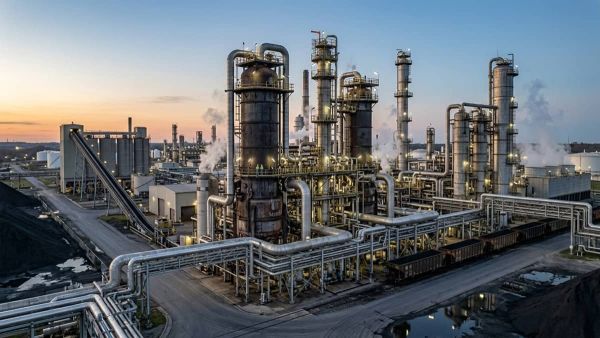
New Delhi: Amidst a global energy crisis, an old fuel source buried deep beneath Indian soil has been thrust back into the policy limelight as the Narendra Modi government seeks to shield the country from global energy volatility. The Union Cabinet on Wednesday approved a Rs 37,500 crore support scheme for coal and lignite gasification, a move that could attract as much as Rs 3 lakh crore in private investment, according to the officials.
The gasification announcement has been made at a sensitive moment for energy markets, with the supply routes remaining under strain due to the ongoing Iran conflict. The Reserve Bank of India (RBI) has cautioned that fuel prices could climb if hostilities persist in West Asia. In the backdrop of such a volatile situation, the government is accelerating efforts to secure domestic alternatives and reduce dependence on costly energy imports.
The officials asserted that by turning abundant domestic coal into gas, chemicals and fuels, India hopes to substitute products it currently buys from abroad. The plan represented a practical theme in a bigger energy strategy that still prioritises renewables, but acknowledges the immediate need for import substitution in chemicals, fertilisers and industrial gas.
How Coal Gasification Works And Why It Matters
The officials explained that the coal gasification, contrary to the image the name evokes, does not involve burning coal outright. Instead, the crushed coal is heated with a controlled amount of oxygen and steam under high temperature and pressure. The process produces syngas, a mixture mainly of carbon monoxide and hydrogen, which can be converted into methanol, ammonia, urea, synthetic natural gas, hydrogen and a range of liquid fuels and chemicals.
In the push for coal gasification by the government, the economic logic is straightforward. In the financial year 2024-25, India spent Rs 2.77 lakh crore importing goods that gasification could replace, including liquefied natural gas (LNG), methanol, ammonia and ammonium nitrate. Further, the import dependence is particularly acute in some segments, with ammonia entirely imported, methanol at 80 to 90 percent, LNG at about 50 percent, and urea at 20 percent.
As per the experts, India’s coal reserves give the policy weight, as the country holds 401 billion tonnes of coal and 47 billion tonnes of lignite, with annual consumption already around one billion tonnes. The coal accounts for over 55 percent of primary commercial energy and 72 percent of power generation, while production reached 1047.5 million tonnes in FY25. Around 40 percent of these reserves lie deep underground and are difficult to mine conventionally, but gasification could unlock them without large-scale excavation.
Policy Timeline And Global Precedents
The latest push by the Modi government builds on a stepped programme that began several years ago. In 2018, the government announced a coal gasification-based fertiliser project at Talcher. The incentives followed in commercial coal mining auctions in 2020, and a roadmap for coal-based hydrogen was set out in 2021. In January 2024, Rs 8500 crore was earmarked to support 8 projects, while the Ministry of Coal launched India’s first underground coal gasification pilot in Jharkhand the same year.
The new scheme targets 100 million tonnes of annual coal gasification capacity by 2030. The private sector interest is already materialising, with the Adani Group beginning work on a Rs 70,000 crore plant in Nagpur that will produce syngas, ammonia and hydrogen.
The international experience offered both a template and a caution, with China now producing around 70 percent of its methanol and over 90 percent of its ammonia through coal gasification, making it the world’s leading methanol producer. Indonesia has invested $2.3 billion in a plant to reduce LPG imports, while Japan has advanced integrated gasification combined cycle technology and clean coal research since Fukushima. Though early attempts in the United States saw limited commercial success.
Union Information and Broadcasting Minister Ashwini Vaishnaw emphasised that the scheme was designed to “crowd in” private capital at scale, giving industry the long-term visibility needed for such capital-intensive projects.
Balancing Gasification With Renewables
The experts suggested that the gasification remains coal-based, but it is cleaner and more efficient than direct combustion and allows carbon capture more readily at the syngas stage. The government is framing it as a complementary measure for import substitution in chemicals and gas, not as a retreat from clean energy.
India added 57.5 GW of net capacity in FY26, with 95 percent coming from renewables, including large hydro. Total installed capacity now stands at 533 GW, of which 52 percent is renewable. Another 151 GW is under construction, and storage tenders are gathering pace, according to data from the Council on Energy, Environment and Water’s Green Finance Centre.
Simultaneously, the policymakers are also exploring geothermal energy, apart from gasification and renewables. A recent study by Project InnerSpace and the Council on Energy, Environment and Water estimates India’s technical potential at 11,000 GW for industrial heat, more than 1500 GW for cooling, and 450 GW for electricity generation. States such as Gujarat, Uttar Pradesh, West Bengal, Telangana, Maharashtra and Andhra Pradesh are seen as promising, with pilot projects like the Tapri geothermal cold storage in Himachal Pradesh already underway.
-
Capricorn Daily Horoscope Today (Dec 22 - Jan 19), May 17, 2026: Stay Humble, Manage Your Diet Wisely

-
One Nation, One Election can align polls nationwide by 2034: JPC
-
CBSE Says Errors Possible In Evaluation, Opens Rechecking Process For Class 12

-
WHO declares Ebola outbreak a global health emergency after 80 deaths

-
Wine investor says 'snap up 3 bottles now' as they could be worth thousands