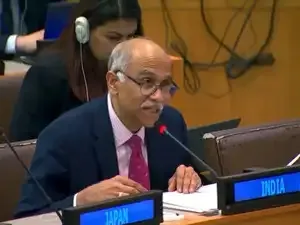
India's Permanent Representative to the United Nations Parvathaneni Harish outlined India's approach towards tackling the ongoing energy and fertiliser crisis amid the conflict in West Asia, stressing the need for a combination of short-term and long-term measures backed by international cooperatioHarish said he participated in the Special Meeting of the United Nations Economic and Social Council (UNECOSOC) on safeguarding energy and supply flows. He emphasised that a mix of immediate and structural measures, along with international cooperation, would be essential to effectively respond to the crisis. Harish also reiterated India's concerns over disruptions to maritime security and freedom of navigation in the Strait of Hormuz.
"Shared India's approach to the recent energy and fertiliser crisis in light of the West Asia conflict at the Special Meeting of the UNECOSOC on Safeguarding energy and supply flows. A combination of short-term and structural measures alongside international cooperation are essential to respond to the crisis. Reiterated that targeting of commercial shipping, endangering civilian crew and impeding freedom of navigation in the Strait of Hormuz, are unacceptable. International law in this regard must be fully respected," Harish wrote on 'X'
This comes after Iran announced a "professional mechanism" to regulate maritime traffic in the Strait of Hormuz through a designated route, which will be unveiled soon.
In a post on X, Iranian Parliament's NSC chief Ebrahim Azizi said that the proposed mechanism has been developed within the framework of Iran's national sovereignty and with the aim of ensuring the security of international trade. He further stated that only commercial vessels and parties cooperating with Iran would be permitted to benefit from the mechanism. Azizi also said that the proposed route would remain closed to operators associated with the so-called "freedom project."
"Iran, within the framework of its national sovereignty and the guarantee of international trade security, has prepared a professional mechanism to manage traffic in the Strait of Hormuz along a designated route, which will be unveiled soon. In this process, only commercial vessels and parties cooperating with Iran will benefit from it. The necessary fees will be collected for the specialized services provided under this mechanism. This route will remain closed to the operators of the so-called 'freedom project'," said the 'X' post from Azizi.
Earlier in the day, US President Donald Trump warned of "very bad time" if any peace deal to end the West Asia crisis is not reached, Al Jazeera reported, while quoting local French broadcaster BFMTV.
Meanwhile, Iranian Foreign Minister Abbas Araghchi asserted that the United States remains the primary barrier to peace in West Asia. Araghchi claimed that after more than a month of failed military objectives, the US attempted to pivot toward dialogue, a move met with deep-seated scepticism in Tehran.
Addressing a press conference in New Delhi following a meeting of the BRICS Foreign Ministers, the Iranian Foreign Minister laid bare the trust deficit defining the current geopolitical standoff."Now, after 40 days of war, when the US became hopeless of achieving any goal in their aggression against Iran, they offered negotiation... We have no trust in Americans... This is the main obstacle in the way of any diplomatic effort. We have every reason not to trust Americans, while they have no reason not to trust us," he stated.
"Shared India's approach to the recent energy and fertiliser crisis in light of the West Asia conflict at the Special Meeting of the UNECOSOC on Safeguarding energy and supply flows. A combination of short-term and structural measures alongside international cooperation are essential to respond to the crisis. Reiterated that targeting of commercial shipping, endangering civilian crew and impeding freedom of navigation in the Strait of Hormuz, are unacceptable. International law in this regard must be fully respected," Harish wrote on 'X'
This comes after Iran announced a "professional mechanism" to regulate maritime traffic in the Strait of Hormuz through a designated route, which will be unveiled soon.
In a post on X, Iranian Parliament's NSC chief Ebrahim Azizi said that the proposed mechanism has been developed within the framework of Iran's national sovereignty and with the aim of ensuring the security of international trade. He further stated that only commercial vessels and parties cooperating with Iran would be permitted to benefit from the mechanism. Azizi also said that the proposed route would remain closed to operators associated with the so-called "freedom project."
"Iran, within the framework of its national sovereignty and the guarantee of international trade security, has prepared a professional mechanism to manage traffic in the Strait of Hormuz along a designated route, which will be unveiled soon. In this process, only commercial vessels and parties cooperating with Iran will benefit from it. The necessary fees will be collected for the specialized services provided under this mechanism. This route will remain closed to the operators of the so-called 'freedom project'," said the 'X' post from Azizi.
Earlier in the day, US President Donald Trump warned of "very bad time" if any peace deal to end the West Asia crisis is not reached, Al Jazeera reported, while quoting local French broadcaster BFMTV.
Meanwhile, Iranian Foreign Minister Abbas Araghchi asserted that the United States remains the primary barrier to peace in West Asia. Araghchi claimed that after more than a month of failed military objectives, the US attempted to pivot toward dialogue, a move met with deep-seated scepticism in Tehran.
Addressing a press conference in New Delhi following a meeting of the BRICS Foreign Ministers, the Iranian Foreign Minister laid bare the trust deficit defining the current geopolitical standoff."Now, after 40 days of war, when the US became hopeless of achieving any goal in their aggression against Iran, they offered negotiation... We have no trust in Americans... This is the main obstacle in the way of any diplomatic effort. We have every reason not to trust Americans, while they have no reason not to trust us," he stated.