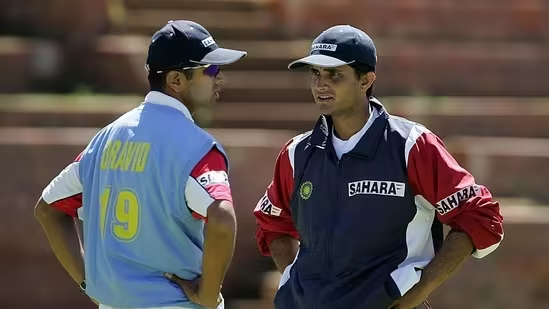
Sourav Ganguly’s latest comments on Rahul Dravid offer more than a nostalgic anecdote. They reopened one of the most consequential tactical decisions in Indian cricket, a move that helped preserve Dravid’s ODI career while reshaping the team structure ahead of the 2003 World Cup.
Speaking on Raj Shamani’s podcast, Ganguly reflected on his leadership philosophy of publicly backing players while privately addressing hard truths. The example he chose was Dravid.
“There was a phase when Rahul Dravid was getting picked in ODIs. But people used to say his strike rate was not good enough. Selectors would say maybe someone else needed to be picked. But I did not leave him, because if I had left him, it could have finished him,” Ganguly said.
That recollection points directly to the early 2000s, when Dravid’s place in India’s ODI side was under genuine scrutiny.
By then, Dravid was already one of India’s most respected batters, but ODI cricket was evolving rapidly. Teams were demanding greater flexibility, quicker scoring and stronger lower-order depth. Dravid’s technique was never in question. The debate was about fit.
India’s structural problem made the pressure worse.
Australia had Adam Gilchrist redefining the wicketkeeper-batter role. South Africa had Mark Boucher. Sri Lanka had Kumar Sangakkara emerging into that same category. India had no comparable option, which often left the batting thinner than rival sides.
The gamble that changed Dravid’s ODI role
Sourav Ganguly explained the thinking behind one of Indian cricket’s most important tactical experiments. “We did not have a wicketkeeper who could bat. Sri Lanka had Sangakkara, South Africa had Boucher, and Australia had Gilchrist. Our batting used to end at six. So we made him the wicketkeeper,” Ganguly said.
That decision was not a stopgap patch. It became a structural reset. The move began around India’s ODI rebuilding phase in 2002 and became central to the combination that carried into the 2003 World Cup. By asking Dravid to keep wickets, India created room for an extra specialist batter while improving balance across departments.
It also helped India bring in players suited to specific roles. “We could play Kaif and extend the batting to seven,” Ganguly said.
The problem was not limited to wicketkeeping. Ganguly also explained that India lacked the kind of genuine all-round depth some rivals enjoyed, forcing the team to improvise with part-time bowling resources.
“We did not have that kind of all-rounder. So Sehwag bowled, Sachin bowled, I bowled, Yuvraj bowled. Good teams had those all-rounders; we did not,” he said.
In hindsight, the decision looks obvious because it worked. At the time, it carried real risk. Dravid was not a natural wicketkeeper in the conventional sense, and the physical demands of the role were significant. But the tactical upside was too important.
The experiment helped India build a more complete ODI side and played a major role in the campaign that ended with a World Cup final appearance in 2003. Ganguly’s comments ultimately reveal how he viewed leadership. Public backing protected confidence. Private decisions demanded uncomfortable adaptation.
Rahul Dravid became the face of one of the boldest examples.
-
Eurovision night filled with music and tension

-
Mango Launji becomes a treasure of taste and health in summer, eat it with pleasure along with Puri-Paratha.

-
Man Messages His High School Bully On Facebook And His Bully Responds

-
Weekly Love Horoscopes For Each Zodiac Sign From May 18 – 24, 2026

-
Flipkart Sale: Up to ₹ 9,000 discount on iPhone 17 Pro, know the whole truth about this viral deal