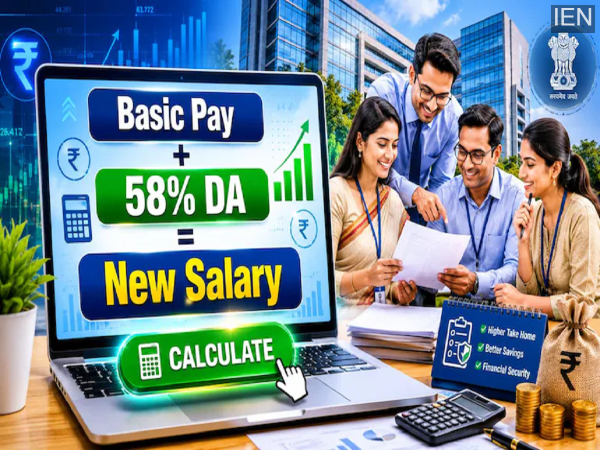
Expectations among central government employees have risen sharply after the formation of the proposed 8th Pay Commission. Amid ongoing discussions, several employee unions have now placed a major demand before the government regarding the merger of Dearness Allowance (DA) with basic salary.
Organizations including All India NPS Employees Federation (AINPSEF) are reportedly demanding that the current DA be fully merged into the basic pay structure. Employee groups argue that periodic DA hikes alone are no longer sufficient to offset rising living costs and inflation.
If the proposal is accepted, experts believe it could lead to a substantial increase in minimum salaries, pensions, and retirement benefits for lakhs of employees.
What Is DA Merger?
Currently, government employees receive:
- Basic salary
- Dearness Allowance (DA)
- Other allowances separately
When DA is merged into the basic pay, the size of the basic salary increases significantly.
This becomes important because several salary components are calculated directly on the basis of basic pay.
Why Employees Want DA Merger
Employee unions argue that inflation and household expenses have increased sharply in recent years.
According to reports submitted to the commission:
- DA is expected to reach around 58% by December 2025
- Rising education, healthcare, and transportation costs are putting pressure on employees
- Small periodic DA revisions are no longer considered enough to manage inflation
Unions believe merging DA into the salary structure would provide more stable and meaningful financial support.
Major Benefits of DA Merger
If DA gets merged into the basic salary, employees could see increases in several areas.
Higher House Rent Allowance (HRA)
Since HRA is linked to basic pay, a higher basic salary would automatically raise HRA benefits.
Better Transport and Future Increment Benefits
Transport allowance and future salary increments could also increase because many of these calculations depend on the revised basic pay.
Higher Pension and Gratuity
Retirement-related benefits such as:
- Pension
- Gratuity
- Leave encashment
could witness major increases because these are heavily linked to basic salary calculations.
How Unions Are Calculating ₹55,000–₹60,000 Minimum Salary
Employee unions have reportedly proposed a new “scientific formula” for determining minimum wages under the 8th Pay Commission.
1. Five-Member Family Unit Model
Currently, minimum salary calculations are reportedly based on a three-member family model.
Unions are demanding:
- Expansion to a five-member family model
- A revised cost-of-living approach
Based on this formula, they estimate the base salary requirement at around ₹30,000.
2. Adding 58% DA
If the estimated 58% DA is merged into the proposed ₹30,000 base amount:
30000+(58%×30000)=4740030000 + (58\% \times 30000) = 4740030000+(58%×30000)=47400
This pushes the amount to approximately ₹47,400.
3. Additional Living and Nutrition Costs
After adding:
- Nutrition expenses
- Healthcare costs
- Education expenses
- Urban transportation costs
employee organizations argue that the minimum basic salary should realistically fall between ₹55,000 and ₹60,000.
Impact Could Extend Beyond Central Employees
Experts point out that if the central government accepts the DA merger proposal, the impact may not remain limited to central government employees alone.
Historically:
- State governments often adopt revised central pay structures later
- Salary revisions at the Centre influence state-level employee demands
- Pension structures across states may also get revised accordingly
As a result, millions of state government employees and pensioners could also be affected indirectly.
Discussions and Consultations Continue
The 8th Pay Commission is currently holding consultations and meetings with various employee organizations and stakeholders regarding:
- Salary revisions
- Pension structure
- DA-related demands
- Family unit calculations
- Allowance restructuring
The government has not yet officially accepted the proposed figures or DA merger demand.
Financial Burden Could Be Significant
Experts say implementing such large-scale revisions could place a major financial burden on the government because:
- Salaries
- Pensions
- Allowances
- Retirement liabilities
would all increase substantially.
However, employee groups maintain that revised salaries are necessary to match the rising cost of living and maintain employee welfare.
Employees Await Final Decision
With discussions intensifying, central government employees and pensioners are closely watching the developments surrounding the 8th Pay Commission.
Whether the government accepts the demand for DA merger and higher minimum salaries remains uncertain for now, but the proposal has already sparked major debate among employee unions, financial experts, and policymakers.
-
IPL 2026, PBKS vs RCB LIVE Score: Punjab won the toss, bowled first, Bengaluru changed captain

-
Doctor told what to do in the morning, focus and strength increases, it also affects mood – News Himachali News Himachali

-
Big news for government employees, new schedule of 8th Pay Commission meetings released
-
Even expensive products will fail! This recipe of lentils will bring glow on the face

-
Kristen Stewart slams Hollywood system, praises ‘Full Phil’ director