
Listen to this article in summarized format
Loading...
××
Subscribe to

Unlock AI Briefing and Premium Content
New Year Offer 24 Hours Left
Subscribe NowAlready a member? Sign In
What's Included
- Exclusive Stories
- Daily ePaper Access
- Smart Market Tools
- Curated Investment Ideas
- Ad-lite Experience
Subscription

The distribution of fertiliser across states in India has long been plagued by shortages, panic buying, diversion allegations, and chaotic scenes outside cooperative societies, with Madhya Pradesh (MP), one of the country’s key agri-producing states, no exception. During the previous kharif season, crowd control emerged as a major challenge at several distribution centres. Against this backdrop, the state rolled out the AgriStack-linked e-Vikas portal statewide from April 1.
While the MP government projects it as a major reform to streamline fertiliser distribution in the state, industry stakeholders say it is a promising initiative but too early to evaluate, while others argue that no system can solve farmers’ problems without uninterrupted fertiliser supply.
Parvar Singh Rajput, a farmer from Vidisha (MP), says the new system has made procurement considerably easier than earlier seasons. “Booking tokens through e-Vikas is simple; getting fertiliser is far easier now compared to the pre-e-Vikas days, when we had to stand in long queues,” he says. “Earlier, we used to purchase through cooperative societies and would get only three or four bags. Now, we can easily procure 30-40 bags at one go.”
Officials say this shift is one of the primary objectives of the platform.
“Farmers need fertilisers at specific times, and any mismatch in their timely availability leads to crowding, long queues, and inequitable access, often hurting smaller farmers the most. We faced issues such as demand spikes during sowing, uneven availability across outlets, and inefficiencies in last-mile delivery,” says Nishant Warwade, Agriculture Secretary, Madhya Pradesh.
“To address these issues, we worked on two fronts. First, Madhya Pradesh already had an ‘Advanced Upliftment’ scheme aimed at pushing fertiliser distribution ahead of the season so supplies reach farmers before peak demand, rather than during it. Second, we strengthened the distribution mechanism through technology using an AgriStack-based system called e-Vikas, short for Electronic Vikas Vitran Krishi Uravarak Aapurti Samadhan. Under this system, a farmer registered on AgriStack can apply for fertiliser of their choice from a retailer of their choice,” adds Warwade.
Allocation under the scheme is linked to the farmer’s landholding and crop pattern. Farmers who are not yet on AgriStack are covered through an exception-handling mechanism, so they continue receiving supplies while being gradually onboarded.
The MP government conducted e-Vikas pilot in three districts in October 2025. Following the positive results, it was then expanded to all 55 districts from April 1, 2026. “As per the latest data, around 14 lakh farmers have benefitted, and nearly 2 lakh tonnes of fertiliser have been distributed through the platform and 11.66 lakh e-tokens have been issued. Most importantly, long queues in front of retail outlets have virtually disappeared,” adds Warwade.
“We are also seeing a behavioural shift,” says Warwade, noting that farmers are increasingly aligning fertiliser demand with crop needs and ICAR-recommended norms instead of booking blindly. There is no cap on additional purchases, and farmers can reapply whenever needed, yet fewer than 5% have sought extra quantities, he notes.
About e-Vikas
The platform digitises fertiliser distribution through Aadhaar-linked e-tokens, QR verification, real-time stock visibility, and slot-based collection. Farmers can generate tokens using their AgriStack IDs between 7 am and 8 pm, with each token valid for 72 hours. Distribution is linked to land records and cropping patterns, while stock updates automatically after fertiliser is lifted from retailers or cooperative outlets.
Under the system, cooperative members are routed to designated cooperative society outlets, while non-members can access nearby centres. The state government says over 1.4 million tonnes of fertiliser stock are currently available and maintains there is no supply shortage. A cap of 50 bags per farmer per month has also been imposed to regulate allocation.
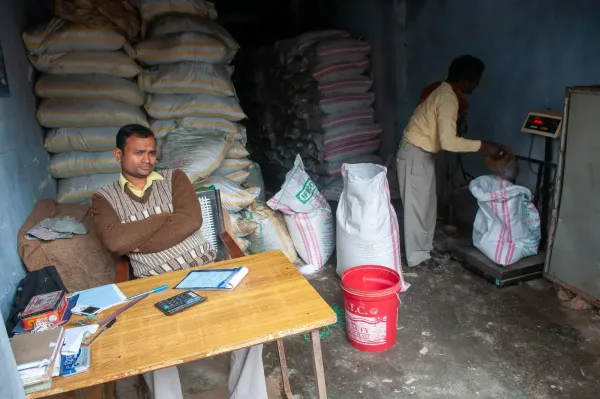 The model was first piloted in Jabalpur, Shajapur, and Vidisha districts before being expanded across the state. Rakhi Raghuvanshi, District Marketing Officer, MARKFED in Vidisha, says the earlier system relied heavily on manual distribution and daily restrictions imposed at local centres. “Before e-Vikas was rolled out, farmers had to visit cooperative societies or vendors, stand in long queues to collect tokens, and then return again on the scheduled date to receive fertiliser,” she says.
Raghuvanshi says that now, through e-Vikas, farmers can view real-time stock availability across MARKFED centres, cooperative societies and private retailers. “Farmers can choose both the fertiliser type and the vendor of their choice through the portal and procure it at their convenience. Farmers can also pre-book and pre-pay for fertiliser online and receive doorstep delivery within 72 hours of the booking slot,” she adds.
Digital system, familiar problems
Even as queues have reduced, some farmers say the new system has created fresh operational problems. Veer Singh, a wheat and soybean farmer from Bhopal, says fertiliser allocations have fallen below actual crop requirements, affecting productivity. He says allocations tied strictly to cropping records have also made it difficult to “procure fertiliser for non-registered crops such as cattle fodder”.
Officials say the system has improved significantly since the pilot phase and add that the Aadhaar-linked authentication remains vulnerable to telecom and connectivity disruptions. “The system runs on Aadhaar-based authentication. If the Aadhaar network is down or there are mobile network issues in a particular area, OTP generation can face problems,” Raghuvanshi says. “Otherwise, it is generally not an issue.”
Officials, however, maintain that farmers in Madhya Pradesh are already accustomed to Aadhaar-based verification through MSP procurement systems, making them more comfortable with technology-driven platforms and reducing resistance to such portals.
Tackling diversion, black marketing
One of the central claims behind e-Vikas is that digitisation can curb the diversion and black marketing of subsidised fertilisers. Under the system, every transaction leaves a digital trail. Stock movement from warehouses to retailers is reflected on the portal, while unupdated or exhausted inventory disappears from the online availability list. Allocation is linked to registered farmers, limiting duplicate purchases and speculative stocking.
Notably, a total of 17,133 retailers have been registered on the portal in the state. Since September 1, 2025, total fertiliser distribution has reached 5.73 lakh tonnes, including 3.62 lakh tonnes of urea and 1.13 lakh tonnes of DAP.
Industry executives say the framework can make diversion significantly more difficult, even if measurable evidence is still evolving.
Rahul Mirchandani, Chairman and Managing Director of Aries Agro, says, “The e-Vikas framework can certainly improve transparency and reduce leakages in subsidised fertiliser distribution through digital tracking, OTP verification, and real-time stock monitoring. While measurable impact data may still evolve over time, the creation of a digital audit trail makes diversion and duplicate lifting significantly more difficult.”
At the same time, Mirchandani cautions, “There are concerns that rigid allocation systems may not fully reflect dynamic on-ground crop requirements, especially for specialty fertilisers and micronutrients, where demand can change rapidly depending on crop stage, weather, and deficiency symptoms. Digital systems should support transparency and advisory functions without constraining genuine demand.”
“Yes, if integrated with soil health data and crop-specific advisories, such systems can gradually encourage more balanced and scientific nutrient application,” adds Mirchandani.
 Core pricing distortion needs correction
According to agriculture economist Ashok Gulati, India’s fertiliser crisis is rooted in a skewed subsidy regime: urea is subsidised by nearly 90%, while phosphatic and potassic fertilisers get far less support. The sharp gap between domestic and global prices has fuelled diversion of subsidised urea to industries and smuggling to neighbouring countries.
The government’s response, Gulati says, focuses excessively on administrative controls rather than correcting the core pricing distortion. Measures such as quantity caps, e-tokens, AgriStack integration, and QR-based monitoring are seen as “second-best” solutions that attempt to ration access without reforming prices. The argument is that if urea remains heavily subsidised, restrictions such as limiting purchases will not eliminate diversion incentives.
“The proposed alternative is a full decontrol of fertiliser prices combined with direct income transfers to farmers on a per-hectare basis. Under this model, subsidy support would go directly into farmers’ accounts, allowing them to decide whether to purchase chemical fertilisers, bio-fertilisers, or adopt lower-input cropping systems,” says Gulati.
‘Technology can’t replace supply’
Farmer leaders and experts argue that digitisation alone cannot solve structural shortages in the long term if physical supply remains inadequate. Anil Ghanwat, President of Maharashtra-based farmers’ union Shetkari Sanghatana, says the system’s success ultimately depends on uninterrupted availability.
“The scheme can succeed only if backed by a seamless and uninterrupted fertiliser supply chain. No amount of technology can work without an adequate supply,” Ghanwat adds.
Aditya Sesh, a member of the expert committee at the Ministry of Agriculture and Farmers Welfare, says the farmers earlier had to queue for hours outside fertiliser distribution centres, often without certainty of getting supplies. During last year’s shortage in Madhya Pradesh, the situation became so tense that police intervention was required as crowds turned unruly.
According to him, the old system forced farmers to repeatedly visit centres for several days, with no assurance of allocation. Sesh argues that behavioural change among farmers is critical and supports efforts to rationalise fertiliser use through digital systems. Referring to Madhya Pradesh’s e-Vikas model, he says the system can be replicated nationwide just as Direct Benefit Transfer mechanisms were scaled up across India.
“Electronic token systems are completely doable and should eventually move towards a DBT-based model,” he says.
Towards a national model?
A section of industry and experts believes the e-Vikas architecture could eventually become a template for wider reforms in fertiliser distribution.
Stakeholders say that the platform should function more as an intelligent advisory and traceability ecosystem rather than a restrictive allocation mechanism.
Similarly, Sesh believes the model is replicable nationally. “Electronic token systems are completely doable and should eventually move towards a DBT-based model,” he says.
For now, the system remains a work in progress in Madhya Pradesh. What is clear, however, is that fertiliser distribution in India is steadily shifting from paper registers and physical queues to data-driven governance. Whether that improves farm productivity and farmer confidence will depend not on technology alone, but on timely fertiliser availability.
While the MP government projects it as a major reform to streamline fertiliser distribution in the state, industry stakeholders say it is a promising initiative but too early to evaluate, while others argue that no system can solve farmers’ problems without uninterrupted fertiliser supply.
Parvar Singh Rajput, a farmer from Vidisha (MP), says the new system has made procurement considerably easier than earlier seasons. “Booking tokens through e-Vikas is simple; getting fertiliser is far easier now compared to the pre-e-Vikas days, when we had to stand in long queues,” he says. “Earlier, we used to purchase through cooperative societies and would get only three or four bags. Now, we can easily procure 30-40 bags at one go.”
Officials say this shift is one of the primary objectives of the platform.
“Farmers need fertilisers at specific times, and any mismatch in their timely availability leads to crowding, long queues, and inequitable access, often hurting smaller farmers the most. We faced issues such as demand spikes during sowing, uneven availability across outlets, and inefficiencies in last-mile delivery,” says Nishant Warwade, Agriculture Secretary, Madhya Pradesh.
“To address these issues, we worked on two fronts. First, Madhya Pradesh already had an ‘Advanced Upliftment’ scheme aimed at pushing fertiliser distribution ahead of the season so supplies reach farmers before peak demand, rather than during it. Second, we strengthened the distribution mechanism through technology using an AgriStack-based system called e-Vikas, short for Electronic Vikas Vitran Krishi Uravarak Aapurti Samadhan. Under this system, a farmer registered on AgriStack can apply for fertiliser of their choice from a retailer of their choice,” adds Warwade.
Allocation under the scheme is linked to the farmer’s landholding and crop pattern. Farmers who are not yet on AgriStack are covered through an exception-handling mechanism, so they continue receiving supplies while being gradually onboarded.
The MP government conducted e-Vikas pilot in three districts in October 2025. Following the positive results, it was then expanded to all 55 districts from April 1, 2026. “As per the latest data, around 14 lakh farmers have benefitted, and nearly 2 lakh tonnes of fertiliser have been distributed through the platform and 11.66 lakh e-tokens have been issued. Most importantly, long queues in front of retail outlets have virtually disappeared,” adds Warwade.
“We are also seeing a behavioural shift,” says Warwade, noting that farmers are increasingly aligning fertiliser demand with crop needs and ICAR-recommended norms instead of booking blindly. There is no cap on additional purchases, and farmers can reapply whenever needed, yet fewer than 5% have sought extra quantities, he notes.
About e-Vikas
The platform digitises fertiliser distribution through Aadhaar-linked e-tokens, QR verification, real-time stock visibility, and slot-based collection. Farmers can generate tokens using their AgriStack IDs between 7 am and 8 pm, with each token valid for 72 hours. Distribution is linked to land records and cropping patterns, while stock updates automatically after fertiliser is lifted from retailers or cooperative outlets.
Under the system, cooperative members are routed to designated cooperative society outlets, while non-members can access nearby centres. The state government says over 1.4 million tonnes of fertiliser stock are currently available and maintains there is no supply shortage. A cap of 50 bags per farmer per month has also been imposed to regulate allocation.
e-Vikas digitises fertiliser distribution through Aadhaar-linked e-tokens, QR verification, real-time stock visibility, and slot-based collection.
Raghuvanshi says that now, through e-Vikas, farmers can view real-time stock availability across MARKFED centres, cooperative societies and private retailers. “Farmers can choose both the fertiliser type and the vendor of their choice through the portal and procure it at their convenience. Farmers can also pre-book and pre-pay for fertiliser online and receive doorstep delivery within 72 hours of the booking slot,” she adds.
Digital system, familiar problems
Even as queues have reduced, some farmers say the new system has created fresh operational problems. Veer Singh, a wheat and soybean farmer from Bhopal, says fertiliser allocations have fallen below actual crop requirements, affecting productivity. He says allocations tied strictly to cropping records have also made it difficult to “procure fertiliser for non-registered crops such as cattle fodder”.
Officials say the system has improved significantly since the pilot phase and add that the Aadhaar-linked authentication remains vulnerable to telecom and connectivity disruptions. “The system runs on Aadhaar-based authentication. If the Aadhaar network is down or there are mobile network issues in a particular area, OTP generation can face problems,” Raghuvanshi says. “Otherwise, it is generally not an issue.”
Officials, however, maintain that farmers in Madhya Pradesh are already accustomed to Aadhaar-based verification through MSP procurement systems, making them more comfortable with technology-driven platforms and reducing resistance to such portals.
Tackling diversion, black marketing
One of the central claims behind e-Vikas is that digitisation can curb the diversion and black marketing of subsidised fertilisers. Under the system, every transaction leaves a digital trail. Stock movement from warehouses to retailers is reflected on the portal, while unupdated or exhausted inventory disappears from the online availability list. Allocation is linked to registered farmers, limiting duplicate purchases and speculative stocking.
Notably, a total of 17,133 retailers have been registered on the portal in the state. Since September 1, 2025, total fertiliser distribution has reached 5.73 lakh tonnes, including 3.62 lakh tonnes of urea and 1.13 lakh tonnes of DAP.
Industry executives say the framework can make diversion significantly more difficult, even if measurable evidence is still evolving.
Rahul Mirchandani, Chairman and Managing Director of Aries Agro, says, “The e-Vikas framework can certainly improve transparency and reduce leakages in subsidised fertiliser distribution through digital tracking, OTP verification, and real-time stock monitoring. While measurable impact data may still evolve over time, the creation of a digital audit trail makes diversion and duplicate lifting significantly more difficult.”
At the same time, Mirchandani cautions, “There are concerns that rigid allocation systems may not fully reflect dynamic on-ground crop requirements, especially for specialty fertilisers and micronutrients, where demand can change rapidly depending on crop stage, weather, and deficiency symptoms. Digital systems should support transparency and advisory functions without constraining genuine demand.”
“Yes, if integrated with soil health data and crop-specific advisories, such systems can gradually encourage more balanced and scientific nutrient application,” adds Mirchandani.
Notably, a total of 17,133 retailers have been registered on the portal in the state.
According to agriculture economist Ashok Gulati, India’s fertiliser crisis is rooted in a skewed subsidy regime: urea is subsidised by nearly 90%, while phosphatic and potassic fertilisers get far less support. The sharp gap between domestic and global prices has fuelled diversion of subsidised urea to industries and smuggling to neighbouring countries.
The government’s response, Gulati says, focuses excessively on administrative controls rather than correcting the core pricing distortion. Measures such as quantity caps, e-tokens, AgriStack integration, and QR-based monitoring are seen as “second-best” solutions that attempt to ration access without reforming prices. The argument is that if urea remains heavily subsidised, restrictions such as limiting purchases will not eliminate diversion incentives.
“The proposed alternative is a full decontrol of fertiliser prices combined with direct income transfers to farmers on a per-hectare basis. Under this model, subsidy support would go directly into farmers’ accounts, allowing them to decide whether to purchase chemical fertilisers, bio-fertilisers, or adopt lower-input cropping systems,” says Gulati.
‘Technology can’t replace supply’
Farmer leaders and experts argue that digitisation alone cannot solve structural shortages in the long term if physical supply remains inadequate. Anil Ghanwat, President of Maharashtra-based farmers’ union Shetkari Sanghatana, says the system’s success ultimately depends on uninterrupted availability.
“The scheme can succeed only if backed by a seamless and uninterrupted fertiliser supply chain. No amount of technology can work without an adequate supply,” Ghanwat adds.
Aditya Sesh, a member of the expert committee at the Ministry of Agriculture and Farmers Welfare, says the farmers earlier had to queue for hours outside fertiliser distribution centres, often without certainty of getting supplies. During last year’s shortage in Madhya Pradesh, the situation became so tense that police intervention was required as crowds turned unruly.
According to him, the old system forced farmers to repeatedly visit centres for several days, with no assurance of allocation. Sesh argues that behavioural change among farmers is critical and supports efforts to rationalise fertiliser use through digital systems. Referring to Madhya Pradesh’s e-Vikas model, he says the system can be replicated nationwide just as Direct Benefit Transfer mechanisms were scaled up across India.
“Electronic token systems are completely doable and should eventually move towards a DBT-based model,” he says.
Towards a national model?
A section of industry and experts believes the e-Vikas architecture could eventually become a template for wider reforms in fertiliser distribution.
Stakeholders say that the platform should function more as an intelligent advisory and traceability ecosystem rather than a restrictive allocation mechanism.
Similarly, Sesh believes the model is replicable nationally. “Electronic token systems are completely doable and should eventually move towards a DBT-based model,” he says.
For now, the system remains a work in progress in Madhya Pradesh. What is clear, however, is that fertiliser distribution in India is steadily shifting from paper registers and physical queues to data-driven governance. Whether that improves farm productivity and farmer confidence will depend not on technology alone, but on timely fertiliser availability.