What if the most elite education in the country teaches you how to solve equations, crack exams, and manage high-pressure roles, but leaves you unprepared for something far more basic, your own emotions? That question has sparked a wide debate online after an IAS officer reflected on what she believes modern education quietly ignores. Her post struck a chord because it came not from theory, but from someone who has studied at India’s top institutions and now works in public administration at the highest levels.
Divya Mittal, an IAS officer, who as per her LinkedIn bio, is in the Uttar Pradesh cadre and currently serving as the CEO of UP Rural Roads Development Agency, shared her reflections on social media about what she feels is missing in formal education systems.
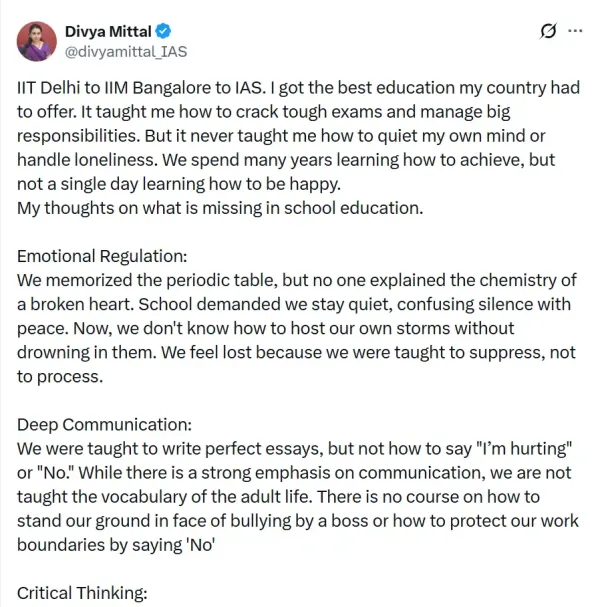
She wrote that she studied at some of the most prestigious institutions in India, moving from the Indian Institute of Technology (IIT) Delhi to the Indian Institute of Management (IIM) Bangalore, and eventually entering the Indian Administrative Service. According to her, this journey taught her how to handle tough exams and demanding responsibilities, but it did not prepare her for emotional challenges such as loneliness or inner mental struggles.
She expressed that while education trains people to achieve external success, it rarely teaches them how to simply be happy or how to understand their own minds. This gap, she suggested, becomes more visible in adulthood when academic structure disappears, and individuals are left to navigate life on their own.
A debate also emerged when one user compared historical rulers and questioned formal education. She responded that formal education and intelligence are not the same, adding that leadership also depends on observation, emotional intelligence, and judgment. Another user highlighted the need to introduce psychology early in schools and stressed the importance of emotional intelligence alongside IQ.
Divya Mittal, an IAS officer, who as per her LinkedIn bio, is in the Uttar Pradesh cadre and currently serving as the CEO of UP Rural Roads Development Agency, shared her reflections on social media about what she feels is missing in formal education systems.
She wrote that she studied at some of the most prestigious institutions in India, moving from the Indian Institute of Technology (IIT) Delhi to the Indian Institute of Management (IIM) Bangalore, and eventually entering the Indian Administrative Service. According to her, this journey taught her how to handle tough exams and demanding responsibilities, but it did not prepare her for emotional challenges such as loneliness or inner mental struggles.
She expressed that while education trains people to achieve external success, it rarely teaches them how to simply be happy or how to understand their own minds. This gap, she suggested, becomes more visible in adulthood when academic structure disappears, and individuals are left to navigate life on their own.
Emotional regulation
One of the key points she raised was emotional regulation. She reflected that students are taught science, mathematics, and memorisation, but not how to process emotional pain or mental overwhelm. She described how silence in classrooms was often mistaken for discipline, even when it may have suppressed emotional expression. According to her, this leads many adults to struggle with managing their internal emotional states later in life.Screenshot of post.
In-depth communication
She also highlighted the lack of training in deep communication. While students are taught how to write essays and communicate formally, she noted that they are rarely taught how to express vulnerability, set boundaries, or say no in difficult professional situations. She pointed out that real-life communication often involves navigating conflict, asserting limits, and dealing with workplace pressure, skills that are not formally taught in school.Critical thinking
Another area she discussed was critical thinking. She observed that education often rewards those who can provide correct answers quickly, rather than those who question assumptions. As a result, she suggested that many adults may grow up repeating established opinions without deeply examining where they come from.Financial literacy
Financial literacy was another major concern in her reflection. She wrote that while students spend years studying mathematics and problem-solving, they are rarely taught how to manage money in real life. She pointed out that understanding debt, savings, spending habits, and financial stress is essential for adult life, yet is often missing from the school curriculum.Self-discipline
She also spoke about self-discipline, explaining that school life is highly structured with fixed schedules, rules, and constant supervision. However, adulthood requires self-motivation and internal discipline without external enforcement. According to her, this transition becomes difficult for many because they were never trained to manage themselves independently.Loneliness
Loneliness was another theme she addressed in detail. She noted that school environments are socially active and constantly surrounded by peers, which can hide the reality of solitude that often appears in adult life. She suggested that many people struggle later because they were never taught how to be comfortable in their own company or understand solitude as a neutral or even positive state.Importance of reading
She further discussed the importance of reading people and understanding intentions. While school friendships are often straightforward and organic, she suggested that adult relationships require greater awareness of human behaviour, boundaries, and hidden motives.Mental health
Mental health maintenance was also part of her reflection. She compared physical education in schools with the absence of emotional or mental well-being education. She noted that students are often taught to push through exhaustion, which can later contribute to burnout if not balanced with self-awareness and care.Self-identity
Finally, she spoke about self-identity. She observed that many people spend years trying to excel academically or professionally without ever learning who they truly are beyond achievements. According to her, the real challenge of life is not just success, but understanding personal values, desires, and identity.Internet reacts
The post sparked strong reactions online, with many users agreeing that it reflects gaps in the Indian education system. One user said the section on “deep communication” stood out, noting that students are trained to write long essays but often struggle to set boundaries or say a simple no in real life. Another comment appreciated the message and thanked her for sharing her thoughts.A debate also emerged when one user compared historical rulers and questioned formal education. She responded that formal education and intelligence are not the same, adding that leadership also depends on observation, emotional intelligence, and judgment. Another user highlighted the need to introduce psychology early in schools and stressed the importance of emotional intelligence alongside IQ.