
Anthropic’s Mythos — an AI system capable of autonomously finding and exploiting software vulnerabilities — has sent shockwaves through India’s financial establishment.
The system reportedly uncovered decades-old security flaws in OpenBSD, one of the world’s most hardened operating systems. For a country that has built its financial stack on deeply interconnected digital rails — UPI, Aadhaar-linked auth, cloud-native banking APIs — the implications are hard to overstate.
The Government Scrambles: Finance Minister Sitharaman called top banks for a high-level security meeting following Mythos’ release, warning of “unprecedented” cybersecurity risks and constituting a panel — headed by SBI chairman CS Shetty — to assess allied risks. The government is also pushing for faster threat-intelligence sharing between banks, regulators, and agencies like CERT-In. The shift in posture is significant: cybersecurity is no longer a compliance checkbox — it’s a national economic security issue.
Legacy Baggage Remains: Kotak Mahindra Bank’s MD and CEO Ashok Vaswani acknowledged that the nature of threats is shifting from human-speed to machine-speed attacks, requiring faster detection and response. But analysts are skeptical about readiness. Gartner’s Jaishiv Prakash warned that many banks still depend on manual triage, fragmented asset visibility, and slow vendor coordination — weaknesses that AI-class systems like Mythos will ruthlessly exploit.
Fintech’s Soft Underbelly: India’s fintech layer is deeply integrated into the broader banking ecosystem through payment gateways, lending APIs, account aggregators, and embedded finance systems — creating potential pathways for hackers to reach larger financial networks through smaller, less-defended platforms. Paytm, Razorpay, and Pine Labs have reportedly reached out to Anthropic to access Mythos for their own vulnerability testing — acknowledging the threat by trying to wield the very tool they fear.
How will the ecosystem deal with this threat? Find out…
From The Editor’s Desk Delhivery’s Mixed Q4 Show
- The logistics major’s consolidated net profit stayed almost flat YoY at ₹72.4 Cr in Q4 FY26. This came despite operating revenue rising 30% YoY to ₹2,850 Cr during the quarter under review.
- In line with the top line, total expenses also rose 26.9% YoY to ₹2,853.1 Cr during the quarter under review. The startup processed 306 Mn express parcel shipments, while PTL freight tonnage rose 20% YoY to 5.49 Lakh metric tonnes.
- For the full FY26, Delhivery’s net profit rose 8% YoY to ₹321 Cr in FY26, while revenue from services increased 17% YoY to ₹10,486 Cr.
- Last week, the UAE President presented a Cerebras chip to PM Narendra Modi. The exchange marked the formal execution of Condor Galaxy India, an ambitious 8-exaflop AI supercomputing partnership between the two nations.
- Under this agreement, 64 Cerebras CS-3 systems will be deployed to build one of the largest AI compute clusters in India.
- Cerebras’ Wafer-Scale Engine chips house over 4 Tn transistors and close to 1 Mn AI-optimised cores on a single piece of silicon. It also claims to deliver up to 20X faster AI training and inference capabilities.
- Indian startups cumulatively managed to raise $303 Mn across 15 deals last week, zooming 129% from $132.2 Mn raised across 18 deals in the preceding week. Rapido and HrdWyr topped funding charts by raising $240 Mn and $13 Mn, respectively.
- On the back of Rapido fundraise, travel tech emerged as the most funded sector last week. Ecommerce clocked the highest number of deals at five.
- Seed stage funding declined nearly 54% to $2.6 Mn from $5.6 Mn raised in the previous week. Meanwhile, Singularity AMC and Titan Capital emerged as the most active investors, backing two startups each.
- India’s ecommerce market has grown into a $165 Bn industry in just over a decade. Yet, only 2% of India’s 958 Mn internet users account for 60% of the country’s ecommerce GMV. This poses concentration risks for local D2C brands.
- To counter these issues, experts urge brands to tap into accessible pricing, distribution, and product strategies to capture scale in emerging markets. Brands also need to address issues to turn Gen Z consumers into repeat users, they add.
- To woo these power users, brands are also focusing aggressively on community building and influencer-led marketing to engage a consumer base that values premium experiences as much as pricing.
 Bearish Week For Startup Stocks
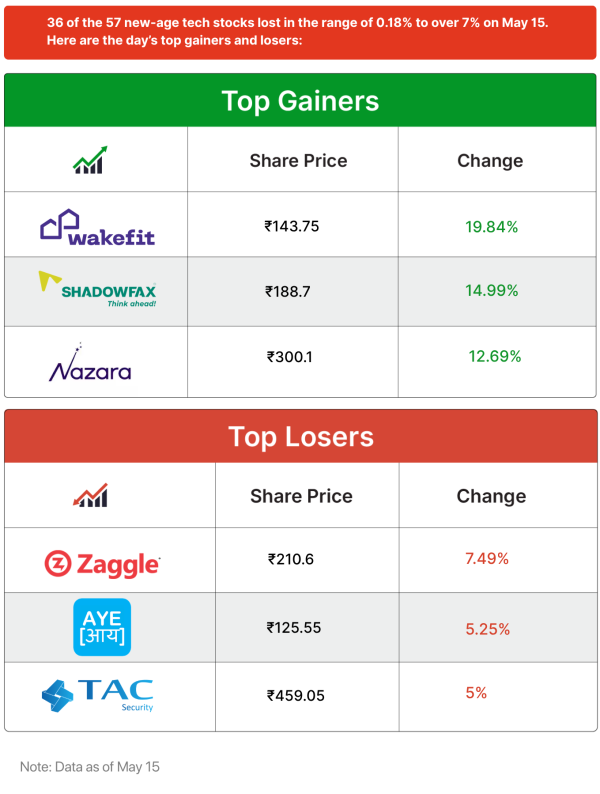
- Of the fifty seven new-age tech stocks under Inc42’s coverage, 46 fell in a range of 0.2% to over 22% last week. The remaining 11 grew in the range of 0.39% to nearly 15%.
- Pine Labs and Zaggle emerged as the biggest losers last week, while Veefin and Wakefit clocked the biggest gains. The cumulative market cap of 57 new-age tech stocks stood at $125.14 Bn at the end of the week.
- The bearish trends came as Indian equities remained under pressure amid ongoing geopolitical tensions, plunging rupee, and inflationary concerns. Moving forward, markets will react to announcements from the recently concluded US-China summit.
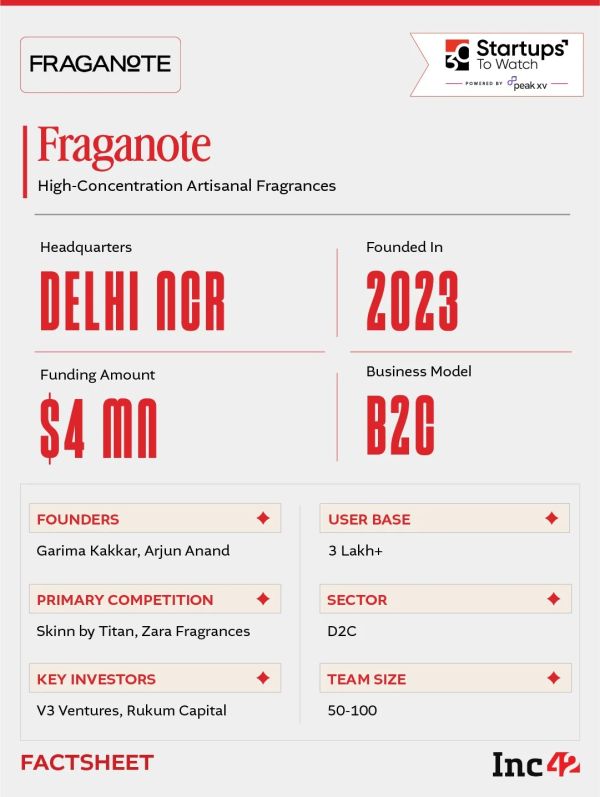
For years, fragrance in India has been treated like a hygiene purchase, not a style choice. Premium scents often feel too expensive, or too detached from local tastes. Fraganote is trying to change this by building accessible, modern perfumes designed for self-expression.
Reframing Fragrance: Founded in 2023, Fraganote is positioning itself as a new-age fragrance brand for Indian consumers. The startup leans into niche aromas, built around edible notes like vanilla and dessert-like accords. It has also expanded into tropical and premium collections, while keeping its portfolio gender-inclusive.
Built For Discovery: The startup sells through its website, quick commerce platforms like Blinkit, Zepto and Swiggy Instamart, along with Nykaa and offline retail. This distribution mix has helped the company garner a customer base of more than 3 Lakh users, with a repeat purchase rate of 35%.
Riding A Growing Market: As Indian consumers increasingly treat personal care as part of identity and lifestyle, the Delhi NCR-based startup is eyeing a piece of India’s fine fragrance and personal care market, which is projected to cross $4.2 Bn by 2030. So, can Fraganote bring artisanal fragrances to the Indian masses?
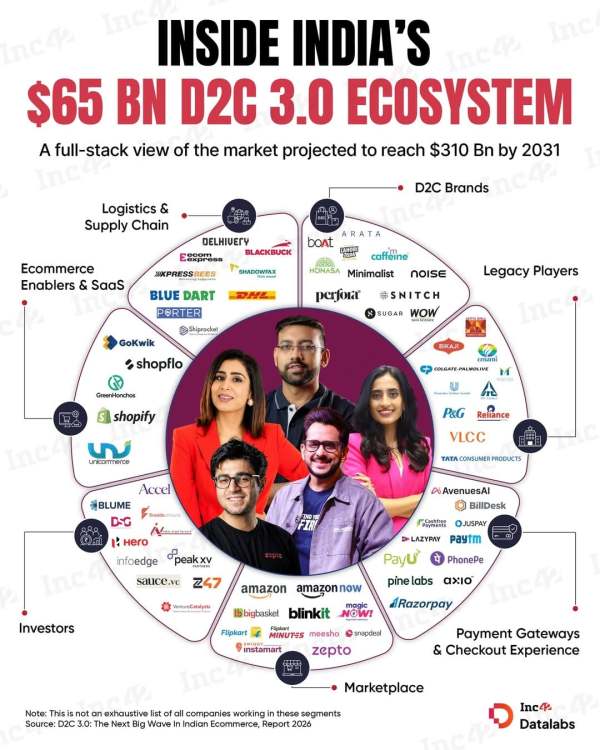
India’s D2C ecosystem has evolved into a full-stack $65 Bn ecosystem powered by quick commerce marketplaces, payment infrastructure players, logistics network and SaaS players. And this market is projected to touch $310 Bn by 2031…
The post The Mythos Threat, Delhivery’s Q4 Snapshot & More appeared first on Inc42 Media.
-
Mateus Mane’s Rise: From Bench to Breakthrough at Wolves Amid Interest from Manchester United and Liverpool

-
Rising to Greatness: How Barcelona’s Sydney Schertenleib Became Women’s Football’s Brightest Young Star

-
Chelsea’s WSL Reign Unravels: How Sonia Bompastor’s Risky Approach Backfired and What Lies Ahead for the Blues

-
Lionel Messi reacts to Inter Miami fans’ protest over players’ ‘respect’ concerns during MLS victory against Portland Timbers

-
Mario Basler: The Bayern Munich Maverick Whose Talent and Rebellious Spirit Defined an Era