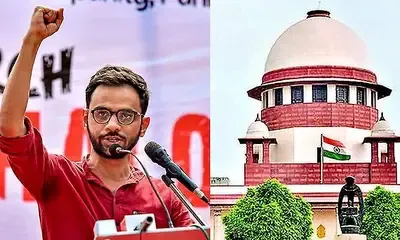
New Delhi: The Supreme Court on Monday (May 18) expressed serious concern over its own previous judgment that denied bail to former JNU student leader Umar Khalid in the Delhi riots case. It observed that the previous judgment failed to correctly apply the principles laid down regarding prolonged incarceration under the Unlawful Activities (Prevention) Act (UAPA).
In its landmark 2021 judgment in the case of Union of India vs K.A. Najeeb, the Supreme Court had opined that the violation of the fundamental right to a speedy trial can be a ground for constitutional courts to grant bail in UAPA cases. However, the bench noted on Monday that this binding precedent was not properly applied while rejecting Umar Khalid’s bail application.
A bench comprising Justice B.V. Nagarathna and Justice Ujjal Bhuyan made these observations while granting bail to Syed Iftikhar Andrabi, who had been in custody for over six years in a UAPA case involving allegations of financing terrorism through narcotics supply.
The bench specifically cited the January 2026 judgment of a two-judge bench that had denied bail to Sharjeel Imam and Umar Khalid in the Delhi riots conspiracy case. Their review petition was subsequently rejected by the Supreme Court in April.
Justice Bhuyan stated that the approach adopted in the Umar Khalid case and another UAPA case involving Gurwinder Singh was "difficult to accept." He noted that both judgments interpreted the stringent bail provisions under the law differently from the 2021 three-judge bench verdict.
"A judgment delivered by a bench of lesser strength is bound by the law declared by a bench of greater strength. Judicial discipline mandates adhering to such a binding precedent, or in case of doubt, referring it to a larger bench. A smaller bench cannot dilute, avoid, or ignore the ratio of a larger bench," Justice Bhuyan stated in the judgment.
The bench emphasized that the 2021 judgment in the K.A. Najeeb case explicitly recognized inordinate delay in trial and extended pre-trial detention as grounds for granting bail, even in cases involving UAPA charges and its stringent bail conditions.
-
Harsha general manager Ramesh Kalmanje dies of heart attack
-
Two interstate burglars arrested; valuables worth Rs 1.15 crore seized

-
Princess Eugenie told to quit royal life as her charity has serious questions to answer
-
Tiger Shroff & Vidyut Jammwal's Action Flick On The Cards? Fans Speculate As Both Actors Share Viral Video

-
POLL: Should parents be jailed for crimes their kids commit?